History book idea was spawned on a Hawaiian lanai
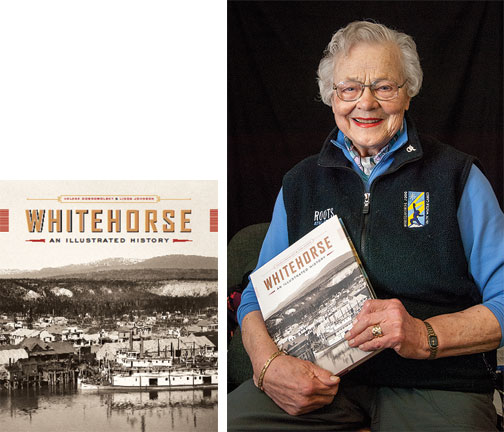
What started as a comment between husband and wife Art and Ione Christensen on a lanai in Hawaii has turned into a 333-page book detailing Whitehorse's history.
By Stephanie Waddell on November 27, 2013
What started as a comment between husband and wife Art and Ione Christensen on a lanai in Hawaii has turned into a 333-page book detailing Whitehorse's history.
While the official book launch will be held Friday afternoon at The Old Fire Hall downtown, Whitehorse – An Illustrated History is now available at Mac's Fireweed Books and at amazon.ca.
"It's exciting,” Ione said in an interview Tuesday afternoon.
It's a process that's always been fun, she added, with few, if any, disagreements or major bones of contention among the authors, researchers or board members.
Sitting with the book in front of her, the former Yukon commissioner and senator recalled the process that started in 2011 with a comment Art made to her.
The couple was vacationing in Hawaii, with Ione working on her autobiography.
As Ione recalled with a laugh, she said something to Art. He replied by asking why she didn't do "something useful,” like writing a book about Whitehorse's history as the city is going through so many changes.
That was the end of the conversation. Art finished his beer, she said, and they had supper.
Then he said he was serious, that the city's history should be recorded in a book. She agreed, and it wasn't long before she was on the phone with then-mayor Bev Buckway.
While Buckway thought it was a great idea and something she'd love to see, she also warned Ione to think about what she might be getting herself into before making any final decisions about whether to go ahead.
Back in Whitehorse, the more Ione thought about it, the more work she started putting into it – drawing up outlines and budgets, and contacting local historians about getting involved with the project.
The Whitehorse History Book Society board was soon formed – and also received charitable status – with Ione serving as chair and Art as a director.
The board also includes vice-chair Bob Cameron, secretary/treasurer Shirley Adamson and directors Vince Federoff, Yann Herry and Gudrun Sparling, all long time Whitehorse residents with a variety of skill sets and experiences to offer to the project.
It was a good book to create around a kitchen table, Ione said as she recalled the discussions, ideas, tea/coffee and cookies shared mainly around her kitchen table over the past two years.
Much of Ione's work was focused on raising the approximately $150,000 needed to produce the book.
Funding came from the city's heritage fund, the Yukon Foundation and the territory's Community Development Fund, its Yukon Historic Resources Fund and personal and corporate donors.
Another 127 people signed on to the group's patron program, paying $250 in advance for a special edition copy and having their names published in the back of the book as patrons.
Ione admits she had expected closer to 150 to sign on as patrons.
However, she was pleased to have 127 patrons come forward, along with the considerable support from donors in the community and the programs which helped put the project in a good financial position.
It was a massive undertaking. Two local authors – Hélène Dobrowolsky and Linda Johnson – were hired to compile the work of many others.
Those people included Cameron, John Firth, Michele Genest, Ty Heffner, Rob Ingram, Marlyn Jensen and Ingrid Johnson, each providing a particular focus in the book.
And still there were more Whitehorse residents involved in providing research for the book.
As more and more stories about the community were collected, decisions had to be made about what would be part of the book and what would stay out.
"It is hard,” Ione said of making those decisions.
To keep focused, the group would ask if particular events and stories were part of Whitehorse's story or if they were part of something else.
The book, she said, was meant to be a logical, chronological story of what has informed Whitehorse as a city.
As an example, Ione pointed to a forest fire in 1958 which threatened the city. Many will remember the smoke and a potential evacuation plan.
The fire never came across the city boundaries and is not a critical piece of the city's history, so it was omitted from the book.
"You can tell too much,” she said, adding the photos included in the book fill in many of the stories.
"The pictures enhance it so much,” Ione said, leafing through to the final page that shows the downtown, including the Yukon River.
"(It shows) we're moving forward, we're moving out,” she said, as she recalled a time when Rotary Peace Park and Shipyards Park (shown in the photo) were once filled with shacks and homes of Whitehorse residents.
"Whitehorse has come full-circle,” she said, referring to the waterfront.
As the book shows, in its earliest days, the waterfront was the central spot for the community, first as a fishing ground for First Nations.
Then, during the Gold Rush, boats loaded with goods and people plied the Yukon River, with Whitehorse turning into a larger community, focused on the river.
With the advent of planes and the Alaska Highway, it seemed Whitehorse had turned its back on the waterfront – "the mother of Whitehorse” as Ione referred to it – for years.
Suddenly, though, people are moving back again, with beautiful parks and facilities such as the Kwanlin Dun Cultural Centre fronting the river, Ione said.
Whitehorse – An Illustrated History follows the city's growth from its earliest years as berry-picking and harvesting site for First Nations through its development into a community and capital city – with chapters sorted by eras.
Ione noted she's especially pleased to have the First Nations history, which shows how instrumental the Kwanlin Dun First Nation and Ta'an Kwachan Council have been to Whitehorse since its earliest days.
The book also details the francophone influence on the city and the continuing impact other cultures are having on Whitehorse.
The community, she said, has become "a league of nations” with just about every corner of the world represented.
And it's something that isn't always thought about by those who have lived here for a long time.
"We're just Yukoners, and I think that is wonderful,” Ione said.
Looking at the book, Ione said the end product is largely what she and Art envisioned on that lanai in Hawaii more than two years ago.
While the Whitehorse book is finished, Ione noted there are still many stories out there to be told.
And she's pleased to see that at least one writer on the book is doing just that, with Firth working on a Yukon sports history book out of the stories collected for this piece.
With the release of the book, the Whitehorse History Book Society will soon wrap up its final business and dissolve the society.
Any royalties from the sale of the books are then set to go to the city's heritage fund with a special designation that they be used for updating the work in future years.
Friday's book launch will get underway at 4:30 p.m. with a formal program featuring presentations by the authors, board members and others involved from 5:30 p.m. until 6:30 p.m. at The Old Fire Hall.
The $50 books will be available for sale at the event, with writers signing them until 9 p.m.
Approximately 1,500 copies have been published.
Comments (1)
Up 5 Down 0
Thomas Brewer on Nov 28, 2013 at 6:08 am
This looks like a fantastic Christmas present! I expect many will be unwrapped Christmas morning in Whitehorse.
Well done to all whom toiled on this worthy project!