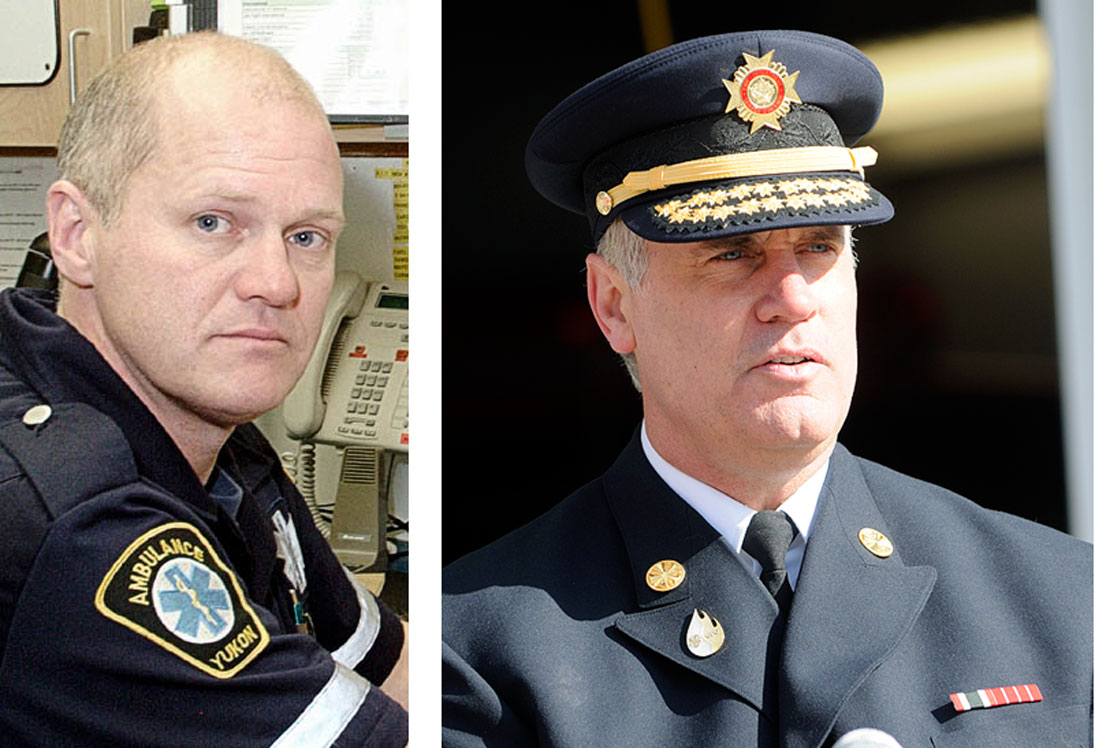
Photo by Whitehorse Star
Michael Swainson, Jim Regimbal
Photo by Whitehorse Star
Michael Swainson, Jim Regimbal
If a firefighter is diagnosed with PTSD, it should be presumed it’s job-related, says the president of the Association of Yukon Fire Chiefs.
If a firefighter is diagnosed with PTSD, it should be presumed it’s job-related, says the president of the Association of Yukon Fire Chiefs.
Dawson City fire chief Jim Regimbal is moving forward with an initiative to have Post Traumatic Stress Disorder included in presumptive legislation so that firefighters diagnosed with PTSD are automatically covered by workers’ compensation benefits.
The onus to prove the disorder is related to work as a full-time or volunteer firefighter should be not be an additional burden placed upon the shoulders of the firefighters, Regimbal said in an interview this morning.
He said it should automatically be presumed the disorder is work-related, and the onus should fall upon the Yukon Workers’ Compensation Health and Safety Board to prove otherwise.
It would be much the same as the presumptive legislation passed by the Yukon government in 2012 that says if firefighters are diagnosed with certain types of cancer, it’s automatically presumed the illness is job-related, he said.
Regimbal said he would like to see the presumptive legislation for PTSD provided for all emergency responders in the Yukon, not just for firefighters.
“I think the key is to get PTSD recognized as an occupational disease,” he said.
Regimbal said last May one of his volunteer captains, Chris Cleland, came forward to say something was out of kilter with him.
WCB’s doctor told him he did not have PTSD; that it was all in his head.
But last July, Cleland, a Dawson City doctor and the chief arranged for Cleland to see a clinical psychologist who specializes in PTSD.
Cleland is indeed suffering from PTSD associated with his firefighting service, the psychologist determined, and Cleland was then eligible for assistance from WCB.
The volunteer captain has served his community as a firefighter for 16 or 17 years, and was an ambulance volunteer before that, Regimbal pointed out.
The fire chief said Cleland’s disorder surfaced after he attended a house fire last year and found the body of somebody he knew.
A volunteer chief in a small community in B.C. responded last year to a vehicle that had gone over an embankment, only to discover his 16-year- daughter had been killed in the crash, Regimbal noted.
Whitehorse paramedic Michael Swainson left his job with the Whitehorse ambulance service because of PTSD, but had to fight tooth and nail to have it recognized as work-related.
Swainson, said Regimbal, has described the disorder as a backpack constantly being loaded with rocks until the weight proves to be overwhelming.
Finding the body of a fellow he knew in the burned-out home was Cleland’s trigger, Regimbal said.
Regimbal said Cleland continues as a volunteer. For now, he’s not yet ready to go back into a burning building, just in case he has a negative response that could jeopardize the safety of fellow firefighters.
Cleland is a positive role model who showed the strength to come forward and say he had an issue that needed to be addressed, the Dawson City chief pointed.
He said the volunteer captain has shown that coming forward is OK; that there does not need to be a stigma attached to admitting the stress of being a first responder can pile up, and eventually boil over.
Society, said Regimbal, owes its first responders the assurance that if they develop PTSD, they will be looked after without having to be dragged through a mountain of bureaucracy.
First responders in small communities, including Whitehorse, are even more susceptible because the emergencies they deal with can often involve people they know, friends, even family members, he emphasized.
“We are constantly stepping in to help, and all of a sudden, when that changes, and we need the help, what do we have in place?”
Regimbal said Alberta has adopted presumptive legislation for its emergency responders – firefighters, paramedics, police and sheriffs – Ontario is about to and B.C. is currently working through the legislative process.
It’s an issue being looked at by the Association of Yukon Fire Chiefs, and is on the agenda for its annual general meeting this August, he said.
Regimbal pointed out Klondike Liberal MLA Sandy Silver raised the matter in the legislature last November.
Regimbal himself wrote to Doug Graham, the former minister of Health and Social Services just previous to the Jan. 16 cabinet shuffle, but hasn’t heard back, though he suspects the shuffle may be a factor in the delay. Mike Nixon is now the minister.
It’s not just a matter of sitting down with the government to discuss the presumptive legislation, he said.
The Dawson chief said it’s incumbent on the Yukon’s firefighting community to make sure it has the mechanisms in place to provide for firefighting staff who develop PTSD.
An academic study in 2009 confirmed 17 per cent of firefighters have been diagnosed with PTSD, and the total may be as high as 20 per cent, he said.
Regimbal said it’s imperative first responders know it’s OK to seek assistance; that there is no need to suppress unrelenting emotions that can be harmful to individuals, their families, and can lead to suicide.
From April to December last year, there were 27 suicides among first responders in Canada, and another 19 in the military, he pointed out.
“Individuals can be diagnosed with Post Traumatic Disorder with just one traumatic experience, where first responders have seen hundreds throughout their careers,” said Regimbal.
In the Yukon, there are 30 career firefighters and 300 volunteers, according to government statistics.
There are 72 full-time paramedics, and 155 volunteer emergency medical responders.
In order to encourage thoughtful and responsible discussion, website comments will not be visible until a moderator approves them. Please add comments judiciously and refrain from maligning any individual or institution. Read about our user comment and privacy policies.
Your name and email address are required before your comment is posted. Otherwise, your comment will not be posted.
Comments (21)
Up 0 Down 0
shannon pennington on Oct 14, 2015 at 2:32 pm
I have read all the comments here. So many thoughts from denial to greed. One thing is for sure we know what it is doing to the first responders and military in our Canadian Society. As a retired Warrant Officer 18 years as a former 26 year career firefighter medic/12 of my career years as a Heavy Rescue Specialist with Calgary Fire Department I can say opinions and comments are all correct as stated. Those who know get it. Those who don't rant and rave. The mental health commission of Canada, The Canadian Association of Fire Chiefs, the IAFF in Canada get it about first responder PTSD and are doing something about it. Read the info at web site firefighterveteran.com - ALL of IT. Twitter feed and videos. Shannon Pennington, Executive Director North American Firefighter Veteran Network and Alberta First Responder Support Network out of Red Deer/ We are the people who worked with the Alberta Gov. to bring in Alberta Bill one Presumptive Legislation for 26 thousand of Alberta Responders at Risk and exposure. While the dialogue here has merit...please check your thoughts out with accurate and up to date information. Firefigherveteran.com does just that....guard your minds at work.
BTW The Mental Health Commission of Canada stated in 2012 at the World Congress on Mental Health and Stigma held in Ottawa (I was invited) in the work place held in Ottawa, that by the year 2030 fully 70 percent of available health care dollars in Canada will be spent on mental health. If your up north Yukon way get out of your igloo thinking and connect with the injury and what it is.....you just might learn something.....
Up 0 Down 0
On Second Thought on Feb 13, 2015 at 10:53 am
It's important to note that PTSD that is caused by work is already covered by WCB. This is not about coverage for PTSD versus no coverage.
The move to have PTSD presumed to be caused by a particular occupation simply means they don't want claims from these workers to be adjudicated and verified. The cheques would flow automatically upon a claim being filed without checking medical history to see if, for example, there may have been causes that had nothing to do with work.
If it is non-work-related PTSD, YG workers still qualify for benefits under the YG disability plan. Not sure if volunteer firefighters and paramedics have access to similar benefits for non-work-related disability.
Up 0 Down 0
BnR on Feb 12, 2015 at 7:59 pm
Wow.
Another News article with Wilf Carter making it all about, well, Wilf Carter.
I agree with the OP, Bill Williams.
Gov workers complaining about PTSD is a slap in the face to our serving men and women in our armed forces. Getting blown up in a IED and seeing bits of your friends lying about the side of the road is a far cry from what Mike went though.
And Wilf, you are ultimately responsible for your own safety. Quit crying.
Up 34 Down 4
Thanks Northern Wonder Wilf Carter on Feb 10, 2015 at 8:29 pm
I have had a major wrong at the hands of government that has harmed me my family. Many others are getting harmed and the politicians refused to do anything about it. The harm has not stopped and is still going on. What is a person to do? The Yukon has problems in patches of administration and it has to be fixed. The medical providers should speak out because the administration does not follow their recommendation on employee files.
Up 28 Down 3
northern wonder on Feb 10, 2015 at 2:32 pm
@Wilf Carter - I understand that you are going through a difficult time and feel the need to vent through this online forum however, I think that by doing so you are making a mockery out of your situation. I think that you need to find this kind of social release through friends and family and/or some sort of support services.
I REALLY do hope that your situation gets better and that you get through it with your head held high.
Up 16 Down 6
Thanks to police, ambulance, firefighters on Feb 9, 2015 at 10:24 pm
Thanks to all of the agencies out there who put their lives on the line to help the public; if you have PTSD then I totally support getting you the help you need. For Mr. Williams, with all due respect, everybody is different. I don't think anybody wants to 'make up' depression, suicidal feelings, despair, insomnia….you sound like you were able to get through extreme traumatic conditions without problems; it's not the same for everybody. That's why you have counselling, help, and sometimes medication….I know I couldn't do the hard job these people do, so I support any help/counselling they need to help them through. They are not just being good samaritans; they are paid and have benefits, which include to help them with the horror they must face as they scrape somebody's dead child off of the highway or retrieve a dead body in a fire. Thank you to all of you and take care of yourselves, mentally especially.
Up 19 Down 5
upnorthish on Feb 9, 2015 at 7:09 pm
Frontline workers need management to mandatorily have debriefing sessions. Supervision is not always provided. Incidents do not always have to be a terrible road accident, it can be listening to story after story of abuse and neglect. So, to help PTSD from occurring, having mandatory debriefing needs to be mandatory. This "suck it up mentality" is getting old. People are affected by critical incident's differently.
Up 33 Down 9
Has anyone ever worked in a work envirnment that is not safe or healthy Wilf Carter on Feb 9, 2015 at 5:56 pm
Has any one worked in an work environment that is not safe or healthy? I have being assaulted, harassed, threatened, false statements made about, false processes etc. Because of my employer actions they have acerbated my health.
There is some very bad things going down in the Yukon and no one will stop it.
Up 22 Down 19
JayD on Feb 9, 2015 at 12:17 pm
While I absolutely acknowledge that PTSD is a terrible thing and I can't help but sympathize with those suffering... I have to raise the point that this isn't the hunger games or divergent, what you do with your life is not decided by some great overlord. Signing onto the armed forces, becoming a firefighter or police officer are all choices one makes for themselves, and they all come with inherent risks, all of which are widely known. So I have a hard time understanding people who sign on for a job that might result in seeing terrible things, and then turn around and complain that they are suffering from PTSD because they saw terrible things. I honestly thought long and hard about becoming a police officer, but when I thought long and hard about what that would mean for myself and my family I made the right choice and went a different direction.
In this day in age where you can chose your own future, I'm not entirely comfortable footing the bill for other peoples decisions, good or bad.
Up 20 Down 16
Just Say'in on Feb 8, 2015 at 7:13 pm
I believe one of the biggest contributors to PTSD in the workforce these days is brought on by Pensions. I know that may seem odd but in the OLD DAYS if you didn't like your job, the work conditions, the people that you work with or your employer you would just simply quit and get a different job. People are just fixated on the date that they have to get to in order to receive the maximum pension. I have seen people with the countdown going on their computer screen showing years, months, days, minutes, seconds left, I find that quite pitiful. I think I am getting PTSD just thinking about it. Someday pensions will be looked upon as a form of slavery. Google Indentured Service.
Up 2 Down 33
Sandy Helland on Feb 8, 2015 at 4:47 pm
There is a cure for PTSD.
It is a drink called Ayhuasca.
What this drink does is heal the hole left in one's spirit or heart. It forces "baggage" out of your body and makes you whole.
You can move on without being encumbered by traumatic memories, abuse. It lets you reconcile with the departed. Ayhuasca heals so very much.
All Canada needs is a government that legalizes the use of Ayhuasca. It would save billions of dollars in medical expenses and actually cure PTSD. It would stop military suicides.
Up 26 Down 11
K.P. on Feb 8, 2015 at 4:43 pm
I'm reading some of those comments and I'm completely disgusted. I'm currently living with a first responder who has PTSD. Let me tell you that it is not only affecting him but the whole family. Everyday is a battle. Before commenting on articles like this you should probably do your homework and research the subject before saying anything that does not make sense.
Up 15 Down 4
June Jackson on Feb 8, 2015 at 12:59 pm
I have read these comments and understand both sides of the fence. When WW2 ended people didn't have the luxury of time. The world was broken; Jews had to find a place to live and then make it home and country; Japan was totally devastated, people just trying to survive. Europe shattered, USA starving. No one had time for PTSD.
These days, we do have time..time to reflect on what we've seen, done..what has been done to us.. some people deal with it..some do not. Any Mother who has lost a child knows what PTSD is, yet, they go on. PSTD as described is not limited to fire fighters/police/EMS etc. Perhaps it should be factored. A PSTD of 1 would be someone that can deal, 2. someone that can deal with help, and so on to 5..someone that can not function at all.
It doesn't matter what the department is, social Welfare, Yukon Health, Workers comp.. there are always people who know how to milk the system. It makes me livid to see the welfare folks on my street sitting on the porch smoking with a beer in their hand while I head out to work..it's just a bad when someone on Workers Comp for back injury is seen lifting an engine into their car.. i know people who don't live here but have a home here and stay on Yukon Health and apply for Northern Residence... but if we cut those programs out because the cheaters are taking advantage of them, then they are not there for the folks that need them. At least I see someone getting some benefit from my tax dollar instead of every red penny going into some politicians pocket.
Up 19 Down 19
north_of_60 on Feb 7, 2015 at 6:15 pm
Greedy government workers who are already entitled to very generous retirement and medical benefits, now want more than their fair share as 'compensation', because they can't cope with the stress from the job they freely chose to take.
Perhaps they should have chosen a different line of work commensurate with their abilities to handle stress.
Up 17 Down 2
Matt Haller on Feb 7, 2015 at 2:02 pm
There is no doubt that mental problems (PTSD) is real and that it is cause by stress and trauma. So how does a country that has more than 1/10th of its taxpayer base in some type of "traumatic job" afford to pension everybody off on WCB rates? The answer is we cannot, not even 10% of them? So how to pick and choose? Will people be asked to sign waivers when they start the job, that only physical injury will be covered? I am not sure of the answer and I do not want to make light of the PTSD, however where does the line get drawn? Are there going to have to be higher standards and tougher testing to see how resilient someone will be before they get started on that career path?
The fact is those type of jobs carry that type of risk and trauma. You cannot be a firefighter whose job it is to save lives without having a few traumas in your career. Interesting times coming up for the CCP anyway.
Up 29 Down 1
Groucho d'North on Feb 7, 2015 at 1:04 pm
Thanks to all the responders who put themselves at risk to save others in need- however they got that way. In our modern politically-correct world the reality of what police, fire and ambulance personal do when called into action has been scrubbed away from the public view because of the graphic nature of some response scenes. In most cases the public has little or no comprehension to the work you perform and conditions in which you perform it.
Thanks for your courage and fortitude to put your turn-out gear back on and once again make a tremendous difference in people's lives when the alarm bells ring.
I hope all get the time and attention they deserve when dealing with the nightmares of your work. Our communities would be lesser without your commitment.
Up 17 Down 22
Wilf Carter PTSD and other Acerbated health issues because of my Work Envirnment on Feb 7, 2015 at 9:23 am
My experience working in the Yukon Government means we all should be covered for PTSD and other acerbated health issues because of our work environment. I suffer from PTSD after an incident with a government manager and other incidents with a group of government managers.
According to my medical provider which there is 10 of them and the government insurance company, the situation where I worked was not safe or a healthy work environment for me created by management.
I have had four strokes, cancer, suffer from PTSD and other chronic health issues because of working in environment that was not safe or healthy according to my medical providers and government insurance company.
I have tried for five years to get a resolve to the situation but all I get is put in more government situations which are not healthy for me and further acerbate my health.
People of the Yukon what should be done in this case?
Up 33 Down 6
Brian Harding on Feb 6, 2015 at 11:53 pm
I am a Yukon first responder and military veteran; a number of people by this alone will know who I am. I'm not too worried about that.
There is no science that tells us reliably who will be hit with operational stress injuries because of traumatic experiences. We don't have a metric for who will be most resilient. We do know from abundant experiences - in fires, crime scenes, medical emergencies, and battlefields - that some of the people regarded as toughest by their peers are cursed by that condition called 'being human' that brings some people to brink of despair, depression, addiction, suicide and despair because of the terrible things their professional career and personal sacrifices have subjected them to. It's not weakness. Good people are hit hard by what they good through. I've known tough people to be struck down, struggle, fight, get back up, spit in the devil's eye, walk into the next burn, kick the next door, or attend that next bad call.
If you are among those hurting: you are not alone. Help is out there, and if you can't talk to anyone else, drop me a line. People will deny your problems and will cut you down: to hell with them, they're part of the problem. If you can see the problem, you can fight it. Recovery is a distinct possibility, I've seen it happen. Don't give up, and don't carry the burden alone. We'll help you find and take the next steps.
Someone needs to be first on scene, but you don't have to be the only one there. Again, if you can't make any other call, drop me a line.
Up 17 Down 9
bill williams on Feb 6, 2015 at 9:44 pm
My comments probably will not be published here as it is not PC. Not all of us ex military play the PTSD game.
Up 17 Down 2
Former Volunteer on Feb 6, 2015 at 6:24 pm
I agree with what this article is saying. I started out as a young volunteer with the ambulance service in a higher call volume community and stuck with it for 10 years. Some of the things you see are deeply disturbing and in my case would cause nightmares and changed my personality noticeably, over time I became withdrawn and moody. People might ask why I just didn't quit volunteering in that case, but we were chronically short of volunteers and I felt responsible to keep going. It got to the point where I felt trapped, if you resign you're letting everybody down, from your community to the few other volunteers you work with that help shoulder the load. I phoned once and tried to ask for help from someone in higher management that I didn't know, but was met with a mixture of disbelief and cynicism so that wasn't an option. I finally found an opportunity to do what I felt was an honorably 'Escape' the situation I found myself in.
This was quite a few years ago now and I think I have dealt with most aspects of what went on, the memories fade with time. However I still try to avoid contact with most people I dealt with in the ambulance service as it tends to bring all those memories back. I firmly believe that when someone has the courage to come forward like Mr. Cleland did they need support and not an argument or denial of counselling. I would also like to commend all the very good ambulance attendants and firefighters throughout the territory, past and present. Also a well done to nurses for the patience and professionalism you always show when dealing with difficult people and situations.
Up 20 Down 25
bill williams on Feb 6, 2015 at 5:30 pm
PTSD appears to be the catchall for anyone that wants a disability payment. As a former member of the armed forces and a civilian firefighter I have handled my share of corpses and combat situations (Bosnia,Somalia, I reintegrated into civvy life with no problems just like my father did after WW2. Heavy combat (artillery, airstrikes, hand to hand combat affects people differently. If PTSD is so common now there are millions of sufferers from previous wars. Why are there no Jewish people who survived the death camps crying PTSD? They formed their own country from their ashes. As for EMT's suffering from PTSD every ER nurse or doc should show the effects. Just my opinion.