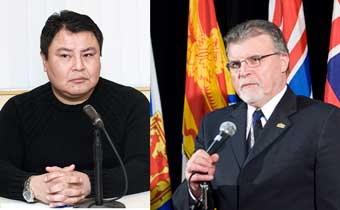
Photo by Whitehorse Star
Vuntut Chief Joe Linklater and Premier Dennis Fentie
Photo by Whitehorse Star
Vuntut Chief Joe Linklater and Premier Dennis Fentie
Chiefs, premiers and ministers met all day Friday and into the evening in Whitehorse to advance a proposed harvest management plan for the Porcupine caribou herd.
Chiefs, premiers and ministers met all day Friday and into the evening in Whitehorse to advance a proposed harvest management plan for the Porcupine caribou herd.
The parties agreed to put the proposed plan into the hands of senior officials to work on outstanding issues and report back to the principals by March 31.
There is general agreement that something needs to be done in light of the herd's shrinking numbers and what many believe is mounting hunting pressure.
The meeting was hosted by the Vuntut Gwitchin First Nation. It passed a resolution last summer at its annual general assembly calling for a meeting of all parties to the Porcupine Caribou Management Agreement.
Vuntut Chief Joe Linklater told the Star this morning that Friday was the first time the political representatives of each party have met since the agreement was signed 25 years ago.
The proposed harvest plan was drafted by the Porcupine Caribou Management Board over the last couple of years after lengthy community consultations.
"What we are trying to do is provide a little more details to the plan,” he said. "We sort of want more certainty, because what we have here is a recommendation from the board.”
Premier Dennis Fentie and Environment Minister Elaine Taylor were in attendance all day Friday, as were N.W.T. Premier Floyd Roland and N.W.T Environment Minister Michael Miltenberger.
Chief Simon Mervyn of the First Nation of Nacho Nyak Dun was there, as was Deputy Chief Roberta Joseph of the Tr'ondek Hwech'in First Nation. Chief Richard Nerysoo of the Gwichin Tribal Council was there, as was Frank Pokiak, chair of the Inuvialuit Game Council.
Linklater told the Star it is imperative the Canadian users of the herd get their house in order before they reach across the border and ask the Alaskan user groups to buy into the harvest management plan.
"I think with the state of the caribou herds across the North, I was very happy to see this level of leadership come together and really openly and honestly discuss the issues,” he said.
"And I was very happy to hear they are all concerned about conservation.
"At the end of the day, we tasked our officials with coming up with a solution to present to the political leadership,” the chief said.
In the case of the Vuntut Gwitchin, said Linklater, its senior staff will be doing the hands-on work, but with direction from the elected council.
The proposed harvest management plan does speak to several thresholds that would trigger or remove restrictions designed as conservation measures.
Linklater pointed out, for instance, there is a proposal to ban all harvesting when the herd shrinks to 45,000 animals.
Not everybody is convinced that 45,000 is the right number, he said.
Linklater said the Vuntut Gwitchin feel it's too low, and that a hunting ban should be in effect before the herd hits 45,000. Other parties, he added, feel 45,000 is too high.
On the other end of the equation, the plan proposes to remove all hunting restrictions if the herd reaches 115,000 or more.
And the parties still have to agree on what is an appropriate estimate of the herd's current size, based on traditional knowledge and available science, said Linklater.
Migration patterns and poor weather have prevented Canadian and Alaskan biologists from completing a comprehensive aerial count of the Porcupine herd for the last seven years.
The number of 100,000 has been bounced around but agreeing to a current estimate is required to discuss thresholds for conservation measures, Linklater said.
He said it's expected that once the senior officials come back with the re-worked harvest management plan in March, the principals will meet again to sign off on the plan and agree to an implementation strategy.
The expectation is to have a harvest management plan in place by this fall, said the Vuntut chief.
The plan, he said, would replace the interim conservation measures put in place by the Yukon government last fall. The government passed regulations requiring all hunters, aboriginal and non-aboriginal, to shoot bulls only, and to report their harvest.
While there was no harvest limit for aboriginal hunters, non-aboriginal hunters were limited to one caribou where they were allowed to take up to two in previous years.
Also agreed to Friday was the need to strike an intergovernmental agreement among the parties to ensure all the governments, even those first nations without self-governing authority, are represented by the harvest management plan, Linklater said.
The Porcupine herd hit a recent high of about 187,000 animals in the late 1980s but has been declining since.
The premier said this morning the key is implement a harvest management plan that will serve as a tool to ensure the herd's sustainability.
The Yukon government, he said, implemented the new harvest regulations last fall as interim conservation measures while the plan is being developed.
"Even if we erred, we erred on the side of conservation,” he said. "I think we all agree the herd is in decline, and that is very concerning.”
The proposed management plan notes that shooting bulls only will protect the breeding cows. One cow and her offspring will give birth to a total of 23 caribou in 10 years.
The harvest plan also sets out a number of other recommendations besides harvest thresholds, such as recommending education initiatives to help hunters identify bulls from cows. It recommends hunters be encouraged to exercise more effort in tracking down wounded animals.
The most recent harvest information is taken from surveys in the early 1990s.
Based on those numbers, the annual harvest was estimated at 4,000 Porcupine caribou. Approximately 60 per cent have traditionally been cows.
But several communities, including Old Crow, have indicated they have been harvesting bulls only for a good number of years now.
Harvest information from the early '90s indicates 65 per cent of the harvest is by aboriginal subsistence hunters, and most of the caribou are taken in the Yukon.
Yukon first nations take 12 per cent, while Alaska's subsistence hunters take 12 per cent.
Licenced Yukon hunters account for six per cent of the harvest and big game outfitters one per cent.
In order to encourage thoughtful and responsible discussion, website comments will not be visible until a moderator approves them. Please add comments judiciously and refrain from maligning any individual or institution. Read about our user comment and privacy policies.
Your name and email address are required before your comment is posted. Otherwise, your comment will not be posted.
Comments (2)
Up 0 Down 0
Terry Wilkinson on Jan 18, 2010 at 10:55 am
I read the above article with interest. I have spent my entire life working in the back country as a trapper, guide and outfitter. If the numbers are as low as they are saying we have taken one big step in getting them back by cutting all cow harvest. This is critical to the recovery. If I remember correctly the harvest is about 4,000 animals with about 40% being cows in the last years. Given their 20 offspring per cow in 10 years this comes to 40,000 animals (20 times 2,000) By these numbers if we would have had a no cow harvest in 1999 we would not be in trouble today.
As humans we have been given the power to manage our wildlife. This requires a hands on management. I don't know the ecology of the herds area as I'm from the south east Yukon but do suspect that the calf per cow ratio is below the 30 calves per 100 cows needed to encrease.If it is below 20 calf predation is to high and we may have to do someting to get it up to at least 25
Up 0 Down 0
JC on Jan 18, 2010 at 10:04 am
What do we need all those caribou for anyway. I say, harvest them and send the meat to poor countries. Haiti for instance, could use some now. Just how many mouths are they feeding up here anyway. More of those animals die from disease every year than are harvested. Lets make it a profitable business and help the world at the same time.