Grand chief vote candidate shares her perceptions
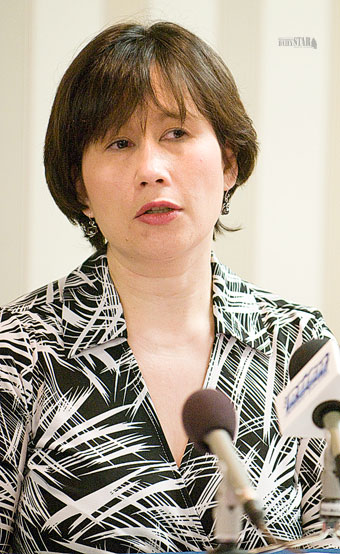
Victoria Fred, a lawyer and member of Kwanlin Dun First Nation, is a candidate for this summer's election for grand chief of the Council of Yukon First Nations (CYFN).
By Jason Unrau on June 5, 2008
Victoria Fred, a lawyer and member of Kwanlin Dun First Nation, is a candidate for this summer's election for grand chief of the Council of Yukon First Nations (CYFN).
Last week, the Star sat down with Fred to talk politics, priorities and her chances as the first candidate who is from a first nation outside of the CYFN tent.
Victoria Fred on why she's running for grand chief:
"For those who are familiar with the work I do, participating and working on behalf of self-governing first nations, this is a long time happening for me, my entire life has been about advocating, protecting and advancing the interests of our people."
On whether, as a Kwanlin Dun First Nation member, currently not a member of CYFN, she can muster the support from member delegates:
"It's not an issue. It hasn't been raised as an issue by those respective chiefs and councils that I've been talking to.
"As the public probably appreciatiates, there are relationships that are devoloping between Kwanlin Dun and other respective first nations that are within CYFN, so one of the things I think we need to appreciate is that we're in a new day and age; it's a very exciting horizon so as you can appreciate, restructuring is at the forefront of some of the leaders' minds so who knows what the future holds?"
On incumbent Andy Carvill's leadership of the CYFN:
"I know for myself, my message is what I can bring to the table and what's important for me is to inform the leadership of that and then they will make the assessment as whether or not that is what they need for us to achieve our common interests."
On the effectiveness, relevance and necessity of the CYFN:
"I think it's absolutely necessary. It's important for us to have a regional influence as well as a national influence. There are a lot of areas in which there are common threads among our first nations members as well as first nations as the collective.
"So I think it's important for the office of the grand chief to support what those common interests are at a regional level, national, and arguably, at an international level."
On the residential school payment fallout in the Yukon:
"I think Darius (Elias, the Vuntut Gwitchin MLA) has made some good arguments, put those issues before the public as well as the Assembly of First Nations (AFN) regional chief.
"And those discussions are ongoing with the AFN and the MLA from Vuntut, so we have to allow those discussions to have some fruition."
On how the CYFN and AFN can work together:
"I think there's a complement aspect to those organizations. Certainly work that the AFN regional office can provide to the CYFN is a complement. We can advance a lot of best practices that happen in this jurisdiction (by sharing them) with other first nations across the country. So I think it's important to have that relationship strengthened."
On whether her candidacy signals that the Kwanlin Dun First Nation may come on board the CYFN:
"Like I said, CYFN is going through a process of evolution, a process of growth. There are relationships that extend between the neighbouring nations surrounding Kwanlin Dun.
"I think we have to allow some of that work that the leadership is undertaking today, to come to light. For me it's important to highlight that I believe there is a necessity to have a regional body.
"I think there's some exciting opportunities and some equally challenging times ahead of us and I want to be a part of what that future looks like.
"Because my child lives here, I have family here and we are here for the duration so a lot of the work of our predecessors, the architects of our agreements, many of which are in elders' positions now, they had envisioned a future for which I will continue to carry out what those objectives are."
On specific issues facing first nations people that she thinks are the most pressing:
"For me, what's important is to be reaching out and listening to the leadership in the respective communities. To be drawing particular conclusions at this stage is presumptuous.
"I think it's important for me to listen to what's most important to them. I think any individual who serves in that capacity has to have an appreciation of the diversity, of the priorities, of the strengths and the challenges and be willing to take that into account."
On acrimony between the CYFN and Yukon government over recent ammendments to the Child and Family Services Act:
"I think leadership is taking those experiences and reflecting on them and always trying to find ways to improve our relationships with the Yukon government.
"I think it's important that Yukon first nations are successful with those relationships because our success goes towards our future successes, so I think it's important to strengthen our relationship with other governments."
On improving the consultation process:
"What I can say of the community visits that I've done thus far, of course consultation is an important issue, in light of when you look at the Little Salmon-Carmacks First Nation decision and the number of processes that Yukon first nations are involved in participating with YTG legislative consultation.
"In addition to Yukon first nations taking those experiences into account and improving on them, what we also have to remember is that common law applies to this jurisdiction - based on that Little Salmon decision that has yet to be fully addressed by the court of appeal - so I think that's important and something that continues to be at the forefront of Yukon first nations and something that we have to continue to advance.
When we're looking at the development of this region, when we say that 'we're interested in first nation interests' that we have to ensure we follow that up with a true partnership approach.
On balancing development with environmental protection:
"It's an issue that's obviously at the forefront of all of our first nations so I want to have an appreciation of what those issues are exactly, before I comment on them."
Be the first to comment