Grand chief hopeful about meeting's prospects
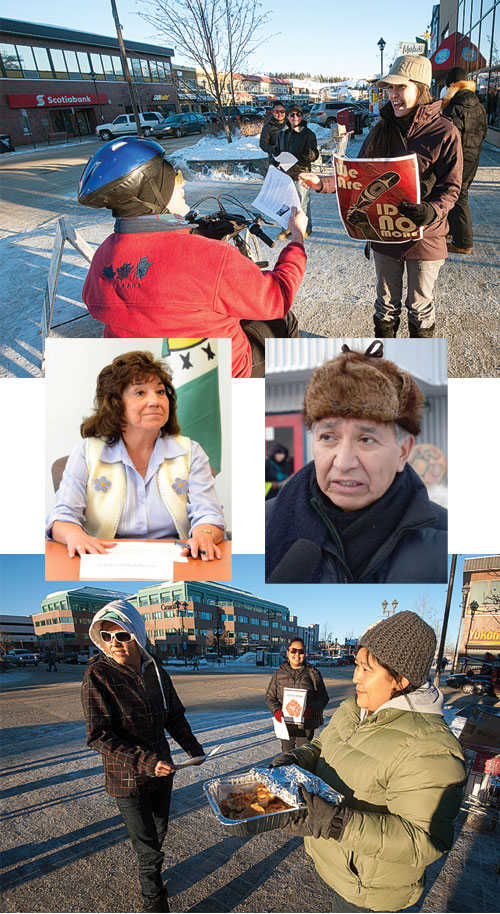
Two Yukon chiefs will attend this Friday's meeting among First Nations leaders, the prime minister, and the minister of Aboriginal Affairs.
By Ainslie Cruickshank on January 7, 2013
Two Yukon chiefs will attend this Friday's meeting among First Nations leaders, the prime minister, and the minister of Aboriginal Affairs.
Both Mike Smith, the Assembly of First Nations' regional chief for the Yukon, and Little Salmon-Carmacks First Nation Chief Eric Fairclough will participate in the meeting.
Fairclough will represent the Council of Yukon First Nations (CYFN), as Grand Chief Ruth Massie is ill.
First Nations leaders will participate in caucus meetings tomorrow and likely Wednesday as well in preparation for Friday's conference, Massie told the Star this morning.
The grand chief hopes the gathering will result in "positive action” on longstanding concerns, including legislation changes stemming from Bill C-45, the second omnibus budget implementation bill passed this year.
The bill made amendments to various acts, including the Navigable Waters Act, which Massie pointed to as a key concern.
"Our expectation is for them to abide by the aboriginal rights and title of our lands and consult with us, but also accommodate,” said Massie.
Yukon First Nations are not against resource development, which she called the prime focus of both the territorial and federal governments.
"But we want to ensure that they engage appropriately for the protection of the future,” she said, highlighting the Peel land use planning process as a prominent example of Yukon First Nations' concerns.
"Look at the millions of dollars that has been spent in developing that plan and the process going forward, and for them to just literally put it aside and ignore it? No. That's not appropriate.”
Fairclough, a former Yukon NDP and Liberal MLA, will also take any available opportunity to speak with Aboriginal Affairs Minister John Duncan about attending an intergovernmental meeting in the Yukon and next month's 40th anniversary celebrations of Together Today For Our Children Tomorrow, the blueprint for the Yukon land claims process.
What would have been the second Yukon Forum of 2012 was postponed in December for reasons that more than likely concern a new resource revenue-sharing agreement between YTG and Yukon First Nations.
Both the territorial government and the CYFN have expressed interest in rescheduling the forum for early this year in conjunction with an intergovernmental forum that would include Canada.
Prime Minister Stephen Harper announced Friday that he would meet with aboriginal leaders after repeated calls to do so from First Nations across the country, including the chief of a northern Ontario First Nation.
Attawapiskat Chief Theresa Spence has been on a hunger strike, subsisting mainly on broth since Dec. 11, in an attempt to draw attention to significant issues facing aboriginal people in Canada and to secure a treaty meeting with Harper.
The Idle No More movement that sprang up in response to Bill C-45 has stood behind Spence in her efforts to secure such a meeting.
Idle No More protests, which have included several blockades, have taken place across the country and are expected to continue despite this week's meeting.
In a statement Friday, Harper highlighted the commitments made at the Crown/First Nations gathering in January 2012.
They included commitments to improve relationships and partnerships between Canada and First Nations, "empowering success of individuals through access to education and opportunity, enabling strong, sustainable, and self-sufficient communities,” and "respecting the role of First Nations' culture and language in our history and future.
"The government and First Nations committed at the gathering to maintaining the relationship through an ongoing dialogue that outlines clear goals and measures of
progress and success,” Harper said in the statement.
"While some progress has been made, there is more that must be done to improve outcomes for First Nations communities across Canada.
"It is in this spirit of ongoing dialogue that, together with minister Duncan, I will be participating in a working meeting with a delegation of First Nations leaders co-ordinated by the Assembly of First Nations on January 11, 2013.
"This working meeting will focus on two areas flowing from the gathering: the treaty relationship and aboriginal rights, and economic development,” he said.
See commentary.
Comments (3)
Up 0 Down 0
Keepin it real... on Jan 8, 2013 at 3:16 pm
Looking at the comment boards from newspapers down south concerning this chief Spence issue is pretty shocking. There are obviously financial irregularities but the people on both sides of the issue are really lowering themselves to the lowest common denominator. Respectful debate and dialogue have really been thrown out the window and it seems to have turned into a mudslinging competition. It's nice to see that here in the Yukon even hot topic issues generally seem to be discussed and settled in a more considerate respectful manner. We all have to live together and life's to short to waste it fighting.
Yukon first nations seem to pretty much have it together for the most part in the business and financial sense. Maybe how they are set up and operate could serve as a model for other FNs down south such as northern Ontario.
Up 0 Down 0
Bob Graham on Jan 8, 2013 at 3:08 am
Many FN people live in horrible conditions & it shouldn't be this way!
The two Yukon Chiefs ought to ask Chief Spence who is on liquid diet why her & her boyfriend earn $240K plus, own a Cadilliac SUV while many, if not most of her band live in poverty conditions? It's not politically correct to ask, but someone has to! People need the help but it seems to go to only the chosen few!
Up 0 Down 0
lisa on Jan 7, 2013 at 4:43 pm
This is a very interesting story, as an aboriginal, I do not support Chief Spencer, Nor do I support the Grand Chief of the Yukon, Ruth Massie.
A few years ago, Ms Massie was the chief of the Taan Kwachan Council in Whitehorse. When Massie was voted out, and a new administration was put in place, a forensic audit was completed because of funds gone missing, and to this day the money has not been found.
First nation leaderships are very sketchy in my opinion, especially now in regards to Chief Spencer, millions of dollars are missing.
Why is this a general theme with our first nations, where does millions of dollars disappear to?