Graffiti plan called 'a huge leap forward'
Graffiti could be cleaned up from city buildings in as little as a day in some places
By Stephanie Waddell on August 27, 2009
Graffiti could be cleaned up from city buildings in as little as a day in some places if the city adopts a policy that was brought forward at a council and senior management meeting Wednesday afternoon.
Doug Hnatiuk, the city's parks and recreation projects co-ordinator, brought forward the policy outlining how city staff would deal with graffiti on its own property in an effort that would see the city lead by example.
"Really, it encompasses all of the amenities," he said, citing along with the city's structures, garbage cans, benches and other pieces of city property.
"It's an ongoing concern," Hnatiuk explained of the numerous calls the city gets.
The proposed document divides the graffiti into three priorities, the first being city buildings and vehicles with direct public access or high public visibility.
"Once reported, graffiti will be removed from these areas within one business day," reads the proposed policy.
The downtown core, with boundaries between the Robert Campbell Bridge and Industrial Road from the Yukon River to the clay cliffs, would have graffiti from city sites removed within three business days of being reported.
Finally, all other areas that fall within city boundaries would fall under priority three, with graffiti to be removed within five business days of being reported.
Those timelines had Mayor Bev Buckway questioning whether that was realistic when the temperature hits -40 C.
As pointed out by Rob Fendrick, the city's director of administrative services, a provision could be added stating those timelines will be weather-permitting.
In some cases, when the weather is warmer, the graffiti may be cleaned up long before the proposed timelines.
"These timelines are a maximum," Hnatiuk said, noting they were put in place in order to give the city flexibility.
While the policy was widely-praised by city council members and staff, engineering manager Wayne Tuck suggested that another provision be added that would make graffiti that includes racial slurs or offensive language, such as profanity, a top priority.
"That sounds reasonable," Coun. Florence Roberts agreed.
Though staff drafting the policy had discussed that, it didn't make it to the document now proposed.
That's because there was a concern that when graffiti is reported, there may not be detail given on exactly what it says, and staff may not get to it within one business day if it isn't in a highly-visible area. If it's something city officials want added, the city can do that.
"It's certainly something we can bring in," Hnatiuk said.
Fendrick also said he'd like to see a section added that the city will move toward prosecution where it can, though as Buckway pointed out, the matter would be turned over to the RCMP.
Also included in the policy are provisions that the city use a surface material that makes it easier to clean paint from an item.
The policy was also written to note the differences between graffiti as an art form and simply tagging with a provision that it "may entertain from time to time a legal graffiti arts program to celebrate young people's talent and sub-culture.
"E.g. graffiti art murals for city waste receptacles could be commissioned to young people."
Downtown businesses owner Chris Sorg has been leading the charge with the Whitehorse Chamber of Commerce to reduce graffiti around the city. He was quick to note graffiti as art is not a big issue around town with some buildings, such as Triple J's, displaying good graffiti art.
Sorg praised the policy as "a huge leap forward."
"I think this is tremendous," he said.
The city isn't at a point where it should move ahead with a bylaw that would force businesses to clean up graffiti.
Rather, he said, he would like to see building owners encouraged to clean up the unwanted spray paint on the side of their buildings.
Both city staff and council members at the meeting noted the importance of leading by example over a bylaw.
"We've got to get our own stuff in order first," Buckway said.
In an interview this morning, she reiterated that point. While it's been a while since the city first began talking about how to deal with graffiti, she said, this will allow the city to do what it can on its own properties.
She didn't rule out the possibility of a bylaw governing the clean-up of graffiti coming into effect in the city at some point in the future, but said right now she would rather see the city proceed with its own initiatives. They would be designed to encourage businesses and other building owners to clean up.
Referring to an informal survey conducted by the chamber of commerce which showed business owners don't favour a bylaw, she pointed out the problem is that the city would end up punishing those who aren't responsible for the vandalism.
"It's a very punitive bylaw," she said.
If the city and then others are encouraged to clean it up quickly, it could mean those tagging buildings around town are less likely to do so because their tags are not going to last.
The mayor compared the situation to that of littering. During the Capital Cities Conference held earlier this month, Buckway said, she heard comments from a number of her counterparts from across the country on just how clean the city streets are.
That is the result of a number of initiatives that have gone beyond the city's efforts to keep the sites clean. And when there's no litter on the streets, the general public are more likely to throw their waste into a garbage bin rather than just dropping it.
"Everybody pitches in," she said.
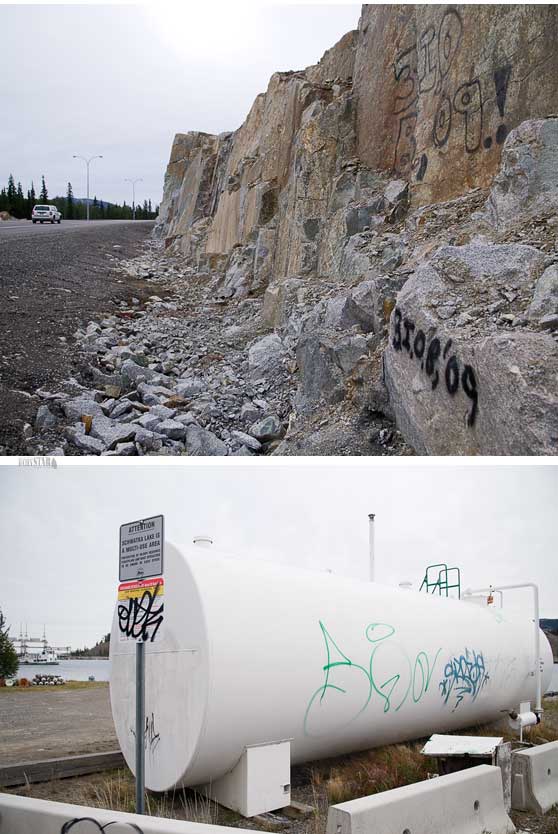
While efforts are continuing on the graffiti front, there continue to be areas around the city that are being tagged. Most recently, Buckway has noticed it on the new Hamilton Boulevard extension.
"That's so unfortunate," she said.
She and Sorg pointed as well to the small business opportunity there could be in cleaning up graffiti for building owners that could come out of an increased effort to deal with it.
This summer, the chamber hired two students who have been doing some cleaning for businesses.
Outside city hall following yesterday's meeting, Sorg also said he hopes businesses will see what the city is doing and follow suit, either adopting their own priorities to deal with it or simply following something similar to the proposed policy.
The development of a policy shows the city is serious in dealing with the problem, he said.
As for whether that will translate into action should the document be adopted by council, Sorg replied: "I think the city is going to try its best."
He also noted his confidence that staff will be as expedient as possible in dealing with the tagging.
Under the proposal, anyone would be able to report tagging and unwanted graffiti to the city through an e-mail address or by calling the Department of Parks and Recreation.
Matthew Grant, the executive assistant to city manager Dennis Shewfelt, pointed to a computer system that would enable the city to track the complaints that come in and when they are dealt with.
While the parks and recreation department would oversee the policy and monitor the issue, reports of individual cases would be forwarded to the respective department to deal with.
In a case where a bus stop has been tagged, for example, parks and recreation personnel would inform the transit department, which would be responsible for the clean-up.
Currently, Buckway said, each department is responsible for cleaning up graffiti at its sites.
What's different now is there aren't any timelines for that clean-up to happen.
It's expected the proposed policy will come forward to council to be considered for adoption in the coming weeks.
Comments (3)
Up 0 Down 0
Arn Anderson on Aug 28, 2009 at 4:58 am
Why are we not using the clowns out of Con College? Put them to work and let them clean up this town. I rather have extra tax dollars spent on a little more security when these clowns are out working in town. Better than paying taxes so they can sit in thier in cells and do nothing.
Watch Cool Hand Luke and get the idea and no, not the idea of escapees but the idea of making prisoners WORK and provide a PUBLIC SERVICE for which they are indebted too.
Up 0 Down 0
Anthony on Aug 28, 2009 at 2:45 am
"Those timelines had Mayor Bev Buckway questioning whether that was realistic when the temperature hits -40 C."
Errr. Does she actually think people spray paint at -40???
Here is a thought: Tags are like signatures, each one ties back an individual. Pay a cash reward to people to rat out the taggers. The taggers then get a weeks work of public service cleaning up tags, sweeping streets etc. They could wear smocks IDing them as vandals while they work. A little humility can go a long was as both a punishment and deterrent.
Currently there is little chance of getting caught and even if you do there is next to zero chance of a meaningful punishment.
Up 0 Down 0
Joseph Campbell on Aug 27, 2009 at 10:38 am
The business community have to start installing security cameras - not too costly. Then when the perps are caught the weeny Judges have to make the little buggers clean it up or go to jail. But then, I guess that would infringe on their Human Rights.