Government will act on police review ideas
Government will act on police review ideas
By Justine Davidson on March 22, 2011
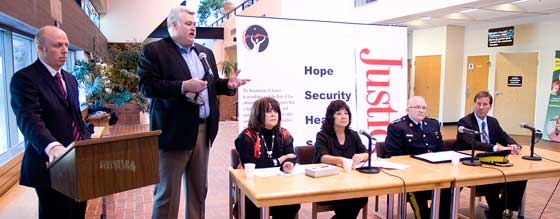
The Yukon government announced today it will implement four more recommendations from the recent police review, with a focus on RCMP responses to domestic violence, impartial investigations of the police, and recruiting more First Nations people into the police force.
The overall goal of the police review was, as Justice Minister Marian Horne told a news conference this morning, "to foster a more responsive, accountable and trusting relationship with our police officers.”
It followed on the heels of a highly publicized coroner's inquest into the death of a Carmacks man who died in police custody.
The details of his mistreatment at the hands of the guards and officers tasked with caring for him caused an uproar throughout the territory and prompted the government and the RCMP to undertake the review.
The resulting report advised the Yukon government and the territory's RCMP to take dozens of actions, from the formation of numerous advisory committees to the construction of a new RCMP holding facility.
The recommended facility is now under construction as part of the new territorial jail being built on Range Road in Whitehorse, and Horne announced today her department "will begin work immediately” on four more of the 33 recommendations.
First on the docket is a Yukon Police Council, made up of a chair and six regular members, three of whom will be aboriginal Yukoners.
The council will be up and running by this summer, Horne promised, and will help in the implementation of the initiatives announced today and in the future.
Justice officials could not say how much the council would cost to operate, but assistant deputy minister Bob Riches said the money would come from his department's existing budget.
The same goes for a domestic assault and sexual violence co-ordinating committee, which will work on creating better supports and better organized responses to domestic and sexual violence.
"People are going to have to reset priorities to do this,” Riches said, noting the department doesn't want to duplicate funding to groups who are already receiving money to work on this issue.
The concrete dollar figure Riches did have today was for the creation of an RCMP domestic violence response team (already coined D-VAT by Justice and RCMP officials).
"They will require special training and we know that,” Riches said of the officers who will be assigned to the team. "... This is difficult, complex work.”
The government will dedicate $600,000 to a four-person team which will work throughout the territory, Riches said, with additional money coming from the federal government, in the standard RCMP funding arrangement.
One of the perennial issues raised by both First Nations people and women during the police review was the sense that many officers, the majority of whom are non-aboriginal males, do not understand or relate to their issues.
The report's authors noted that between 2004 and 2010, nine aboriginal men and nine aboriginal women applied to join the RCMP in the Yukon, but only one man was ultimately hired.
"The underlying reason those 20 or so people didn't succeed needs to be looked at,” Chief Supt. Peter Clark of the RCMP said this morning, adding he hopes a law enforcement orientation program slated to start at Yukon College next spring will do just that.
"It needs to be a holistic approach,” which may include academic assistance, ride-alongs, and hiring summer students, Clark said.
The government also announced it has entered into an agreement with the Alberta Serious Incident Response Team (ASIRT), a civilian agency which investigates in-custody deaths and other serious incidents involving the RCMP.
Up until now, the RCMP have either done such investigations themselves, or farmed them out to other police forces.
Critics have complained that it is not appropriate for police to be investigating police, even if they are from different jurisdictions or forces.
More details about the agreement with ASIRT will be made public at a news conference this afternoon.
Be the first to comment