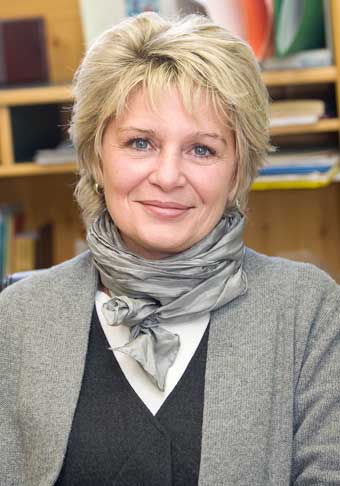
Photo by Whitehorse Star
Union President Katherine Mackwood
Photo by Whitehorse Star
Union President Katherine Mackwood
The Yukon teachers' union and the government failed to reach an agreement after two days of mediation at the beginning of the week.
The Yukon teachers' union and the government failed to reach an agreement after two days of mediation at the beginning of the week.
Talks between the Yukon Teachers' Association (YTA) and the Public Service Commission broke down last September over wage demands and classroom composition.
Following further dialogue Monday and Tuesday, negotiations have officially reached a deadlock.
"The mediator will go back to the Yukon Teachers' Labour Relation Board in Ottawa and make a report ... that an impasse exists,” union president Katherine Mackwood told the Star Wednesday afternoon.
"From there, we will have a week to decide whether we will be going to arbitration or conciliation.”
The YTA's 750 members will have to decide whether to seek a binding settlement (arbitration), or go the route of conciliation – a deal emanating from here would require ratification from the YTA's membership, or could lead to strike action.
"We're not even looking at (a strike) right now,” Mackwood said.
The only time union members have withdrawn their services occurred in the early 2000s, on a rotational basis.
The teachers' union president said "some progress” was made on some matters, "our two outstanding major issues, working and learning conditions and classroom composition.”
But the sides could not reach an agreement on a financial package, Mackwood confirmed.
Teachers are seeking a nine-per-cent wage hike over two years, a demand the Public Service Commission is not willing to meet.
Last September, Public Service Commissioner Pat Daws declared the two parties "were not in the same settlement zones.”
Following the mediation failure, neither side would confirm how close, if at all, the sides were to achieving a deal on pay increases.
"As we said in the press release, we wouldn't be releasing any information regarding the mediation,” Daws told the Star this morning.
Educators in the territory have been without a collective agreement since June 30, 2009.
Already they are among the highest-paid in Canada, as the starting wage for a teacher in the Yukon is $57,398 annually. That is nearly $20,000 more than one would earn as a first-time teacher in British Columbia.
For the current 2009-2010 fiscal year, wages paid to teachers, education assistants, tutors, native language instructors and substitute teachers exceeded $61.5 million, which represents a four-per-cent increase over 2008-2009.
On top of salary demands, the teachers' union wants concerns over classroom composition addressed.
Last September, Mackwood told the Star that teachers are often tasked to do too much, and the status quo is contributing to dismal graduation rates Auditor General Sheila Fraser outlined in a January 2009 report.
"If you only have a certain amount of support in that class, i.e., one teacher, the individuals who need the support aren't getting it and neither are the other students,” said Mackwood.
Teachers are typically faced with class sizes of 23 to 24 students; upwards of 20 per cent of whom have learning or behaviour disabilities.
But Daws downplayed the union's opinion that it was forced to negotiate more manageable classroom scenarios.
"One of the things that's important to us is class contact time – the amount of time that there's teachers with the students – which improves the ultimate results,” Daws said last September, responding to Mackwood's claims.
Daws added that classrooms in the Yukon are among the smallest in Canada, with the average student-to-teacher ration of 10-to-one.
And according to Fraser's report, graduation rates in the territory are among the worst in Canada, with only 40 per cent of first nations students earning their Grade 12 diploma and just 58 per cent of all Yukon students reaching that milestone.
In order to encourage thoughtful and responsible discussion, website comments will not be visible until a moderator approves them. Please add comments judiciously and refrain from maligning any individual or institution. Read about our user comment and privacy policies.
Your name and email address are required before your comment is posted. Otherwise, your comment will not be posted.
Comments (12)
Up 0 Down 0
soldierpiper on Jan 22, 2010 at 2:39 am
9% over 2 years ,that seems a bit to high.The teachers here are no better then the teachers in the rest of the country who have larger classes & heavier workloads & less money.Greed is whats happening here I say.
Up 0 Down 0
Wayne Campbell on Jan 21, 2010 at 11:17 am
The point is that the high-priced teachers we have now can't deliver students who are well-educated. So, why not get the same results for less?
Up 0 Down 0
Jack Malone on Jan 21, 2010 at 10:33 am
@ Mike Reed. What is your point? Should Yukon teachers be paid whatever they demand? It seems to me that 9 percent over 2 years is a lot ask. I wish that I could get that kind of raise - whether or not I was entitled to it based on merit! I am not suggesting that we import Eastern European teachers or anybody else to teach Yukon kids - but if Yukoner teachers already get excellent salaries and benefits (and much more than their provincial counterparts) - why should they be entitled to more?
Save the sob story about the tough jobs facing teachers. Everybody has tough jobs but few get government wages and security like those provided to teachers. Hey - I don't mind rewarding teachers with higher salaries based on merit. But there are a lot of teachers riding the coat-tails of others.
Up 0 Down 0
Mike Reed on Jan 21, 2010 at 6:16 am
Jack Malone:
Yeah I am familiar with the situation in BC and the Campbell government which has gutted education for the sake of a 17 day sporting event. BC is certainly not the model to follow as they have closed hundreds of schools and expanded class sizes. At the same time these are the same people who whine about the quality of education. Try teaching four blocks of classes with 36-38 kids in each class and still deliver the curriculum. Most would not walk a half-block in a teacher's shoes never mind a full mile in a teacher's moccasins. That aside, Jack, once you attain the cheapest teachers available it goes without saying that you will also have the best or maybe the worst possible education. And those teachers from BC that you speak about? They too can be replaced by even cheaper teachers from Eastern Europe so it is important to note that even the el cheapo BC teachers would have zero job security also. Great world! Education should be shipped offshore because someone else can do it cheaper..seems to be the trend...what a bargain for the taxpayer! Krappy deal for the kids though.
Up 0 Down 0
Kailey Irwin on Jan 20, 2010 at 12:31 am
Bernd,
For the record you were always a favourite teacher of mine when we were lucky enough to have you sub for us :)
I agree that the student needs to make an effort. I must admit I was never the best of students, but I at least had the sense to complete assignments and graduate. I think a learning assistance program for troubled students would be beneficial. I know we have such programs already but not many parents know alot about them.
Plain and simple, the parents also need to help if their child is a "problem" student. Teach your children good study habits. Take away the TV, the cell phone, the video games and spend time with your children. My dad may have been a work-a-holic, but he always had the time to sit down with me and help with my homework, give me study tips and answer what questions he could.
Parents, you are the teachers in the home. Teach your kids the life skills they need to succeed in school so that they can build their own future. Heck, even getting them outside for a break from all the electronics is helping to teach them.
Up 0 Down 0
Jack Malone on Jan 19, 2010 at 9:39 am
It is interesting that Yukoner teachers want a 9 percent increase over 2 years while the Vancouver school district advised 800 teachers today about possible layoffs. I bet there are a lot of teachers in B.C. who be pleased to take a job in the Yukon at the current salary levels without a 9 percent raise. Remember that Yukon teachers are already highly paid with great benefits. Perhaps we need some sort of merit-based salary scale for teachers(ie. reward teachers for strong student performance, etc.). I went to school for 12 years in the Yukon and there were some committed teachers but others were unmotivated and simply waiting for retirement [and some are still teaching years after my graduation]!
Up 0 Down 0
Bernd Schmidt on Jan 18, 2010 at 12:46 pm
"One of the things that's important to us is class contact time - the amount of time that there's teachers with the students - which improves the ultimate results" Pat Daws, quoted in your article.
Ah, so many questions (e.g. Who is "us"? - PSC, parents, politicians? or What is the 'ultimate result'? - Graduation, fit for the workplace, fit to live a decent life, keep you out of jail?) but so few concrete answers.
So the fact that there's teachers with the students (Doing WHAT? exactly; Babysitting, playing with clay, dressing up?) improves their lot. Nah!
You see, the idea is not that bad - teachers spending time with the students. The problems come when a few students require ALL the teacher's time most of the time or all the time. And not for academic instruction but to remind him that this is school, to bring his work and utensils, to respect others, to wake up, not to text his buddies during class, to PAY ATTENTION, to talk about his problems, to help him find a place to spend the next night, to get lunch for him from the counselor, to PAY ATTENTION, to correct his rude language, to have him stop bothering the neighbor who may want to learn, to get him to copy from the board, to hand in his homework, to do the class assignment, to PAY ATTENTION, to use more pleasant language, not to rake on his parents, not to focus too much on the weekend beer fest, to possibly take a shower rather than spray himself with AXE, not to make rude remarks about the material presented, to PAY ATTENTION, not to get up three times and "go to the washroom" without permission ... you get the picture.
Classroom composition is a tool to address these issues, to make it possible for the teacher to teach those who want to be taught. We can bend over backwards and make hand stands to get someone's attention - teachers have tried just about anything permissible over the years. But, at some point, the student has to play his role as a learner. Failure to teach has little to do with a teacher's effort, but everything with the condition and the mindframe of the kid who comes to school. Teachers want to teach; they cannot do the parenting other people's children, provide remedies for problems that come from the students' homes, they cannot give every student who needs it the lunch money or bus fare.
They sure try very hard to help - most teachers are dependable, caring adults to their students - and it would be nice if someone out there could recognize the scope and the size of the job and help organizing classrooms in a way that enables the teachers to be all that for EVERY child in the class. Sometimes even a class with just six kids is too big.
It is NOT about just being there; it is about teaching and caring. And these two are not really quantifiable units.
Sorry, Pat.
Up 0 Down 0
Hugh Burton on Jan 18, 2010 at 10:01 am
What is the difference in the cost of living B.C. vs YT? I don't see the salary differential as being out of line at all.
If you want to attract quality teachers from outside with special needs experience, there needs to be an attractive salary package at the very least.
I don't see it as self entitlement to want to have the tools and staff (class size) to a better job.
Up 0 Down 0
K Green on Jan 15, 2010 at 6:54 am
Ms Mackwood, Look in the mirror, the delusional sense of entitlement that has infiltrated our society, you own a large part of that.
K Green
Up 0 Down 0
Anonymous on Jan 15, 2010 at 6:27 am
I think that the pay increase being requested is unjustified as we have some of the highest paid teachers in the country. As a highschool graduate in the Yukon, I admit that class sizes could be improved to allow more one on one time for students who need it. I think the main thing here would be to improve programs for the students with learning disabilities to allow them the extra attention they need. In doing this you will also allow the teachers to spend more one on one time with all the other students that do not have learning disabilities.
As for the pay increase, I personally don't see the need for it. I mean I work just as much as the teachers in an office and I make about half their current salary a year. Money should never be the issue and I hope they see that, yes they put in overtime but they should forget about the pay increase and focus on their more important issue which is the composition of classrooms.
Up 0 Down 0
Arn Anderson on Jan 15, 2010 at 5:20 am
What a joke.
Up 0 Down 0
johnjack on Jan 15, 2010 at 4:11 am
How much do the negotiaters make a year What a joke gov. rip off!!! they will hold out until the teachers will never make back what they lost Wake up people!!!!