Government obtained exemptions in trade deal
The Yukon government negotiated more than two dozen exemptions through Canada’s new internal trade deal.
By Sidney Cohen on April 10, 2017
The Yukon government negotiated more than two dozen exemptions through Canada’s new internal trade deal.
They ensure local companies are able to compete inside the territory, and in the national marketplace.
The new Canadian Free Trade Agreement (CFTA) will not affect the Yukon’s business incentive policies, nor procurement by school boards, municipalities, the Yukon Hospital Corp. and Yukon College.
There are also exemptions relating to forestry, agriculture, hunting and regional economic development.
The CFTA takes a “negative list” approach, meaning it automatically includes all sectors of the economy unless a province or territory requests specific exemptions. It will also cover new and emerging industries, such as self-driving vehicles and, possibly, cannabis.
“(The Yukon is) competing with massive manufacturing markets who have totally different circumstances and economies that are worth billions and billions of dollars in trade internally,” Andrea Buckley, assistant deputy minister of corporate programs and intergovernmental relations, said Friday.
“We have a small and growing economy, and we had to convince the others at the table that we needed some special considerations in order to protect those smaller
companies.”
The CFTA, which will come into force on July 1, was ratified after 2 1/2 years and 21 rounds of negotiations.
The new trade deal replaces the two-decades-old Agreement on Internal Trade, which took an opposite, “positive list” approach.
The old agreement included only those sectors that were put forward and agreed upon by all jurisdictions.
This resulted in many irritating trade barriers and “was problematic from the start,” said Buckley.
The recent signing of the Canada-European Union free trade agreement added urgency to the deal.
As Shay Kokiw, a senior policy advisor with Economic Development, pointed out Friday, there could have been situations where European companies had trade freedoms within Canada that Canadian companies didn’t have from one province to another.
To ensure that Yukon companies have a fighting chance against heavyweights from elsewhere in the country, the territory negotiated 26 special exemptions, more than any other jurisdiction.
For example, the new deal allows the Yukon to withhold 10 projects a year worth up to $1 million from nation-wide competition, if these projects bolster regional economic development.
This provision is a favourite of the Economic Development Minister, Ranj Pillai.
It allows for a large project to be broken into smaller pieces that would be tendered separately, he explained.
“It gives us the ability to make sure that we have only Yukon companies competing on those pieces,” said Pillai.
Like with the previous internal trade agreement, under the CFTA, the Yukon can restrict to local companies government procurement on tenders under $25,000 for goods, and $100,000 for services and construction.
Unlike before, the CFTA opens up procurement by public energy utilities.
In Canada, utilities procure about $4.7 billion a year, said Kokiw.
“It’s a huge opening of procurement that may have been previously restricted to suppliers in just their area.”
Under the new rules, Yukon Energy and the Yukon Development Corp. must open up access on contracts of $500,000 or more for goods and services and $5 million or more for construction to Outside companies.
Not requesting an exemption for Yukon Energy was part of the territory’s contribution to the “larger ambition of the agreement,” said Kokiw.
That ambition is to expand business opportunities for Canadian companies, regardless of where in the country they’re based.
“It’s a huge sector,” Buckley said of the energy industry.
“One of the main goals was to have that energy sector procurement included (in the free trade agreement), and where ours was not before, it now is.”
The federal government is currently developing a website for the purpose of listing all federal, provincial and territorial procurement opportunities in one place.
Procurement by Yukon municipalities, school boards, Yukon College and Yukon Hospital Corp. have been excluded from the new rules for competitive tendering.
Right now, Yukon companies win more than three quarters of Yukon government contracts for services and construction, and more than half, in terms of value, for goods, said Kokiw.
These aren’t expected to change under the new agreement.
All of the Yukon’s business incentive policies remain intact under the new agreement.
The territory will continue to offer rebates to contractors who hire Yukoners and use Yukon-made products while working on government contracts.
In the last five years, the Yukon paid out around $15 million through its five largest incentive programs, said Kokiw.
“We had to balance the benefits to those companies that are ready to expand – new markets, more access – while maintaining some protections here at home,” said Kokiw.
For consumers, the new deal will allow for more choice of goods and services, and hopefully lower prices with increased competition, she said.
Yukoners will also continue to get preference in country and recreational land lotteries.
The CFTA ensures certain protections to all Canadian jurisdictions, such as those related to indigenous peoples, water, culture and health care.
“I’m most excited about the reduction of red tape,” said Pillai at the CFTA announcement in Toronto on Friday.
What he meant is the process laid out in the new agreement will work to eliminate duplicate and conflicting trade regulations across the country.
“The idea is that if you’ve got different regulations or product requirements from one place to another, it’s a lot harder and more expensive for companies to expand,” said Kokiw.
“Because one, they have to be aware of what the requirements are, and two, they might actually have to modify their product to sell it in different parts of Canada.”
The Yukon exports about 20 per cent of goods it produces, mostly mineral ores and concentrates, said Kokiw.
Of that, 60 per cent go to other provinces and 40 per cent are sent overseas.
The CFTA doesn’t cover alcohol, but a working group has been set up to address the matter.
Another working group will look at ways to expand access to healthy, affordable food in the territories.
Pillai gave credit to the former Yukon Party government for its work negotiating the trade deal.
“We have to thank the previous government... We appreciate all the effort they put into this agreement. This has been ongoing for multiple years,” he said.
The territory can be fined $250,000 if it does not comply with the agreement, which is the same as under the previous agreement.
The Yukon has never before been fined for breaking internal trade rules, said Kokiw.
Comments (5)
Up 3 Down 2
Wundering on Apr 15, 2017 at 11:17 am
To bad they didn't get an exemption preventing companies from sueing if they think the government passed legislation affecting the companies ability to profit.
Up 7 Down 14
Trailgirl on Apr 11, 2017 at 6:47 pm
Yukon56....that is a sexist comment if ever I heard one. Hmmm - how old do women have to be in order to be experienced enough for the job? Looks to me like they got the job done.
You need new underwear...and a more open mind.
Up 13 Down 6
Nile on Apr 11, 2017 at 10:59 am
Glad to see the Libs agreed with the Yukon Party on this and let it move forward without meddling.
Up 20 Down 2
Anonymous on Apr 10, 2017 at 5:51 pm
Sure hoping that it does not include television and Internet companies. Northwestel has had a complete monopoly on these. Let's have one competition to bring quality up and prices down. Possibly even have some customer service.
Up 10 Down 11
yukon56 on Apr 10, 2017 at 5:12 pm
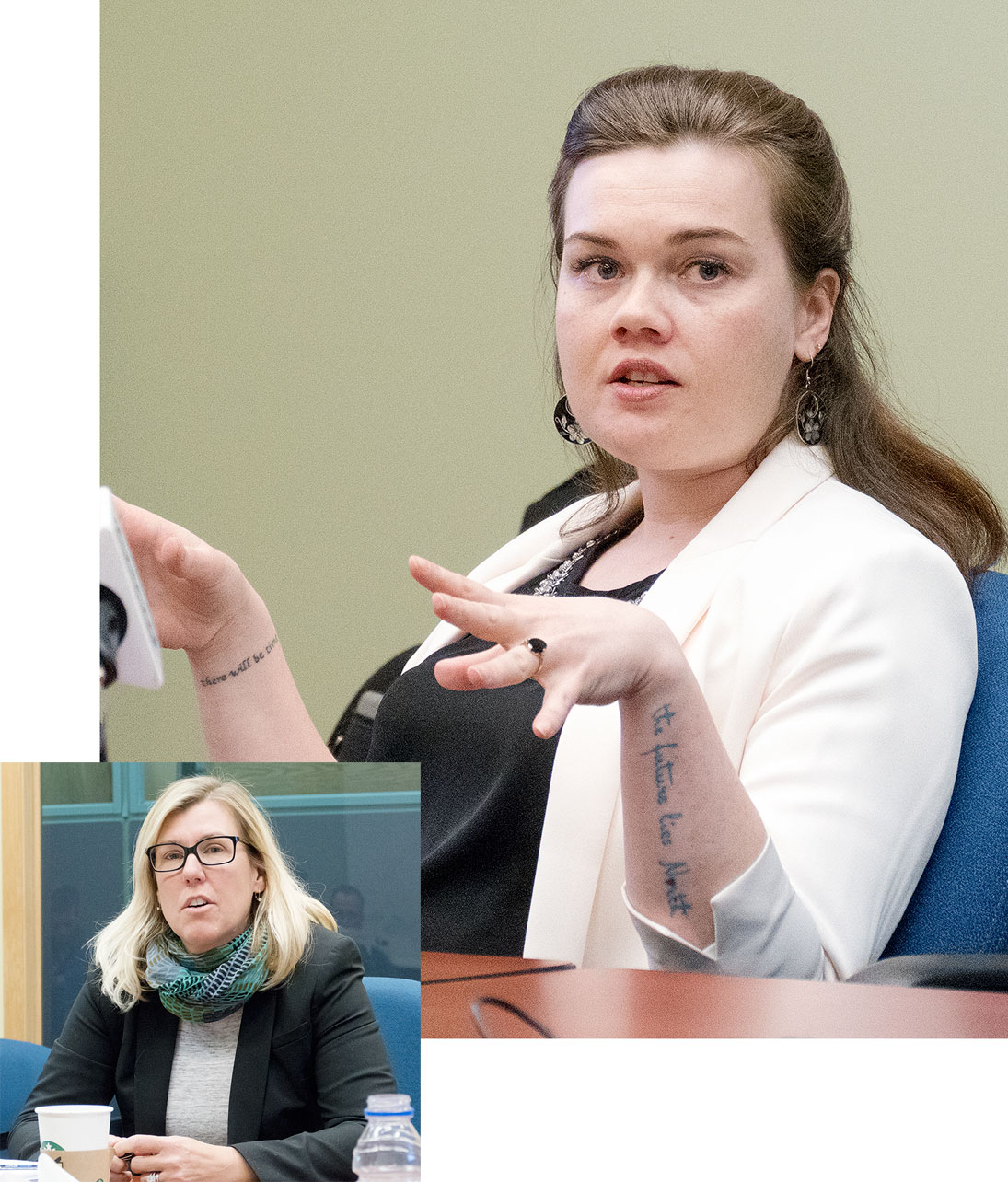
SPECIAL CONSIDERATION – In acknowledgement of the Yukon's small and growing economy, the territory secured a number of protectionist measures under the new Canadian Free Trade Agreement, explained Shay Kokiw, senior policy advisor with the Department of Economic Development. Inset Andrea Buckley
Seriously, I have underwear older than these two making policy.