Photo by Whitehorse Star
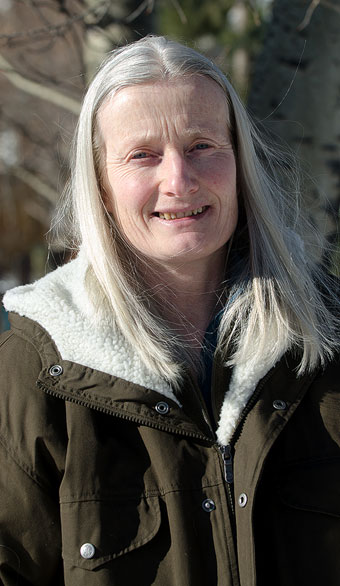
Gill Cracknell
Photo by Whitehorse Star
Gill Cracknell
CPAWS-Yukon has produced a statistical review of responses to the Peel River consultations, suggesting the Yukon government didn't want to be upfront with the numbers.
CPAWS-Yukon has produced a statistical review of responses to the Peel River consultations, suggesting the Yukon government didn't want to be upfront with the numbers.
The government's summary was general in nature because it did not want to show exactly how much support there is for protection of the Peel, says a new release issued Wednesday by CPAWS (the Canadian Parks and Wilderness Society).
"So many people have expressed their frustration and bewilderment that government chose not to mention these numbers that we felt obligated to calculate the numbers ourselves,” Gill Cracknell, CPAWS' executive director, said in the release.
In an interview this morning, Cracknell said the government report on the final round of public consultations over the last four months, released earlier this month, does identify where the responses came from, whether there were local or from abroad.
The 27-page What We Heard document also identifies how many responses were received through petitions or form letters sponsored by CPAWS or the mining industry, she said.
Cracknell said the government's summary provides a list of different perspectives contained in the responses received. But it does not attach any numbers to those different perspectives, she said.
"There is nothing about the number of people who said what, and that is what we are providing because that is what people have been asking for,” Cracknell said.
"People actually want to know how many people think like they do. I mean it is quite simple, really.”
CPAWS said it hired an independent consultant to provide a numerical assessment of the responses received.
Cracknell said their assessment is not meant to be a statistical report, and is not meant to be accurate to plus or minus five per cent 19 out of 20 times.
But it does serve as a valid picture of what people are thinking when they're asked about the future of the Peel River watershed, she said.
Altogether, there were more than 10,000 responses, including 5,058 signatures attached to a CPAWS petition in favour of the recommended land use plan calling for maximum wilderness protection.
Another 299 responses were received through form letters sponsored by the Yukon Chamber of Mines supporting the Yukon government's desire for greater access for the mining industry and other economic pursuits.
The CPAWS analysis says of 10,000-plus responses received in all forms from across Canada and world, approximately 2,024 originated in the Yukon or Northwest Territories.
Of the 2,024, 1,622 or 80 per cent supported the maximum wilderness protection outlined in the Peel commission's land use recommendation.
In order to encourage thoughtful and responsible discussion, website comments will not be visible until a moderator approves them. Please add comments judiciously and refrain from maligning any individual or institution. Read about our user comment and privacy policies.
Your name and email address are required before your comment is posted. Otherwise, your comment will not be posted.
Comments (1)
Up 0 Down 0
Joel on Apr 26, 2013 at 1:56 am
"Not meant to be a statistical report"
"Not meant to be accurate"
So, unless there is a typo here, their report is not useful whatsoever. It cannot be a valid picture of what people are thinking if it is not accurate.
If it is a typo I would hope Whitehorse Star would fix it quickly so maybe this article has some purpose.