Government announces Fortymile caribou harvest
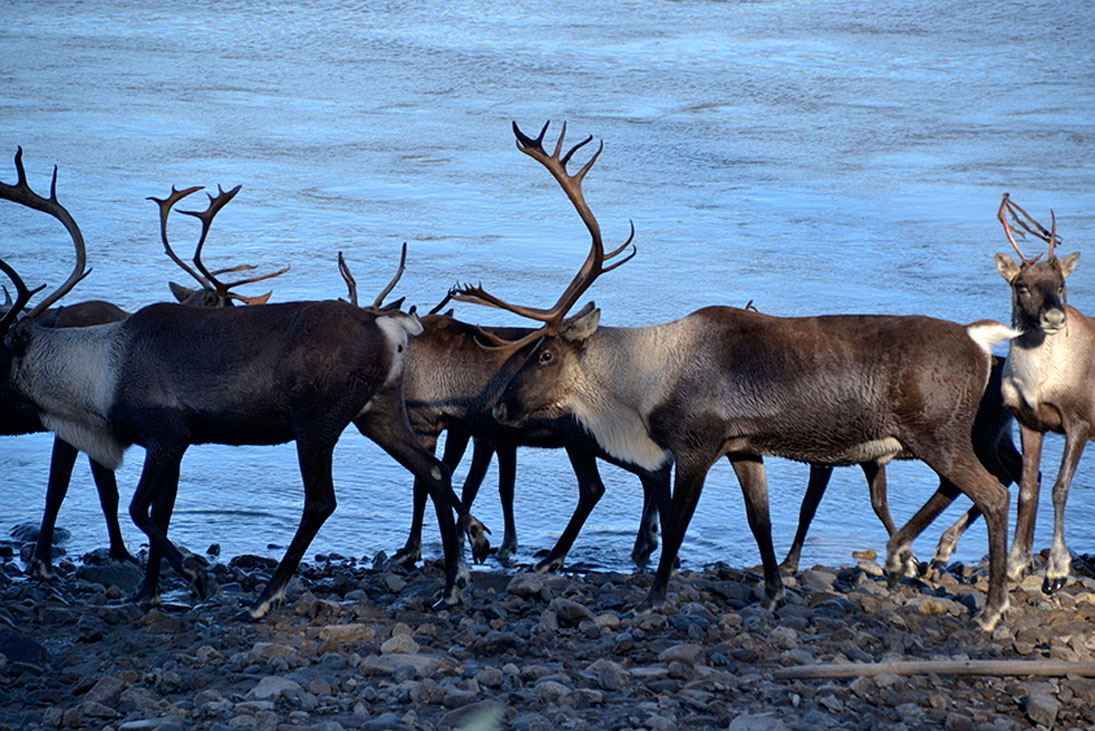
Yukon hunters will be allowed for the first time in 25 years to harvest caribou from the Fortymile herd beginning Wednesday.
By Chuck Tobin on December 31, 2019
Yukon hunters will be allowed for the first time in 25 years to harvest caribou from the Fortymile herd beginning Wednesday.
The Yukon government announced the limited permit hunt with its unique rules in a press release this morning.
The decision to have a hunt comes four years after the government’s proposal to implement an adaptive management plan for the transboundary herd received the support from the Yukon Fish and Wildlife Management Board.
It notes the herd has been under a recovery effort since 1995, when the population hit a low of 6,500 animals. It has since rebounded to an estimated 84,000 and can support a harvest.
Senior government biologist Rob Florkiewicz explained this morning the government did put forward a harvest proposal to the management board earlier this month for 225 animals from Jan. 1 to March 31.
The proposal received the board’s support.
The Fortymile herd ranges between the Dawson region and Alaska.
Alaska, he explained, wants to see a harvest happen in the Yukon as part of its management strategy.
He emphasized the format for the permit hunt was developed to serve as a learning tool, and to avoid inundating the Dawson area with hunters and possibly impact others like trappers.
The permits will be issued on a first-come, first-served basis and will only be good for 10 days. The permits will be issued in intervals of 25 every 10 days, with the first 10-day interval beginning on New Year’s Day and the last ending on March 31.
Permits are available at all Environment Yukon offices. The permits will become available two days before the beginning of the next interval.
If a hunter is unsuccessful, they are still entitled to get another permit, but they have to skip one interval.
Hunters who’ve already reached their bag limit for caribou for the current hunting season are not eligible.
Successful and unsuccessful hunters will be required to report the results of their hunt, and successful hunters will also need to submit the caribou’s incisor bar within 72 hours of the permit’s expiry date – or the last day of the interval.
Florkiewicz said permit holders will be given forums to fill out so that wildlife management officials can gather as much information as possible, such as where hunters were seeing the caribou.
“We are feeling our way through this,” the senior biologist said.
“This follows 25 years of recovery efforts and we are committed to continuing our work with partners to monitor the herd and ensure healthy, sustainable populations into the future,” Environment Minister Pauline Frost said in a statement issued with the press release.
The herd ranges along both sides the Yukon-Alaska border to as far north as game management subzone 219 and south to the Stewart River.
Florkiewicz said there are reports of Fortymile caribou being seen along the Top of the World Highway.
There is some anecdotal evidence the Fortymile used to number in the hundreds of thousands.
Yukon wildlife managers began pushing for a recovery effort in the 1990s, resulting in the 1995 hunting ban. That same year, Alaska curtailed its hunt to 150 bulls, and has slowly increased the harvest as the herd rebounded.
Florkiewicz said the Tr’ondëk Hwëch’in have concerns with the hunt, though the Dawson District Renewable Resource Council is in support, along with the wildlife management board.
Environment Yukon and the Tr’ondëk Hwëch’in continue to work on the development of an overall management plan for the herd, he said.
He explained the Alaskan management plan identifies a preferred harvest of 3,800 caribou, with 2,600 allotted to Alaska and 1,200 allotted to Yukon hunters.
The state is watching the herd and is noticing a low survival rate of calves and a drop in the reproductive success of three-year-old cows, he said.
Florkiewicz said Alaska has indicated it would like the Yukon to harvest its allotment as part of the state’s management strategy.
Alaska has indicated that if the Yukon does not, it might increase harvest opportunities on its side of the border, he said.
Comments (4)
Up 4 Down 1
M. Y. Reese-Spekk on Jan 5, 2020 at 7:09 pm
Cheers Miles - I do appreciate the balance you offer in your post: Miles Epanhauser on Jan 4, 2020 at 2:23 pm. I also appreciate the tone that you often model for others in your submissions and it is often a refreshing read whether I can agree or not with your predicates and, or your conclusions.
You are correct that social media can often be a platform for contempt rather than discussion. Responsible engagement seeks to clarify, argue, reflect and adapt where necessary to maintain that responsibility.
Thank you for your message. It is one that I can gratefully heed.
Up 7 Down 4
Miles Epanhauser on Jan 4, 2020 at 2:23 pm
If I were the GY there would be a series of talks with Trondek Hwechin to ameliorate their concerns and develop a management plan. The recovery effort and plan should be a robust document of the highest social and environmental standard.
Too many times First nations are referred to as governments then treated as just a user group.
In fairness to recreational hunters and the resource management the status of the run and recovery efforts have to include first nation harvest statistics. I know of many cases of First Nation conservation practices that end up being voluntary and some members will continue to harvest.
If we had First Nation harvest stats and a formal management plan people would not be finger pointing.
Up 48 Down 2
Joe on Jan 2, 2020 at 10:33 am
Tr’ondëk Hwëch’in should be required to report also. Why the special treatment? You want to be part of the discussions then step up to the plate and do your part.
Up 38 Down 6
SheepChaser on Dec 31, 2019 at 6:07 pm
Great news! And it looks like a responsible rollout to avoid disrupting the community too much. Hopefully visiting hunters from elsewhere in the Yukon will choose to contribute to the local economy and be respectful of traditional territory.
How this goes the first year will be very important! I call on all my fellow hunters to uphold the highest standards of behaviour and respect!