Photo by Whitehorse Star
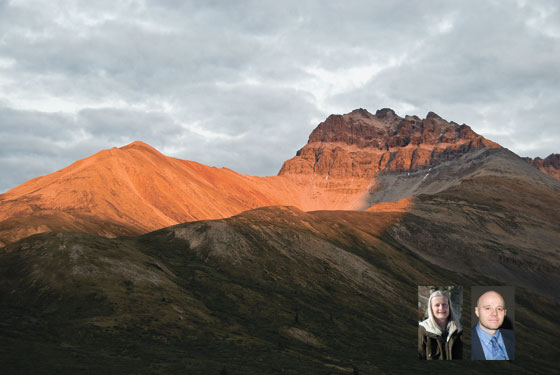
A GLOBAL CONCERN – The territory's consultations on the future of the Peel watershed (above) attracted international responses. Inset: GILL CRACKNELL and MATTHEW GRANT.
Photo by Whitehorse Star
A GLOBAL CONCERN – The territory's consultations on the future of the Peel watershed (above) attracted international responses. Inset: GILL CRACKNELL and MATTHEW GRANT.
More than 7,500 people came out in support of the Peel Planning Commission's final recommended plan during the final round of public consultations, which wrapped up Feb. 25.
More than 7,500 people came out in support of the Peel Planning Commission's final recommended plan during the final round of public consultations, which wrapped up Feb. 25.
That figure comes from the records of the Yukon chapter of the Canadian Parks and Wilderness Society (CPAWS).
But Matthew Grant, the director of communications for the territorial cabinet, said it's important to note the majority of those 7,500 responses are part of petitions CPAWS organized, and most are from Outside.
"I think it's very important to know that this issue is of concern to the public both within the Yukon as well as Outside,” Gill Cracknell, the executive director of CPAWS Yukon, said in an interview today.
Cracknell said that 7,500 figure includes respondents who participated in a CPAWS letter-writing campaign.
She also noted there were emails sent to the government and copied to CPAWS.
But whether respondents participated in a campaign, or reside in the Yukon, shouldn't minimize their contribution, she argued.
"Many people come from all over the world to travel in Peel, to canoe rivers and hike in that beautiful area, so to me, those individuals have as much right to participate in this process as everybody else,” she said.
The commission was tasked to represent all Canadians, Cracknell pointed out.
The government has not yet released the final tally of respondents, but Grant said it can be expected in the near future.
The government is in the final stages of compiling that information, he added.
The government received 897 responses during the previous consultation period in 2010 from 228 registered individuals and organizations.
A government summary of the 2010 feedback, obtained through an access to information request by CPAWS, shows 79 per cent of respondents favoured 100 per cent protection of the Peel.
A further nine per cent supported the commission's recommended 80 per cent protection echelon.
Seven per cent wanted "unfettered” access for oil and gas development.
Four per cent called on the government to reject the plan but didn't specify whether they wanted some form of protection.
One per cent said the protected portion should be less than 80 per cent.
"One way or another, 7,500 individuals supported the commission's final recommended plan; that's so much larger than what happened in 2010,” said Cracknell.
"I think it's a significant figure, and it shows how important this issue is to the public.”
Grant also wanted to clarify a quote used in a CPAWS new release Wednesday, which he called "inaccurate.”
The CPAWS release said Energy, Mines and Resources Minister Brad Cathers told Yukon outfitter Alan Young that "only three per cent of Yukoners care about the Peel.”
In fact, Grant said, what the minister stated was similar to what he'd said previously in the legislature.
For instance, on Dec. 13, 2012, during question period, Cathers said: "Fewer than three per cent of Yukoners indicated a position in support of the so-called 80 per cent or more protection.”
Young could not be reached for clarification before press time this afternoon.
In order to encourage thoughtful and responsible discussion, website comments will not be visible until a moderator approves them. Please add comments judiciously and refrain from maligning any individual or institution. Read about our user comment and privacy policies.
Your name and email address are required before your comment is posted. Otherwise, your comment will not be posted.
Comments (5)
Up 0 Down 0
perhaps.. on Mar 15, 2013 at 11:19 am
By the same token then, we should be asking the rest of Canada if they think it's ok for us to be a welfare state on their backs while we "save" our natural resources.
We should also ask the rest of the world what they think about the pollution/global warming/consequential loss of arctic ice caused from us bringing tourists here to sample our wilderness.
Up 0 Down 0
Joel on Mar 15, 2013 at 4:55 am
So, what I am basically reading from the comments is people think local residents should have less say than people from outside who have a better understanding of what we need locally? Kinda falls into that "we know better than you" mantra that the USA has been running with for a while now....
Don't think it has worked out so well there either....
Up 0 Down 0
Stan Hollway on Mar 14, 2013 at 2:09 pm
"But whether respondents participated in a campaign, or reside in the Yukon, shouldn't minimize their contribution, she argued." I agree with Cracknell.
On some issues its better to have a broader perspective or broader range of participants.
For example, If you held a local poll on drinking and driving 75% of drivers may say its accepable whereas a BC poll may show only 1% of their drivers think its accepable.
Up 0 Down 0
bobby bitman on Mar 14, 2013 at 9:53 am
I saw in a newspaper ad that a person should forward their input to some address as well as sending it to the government to make sure that there was an independent record of that input in case it 'got lost'. So I cc'd my input to that address and I do not even know if it was CPAWS.
Sounds like the government is already trying to throw up excuses to ignore input. Well, well. Surprise, surprise. We'll see how this all goes.
Up 0 Down 0
John Walsh on Mar 14, 2013 at 8:53 am
...and the government spin starts. Does anybody think Brad Cathers tells the truth anytime?