Photo by Vince Fedoroff
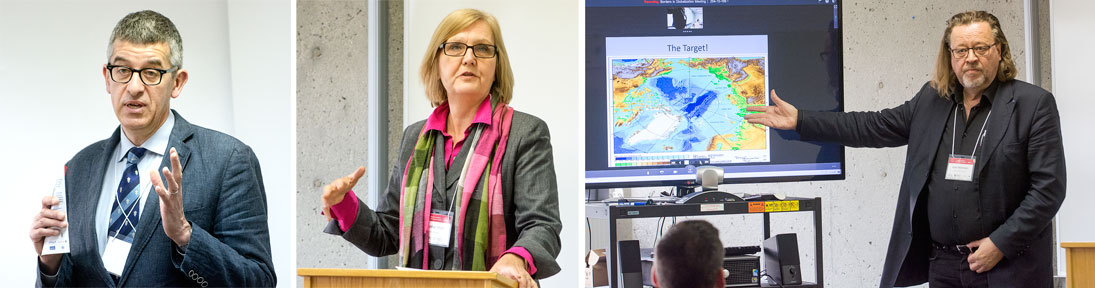
Emmanuel Brunet-Jailly Heather Nicol EXPRESSING HIS THOUGHTS – Lassi Heininen, a professor at the University of Lapland in Finland, makes a point this morning at the conference taking place at Yukon College.
Photo by Vince Fedoroff
Emmanuel Brunet-Jailly Heather Nicol EXPRESSING HIS THOUGHTS – Lassi Heininen, a professor at the University of Lapland in Finland, makes a point this morning at the conference taking place at Yukon College.
Borders in Globalization kicked off its first summer conference at Yukon College this morning.
Borders in Globalization kicked off its first summer conference at Yukon College this morning.
The event has brought in about 20 international border experts, government leaders, private sector partners and graduate students from across Canada and around Europe.
The Borders in the North: Yukon Summer Conference is exploring six themes today and tomorrow—culture, flows, governance, history, security and sustainability and how they relate to the challenges and opportunities of the North.
Each theme will host a panel of experts and include presentations from graduate students.
The Yukon conference is a test, said Emmanuel Brunet-Jailly, the director of Borders in Globalization.
Over the course of seven years, the research collaboration led by the University of Victoria hopes to host at least 10 more conferences or summer schools.
Graduate students taking part in the first conference took a course from January to April about borders in the North.
They each wrote an academic paper for the course, which will be used within the conference. The idea is to get experts to discuss their own views on the papers and themes within them.
It also provides an opportunity for students to make connections with policy makers and border professionals.
During this morning’s opening remarks, Brunet-Jailly thanked the Yukon government members involved for taking the time beyond their mandate to provide comments on the students’ presentations.
Community Services Minister Currie Dixon was included in the first panel this morning, taking a look at geopolitics and politics of the North.
Dixon took a local approach, explaining how the Yukon fits into the geopolitical scheme of things.
He said the Yukon has “multiple identities,” not referring to schizophrenia, but rather in terms of how geography affects Yukon in terms of politics.
“Without a doubt, the Yukon is an Arctic territory,” he said, “We’re compared to other Arctic areas.”
But in terms of economy, the territory is labelled as a “western economy”—not only because western Canada’s association with natural resources, but also because the territory participates with other provinces in the West during trade missions in Asia, for example.
In relation to Confederation, the Yukon puts on another hat of identity: the “small jurisdiction.”
Dixon said that during meetings with other ministers across Canada, the Yukon government tends to “chum up” with small provinces like Prince Edward Island and Nova Scotia because they adopt policies that are similar to those in the Yukon.
Finally, the last identity of the Yukon is perhaps the most obvious—Yukoners are considered “Northern Canadians.”
Lassi Heininen, a professor at the University of Lapland in Finland, spoke about the “big picture” of geopolitics in the Arctic. He identified areas to question, such as who takes ownership of the North Pole.
“Maybe it’s Canada. Your prime minister is thinking along these lines,” Heininen said.
Because Canada’s northern borderlands are not as well-studied as they are in other Arctic countries, such as Russia, it creates tension and raises questions, he explained.
Geography professor Heather Nicol touched on Heininen’s questions and brought some ideas closer to home.
Right now, Nicol said, there’s this “juggling” of ideas and tensions occurring— the United States wants to restrict exploration in the Arctic; Canada and Russia are opposed to more countries making land claims in the Arctic.
But there’s also what Nicol calls the “enigma of land borders.”
“We’re bringing a one-size-fits-all approach to border management. I want to show you how inappropriate that is here,” she said.
At border crossings in the North, laying on more border guards and technology might not be the answer, she cautioned.
“Though we haven’t seen the heavy hand, we could.... We don’t know how that would impact our borders.”
She further explained her point by showing pictures of busy Canadian-American border crossings, and compared them to the much smaller-scale ones in the North.
Nicol said the answer is to get a better understanding of the passing people and goods across northern borders.
“Trying to make sense of what all this means,” she said, “is what this workshop is about for me.”
Conversations like these will continue this afternoon and tomorrow at the college.
The conference’s first keynote speaker, David Johnny of the White River First Nation, was scheduled to speak over the lunch hour.
City councillor John Streicker will be presenting the second keynote speech tomorrow, covering the topic of sovereignty and sustainability in the Canadian North.
In order to encourage thoughtful and responsible discussion, website comments will not be visible until a moderator approves them. Please add comments judiciously and refrain from maligning any individual or institution. Read about our user comment and privacy policies.
Your name and email address are required before your comment is posted. Otherwise, your comment will not be posted.
Comments (7)
Up 7 Down 0
Boarders in the north are a big issue because of Russia on Jun 22, 2015 at 4:46 pm
Boarders in the north are a big issue because of Russia.
Russia is using their north as toxic waste dump.
Up 13 Down 1
umm, what? on Jun 22, 2015 at 10:31 am
I'm sorry, but where does it ever say that Yukon College paid for this? Just because something is held at the College, it doesn't mean that they are paying for it. Many events are held at the College because in the summer, the classrooms are empty.
Up 11 Down 15
Some people just don't get it on Jun 21, 2015 at 7:16 am
Some people don't get it and make statements that add negative value.
If you can't say some positive, then don't speak at all because you are looking disrespectful and have a bad attitude.
Up 20 Down 0
north_of_60 on Jun 19, 2015 at 1:22 pm
@steve
An expert is someone from more than 50 miles away with a briefcase and a suit.
Up 18 Down 25
Just Say'ina on Jun 18, 2015 at 10:31 pm
Who paid for this large contingent of "Navel Gazers"? Oh yeah I forgot, us. Why can't they just have a meeting by phone or on the net? What a waste of money. No wonder the Yukon College is a joke and broke.
Up 14 Down 0
Just Say'ina on Jun 18, 2015 at 10:27 pm
@steve You asked the question, here it is. An Ex is a has been and a spert is just a little better then a drip. hahaha
Up 24 Down 1
steve on Jun 18, 2015 at 12:39 pm
Can someone tell me what an expert is because based on the dictionary definition we are all experts as we have knowledge. Might it be better to say these people have extensive or localized knowledge in the field.
It would be nice if the media would stop calling everyone experts as that word has become a joke to most of us.