Photo by Whitehorse Star
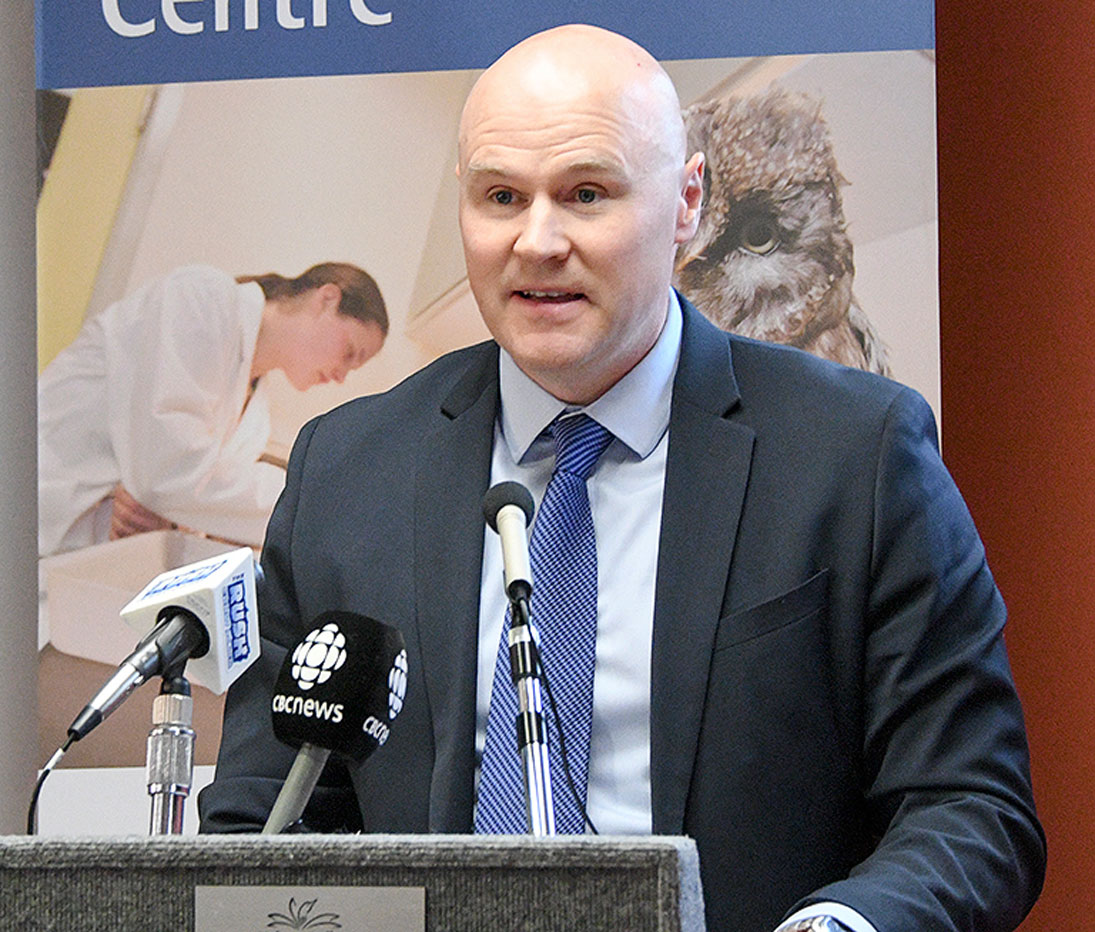
Yukon Energy President Andrew Hall
Photo by Whitehorse Star
Yukon Energy President Andrew Hall
Yukon Energy has released its vision to increase stability and generate capacity on the territory’s electrical grid over the next five years.
Yukon Energy has released its vision to increase stability and generate capacity on the territory’s electrical grid over the next five years.
The draft of the updated 20-year resource plan includes a new diesel generating plant to serve as an insurance policy in case the Aishihik Hydro Plant goes down when demand is at its peak during the coldest days of winter.
It includes adding a third generator at the LNG plant, building a facility for grid-scale battery storage and increasing water storage in the Southern and Mayo lakes.
Yukon Energy president Andrew Hall explained Thursday the draft resource plan is a living document with the flexibility to adapt if things change, such as not being able to obtain public approval for increasing storage in the Southern Lakes.
The plan does, however, put forward Yukon Energy’s best options of increasing stability and generation in the short-term under a medium-load scenario, he said.
“Right now we are short,” Hall said of the ability to meet peak winter demand without Aishihik.
“That is what the analysis shows us; that is where we are.”
The Yukon Energy president said if the Aishihik plant went down during the coldest winter days, the publicly owned utility might have to resort to rolling blackouts to supply customers, even if it fired up every back-up diesel and natural gas generator.
Yukon Energy has held public meetings and met with First Nations and other stakeholders over the past 18 months to put forward options to beef up the grid.
In addition to increasing dependency on diesel and natural gas, consideration was given to various forms of renewable energy, including solar, wind and geothermal.
The cost of using increased dependency on fossil fuels, additional water storage and upgrading existing hydro plants over the next five years to meet the demands under a medium-load scenario is estimated at $202 million.
Achieving the same increase in reliability and generation using only renewable generation such as wind and solar, the estimated cost is more than three times higher, according to the analysis included in the plan.
Yukon Energy is accepting comments on its draft proposal until March 15. It plans to submit the document for review by the Yukon Utilities Board this spring, at the same time it intends to file an unrelated application for a new rate increase.
Before Yukon Energy moves forward with any of these options, it will need to go before the environmental assessment board and back to the utilities board for the OK to proceed.
The nine short-term initiatives recommended in the draft plan under a medium load scenario are:
• 2018 – Begin additional demand-side management programs to promote further conservation, such as the existing programs promoting LED lighting and the use of timers on vehicle plug-ins. Estimated cost: $17.2 million.
• 2019 – Installing the third, 4.4-megawatt natural gas turbine at the LNG facility. This turbine was reviewed and approved as part of an initial LNG project. Estimated cost: $5.9 million.
• 2020 – Replacing or upgrading parts and equipment at the Aishihik and Whitehorse generating plants to increase efficiency and generation. Estimated cost: $12.6 million.
• 2020 – Expanding water storage in the Southern Lakes. Estimated cost: $15.4 million.
• 2020 – Installing four megawatts of battery storage at the Takhini substation along the Mayo Road.
Hall explained the batteries would be charged using excess water when demand is low and used to help meet demand during the morning and dinnertime peaks.
The Mayo Road site was chosen because Yukon Energy is out of room at the Whitehorse Rapids Dam, as the battery facility will require a lot of space, equivalent to about 20 shipping containers, he said.
Hall added the site is still close enough to the largest load that it makes sense. Estimated cost: $39.1 million.
• 2021 – Installing a diesel plant capable of generating 20 megawatts at the Takhini substation.
Hall explained the decision to go with diesel rather than LNG is linked to the difference in the capital cost between the two. The diesel plant is less expensive to build.
While it’s more expensive to run, it’s not expected to run much at all, given that it’s more of an insurance policy in case there’s a problem with the Aishihik plant or the transmission line connecting Aishihik to the grid, he said. Estimated cost: $62.2 million.
• 2022 – Refurbishing the two old 2.5-megawatt hydro units at the Mayo A hydro facility. Estimated cost: $28.6 million.
• 2022 – Increasing water storage in Mayo Lake. Estimated cost: $20.5 million.
• 2022 – Anticipating contributions to the grid from independent power producers, such as additional wind generation from a Haeckel Hill project are currently being studied.
For the medium-load scenario, the recommended options are based on activity at the Minto Mine ending in 2021 with two other mines operating – one on the grid and one off the grid.
A low industrial scenario contemplates activity at the Minto Mine ending in 2021 with one mine beginning to operate the same year.
The high load scenario contemplates four mines operating – two connected to the grid and two operating off the grid,
Under a high load scenario, the draft plan identifies the additional option of a small, eight megawatt hydro project at Drury Creek in 2023, at an estimated cost of $97.3 million.
The president of Yukon Energy said achieving the recommended level of investment into the grid over the short-term will require financial assistance from government.
In the last 10 years, the Crown corporation has invested $370 million on improvements, such as the expansion of the Mayo B hydro facility.
As well, it has received substantial contributions from the Yukon and federal governments, Hall pointed out.
“We have to start the conversation about how we get those dollars.”
While acceptance of the recommended initiatives will be required before Yukon Energy moves forward with any of them, Hall said, the corporation is actively planning and working on four of the initiatives: enhancement of water storage in the Southern Lakes, the addition of the third turbine at the LNG plant, as well as the addition of battery storage and the 20-megawatt diesel generating plant.
Under existing regulations, Yukon Energy must be able to offset the loss of its largest generating asset when demand is at its peak.
While the Whitehorse Rapids Dam is the largest generating asset in the summer when water flows are abundant, the Aishihik plant is the largest generating asset in the wintertime.
Aishihik Lake is used in the summer to store water for generation in the winter.
In order to encourage thoughtful and responsible discussion, website comments will not be visible until a moderator approves them. Please add comments judiciously and refrain from maligning any individual or institution. Read about our user comment and privacy policies.
Your name and email address are required before your comment is posted. Otherwise, your comment will not be posted.
Comments (18)
Up 1 Down 0
Groucho d'North on Oct 25, 2018 at 4:53 pm
"...• 2021 – Installing a diesel plant capable of generating 20 megawatts at the Takhini substation..."
How much fuel storage will be located on site and what fire safety measures will be enhanced to mitigate the threat of fire?
Up 2 Down 0
bill cuban on Mar 16, 2017 at 4:28 pm
The elephant in the room keeps whispering "there are only 40000 people in Yukon, how do we pay for all this?" how will my electrical bill be affected? Taxes, smart meters, the future is not all roses.
Up 1 Down 7
balmy on Mar 15, 2017 at 6:57 pm
The problem with sound engineering of nuclear waste is reading the warning signs 100,000 years from now.
Up 6 Down 0
bill cuban on Mar 15, 2017 at 4:07 pm
https://dddusmma.wordpress.com/2017/01/24/vastly-improved-modern-coal-fired-power-plants/
cheaper than nuclear and IGCC, and a local source of fuel, might be worth a look. i forget, the anti-everything crowd is against any development.
Up 13 Down 5
ProScience Greenie on Mar 15, 2017 at 12:39 pm
Generating power from the Braeburn-Kynocks Coal area using state of the art technology is actually not a bad idea and might even be more carbon friendly than shipped in LNG or diesel. Kind of fits the '100 Mile Energy Diet' concept. The problem is the optics are not good and the anti-everything crowd would be all over it whether it was green or not.
When it comes to dealing with nuclear waste there are ways to deal with it based on very sound engineering - deep storage in the Precambrian Shield comes to mind. Sadly, the anti-everything crowds would rather see the waste stored out in the open than properly dealt with. Again, it is a case of sound engineering and science being trumped by green optics.
Up 4 Down 18
Spud on Mar 15, 2017 at 11:20 am
ABSOLUTELY, NO NUCLEAR - WHO WILL STORE THE REMAINS FOR ETERNITIES?
Sooner build coal generation at Braburn. No need to haul the coal and new plants much cleaner. Catch the CO2 and convert it to fertilizer.
One would be extremely surprised how many Yukon homes are mostly solar more would be if it was easier to return excess to the grid.
Up 10 Down 4
diesel power on Mar 15, 2017 at 4:03 am
62+ Million for a diesel generator? That's your best option... wow, that's out of the box thinking! Maybe you should allow some of your engineers to get out of the Yukon and go to an energy conference... there is a lot of new technology out there, lot's of in stream and run of the river options.
Up 21 Down 9
ProScience Greenie on Mar 14, 2017 at 4:03 pm
If you want to completely sidetrack the Yukon anti-everything crowd from fracking just put nuclear energy on the table as a serious option. Grab some popcorn and your favorite beverage and watch them totally freak out.
Meanwhile, back in the real world, the Southern Lakes concept should go ahead (without the Atlin option) right away. Most of the concerns about the project are bogus. Another hydro dam similar to Aishihik should be closer to being shovel ready. Not sure why there isn't more micro-hydro as it is gentle on the environment and we have so many small watersheds suitable for it. There should be more private small scale solar and wind generation coming online. Why we are not already drilling and working the bugs out of geothermal generation is odd. Not sure what's up with that.
Lots of options out there if we want to get serious but the major issues, as always in the Yukon, are politics, endless consultation and the various squeaky wheel gets the grease clubs.
Up 19 Down 1
north_of_60 on Mar 14, 2017 at 1:41 pm
@BnR is correct about nuclear.
The Energy Returned on Invested, EROI, has been evaluated for typical power plants representing wind energy, photovoltaics, solar thermal, hydro, natural gas, biogas, coal and nuclear power. ... The results show that nuclear, hydro, coal, and natural gas power systems (in this order) are one order of magnitude more effective than photovoltaics and wind power.
Graph:
https://scontent-sea1-1.xx.fbcdn.net/v/t1.0-9/12321359_10153304438441222_3335738321966136669_n.jpg?oh=0bfbc93b4f0ce5887358e46c8621b502&oe=592AEAFA
Source:
http://festkoerper-kernphysik.de/Weissbach_EROI_preprint.pdf
Up 19 Down 5
BnR on Mar 14, 2017 at 7:04 am
I've said it before, and I'll say it again, why is small nuclear not even mentioned? YEC is even throwing out more diesel powered options, but not even a mention of whether small nuclear would be cost effective or not. It IS an option, but come on YEC, at least give Yukoners the necessary information on it, such as cost/KWh.
Total up the costs on the goals YEC has listed, and one wonders if there is a cheaper option.
Up 5 Down 25
cloudydetails on Mar 13, 2017 at 6:40 pm
For those who don't know, Yukon is a nuclear free zone.
Up 15 Down 8
north_of_60 on Mar 12, 2017 at 9:13 pm
Storage enhancements increase the amount of water stored in an existing reservoir, resulting in the ability for a hydro facility to generate more electricity.
The plan involves holding September water levels into the winter months so water is available behind the dam instead of using more fossil fuels.
Storage enhancement studies on the Southern Lakes concept show that the likely effects are subtle, mainly adding to erosion and groundwater issues that already exist. Research shows there should be no significant impacts on water and land animals and their habitats.
People who educate themselves before making misinformed comments won't appear quite so foolish.
http://resourceplan.yukonenergy.ca/options/storage-enhancements/
Up 22 Down 11
Putin on Mar 12, 2017 at 4:31 pm
Small nuclear plant would be the best option, they are available safe and great source of power.
Up 6 Down 20
wundering on Mar 12, 2017 at 8:47 am
@ North of 60
There you go with the labeling people again, can you name any of these "elites", you so despise.
Or is it just anyone with a different point of veiw.
Up 6 Down 15
yukondsl on Mar 11, 2017 at 4:23 pm
north_of_60 You are forgetting about the Carcross/Tagish First Nation who be affected by increased lake levels at Tagish and Carcross.
Up 18 Down 4
Just Say'in on Mar 11, 2017 at 3:33 pm
Why are Yukon Energy, Yukon Electric and the Government always sending out mixed messages. On one hand they offer incentives to heat with electric. They also urge you to cut consumption. The messages are so conflicted. Is electricity the best choice? If yes then lets start producing enough. The greenies have to be on side with that don't they? Oh I forgot they are the against everything crowd.
Up 32 Down 8
north_of_60 on Mar 10, 2017 at 7:23 pm
Water storage is the most viable option to reduce fossil fuel use on the grid. Increasing water storage in the Southern Lakes is ‘ready to go’, requires no new infrastructure, and should be implemented immediately. Nothing else makes as much sense. Delaying it until 2020 is irresponsible.
If it wasn’t for influential retired bureaucrats and politicians who built too close to the shoreline it would have been done years ago.
The privilege of those few elites is always more important than the common good in the Yukon.
Up 17 Down 17
Holy erroneous on Mar 10, 2017 at 5:55 pm
Firstly it is not an LNG plant at the South access site. They are LNG generators powered by LNG that is trucked in. 2. I really question the statement that says Aishihik is the largest generating asset in the winter. (When did they change out that generator and somehow increase the water flow to an unrealised quantity)? 3. Why do the LNG generators fire up on a regular basis if they are supplying no load. (Is someone practicing wasting LNG? Sometimes one is running, sometimes both are pumping exhaust up to no avail for hours at a time) 4. Somehow despite L.E.D. street lights, power smart led lighting in houses and other conservation practices our load is magically at peak.
Who is running this gong show?