‘Frank discussion can be part of the healing process’
‘Frank discussion can be part of the healing process’
By Rhiannon Russell on November 14, 2014
Allegations of violence and abuse by former CBC radio host Jian Ghomeshi.
Sexual harassment allegations on Parliament Hill.
The murder of Tina Fontaine and attack on Rinelle Harper in Winnipeg.
The sentencing of a young man in Halifax who circulated a photo of a girl at a party being sexually assaulted.
The ongoing push for an inquiry into the country’s hundreds of missing and murdered indigenous women.
Violence against women has repeatedly made headlines in Canada in recent weeks, prompting much-needed discussions about rape culture, consent, reporting sexual assault and victim-blaming.
As White Ribbon Yukon gears up for its annual campaign to end violence against women, its members agree that these are discussions that should happen locally, too.
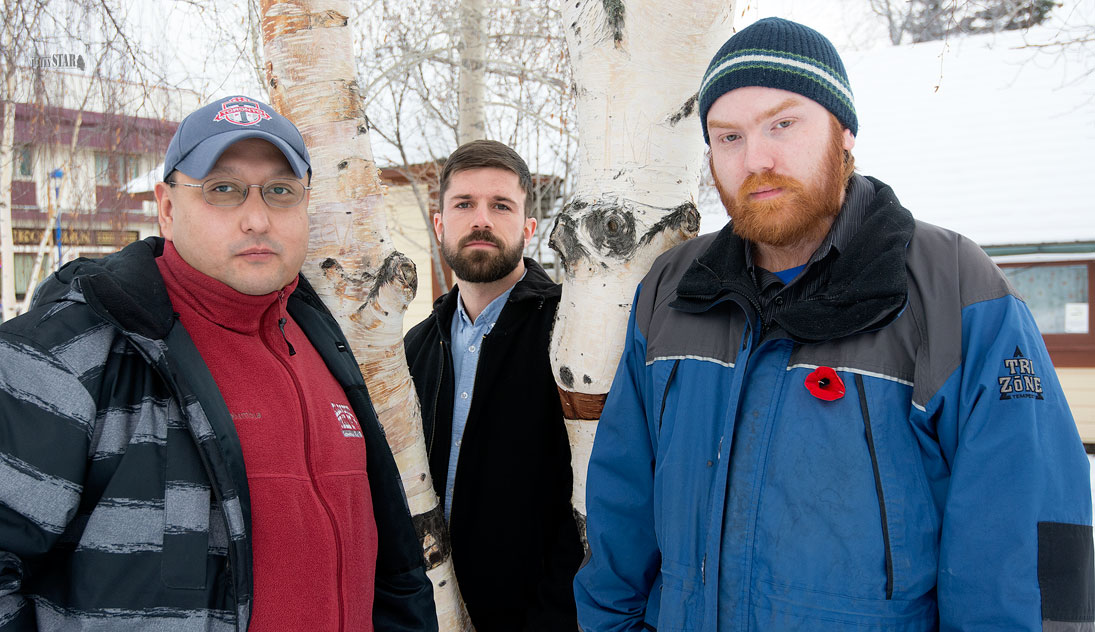
National stories like the allegations against Ghomeshi should prompt us to localize the issue and look at the violence that exists in our community, says Mark Rutledge, one of the organization’s board members.
“It does happen, and I think this just leads to a discussion, an opening-up of the issue,” he said in an interview Thursday.
“And discussion is a good thing. It’s not this hidden-under-the-carpet kind of deal anymore. I think open, frank discussion can be part of the healing process.”
Steve Roddick, the organization’s co-founder, said one of the things he’s taken away from the still-unfolding Ghomeshi story relates to the fact that people had heard rumours about the former Q host being sexually inappropriate with women years prior to the explosive allegations made this fall.
“I wonder how many people in Whitehorse or in the Yukon know people that engage in violent or predatory behaviour,” says Roddick.
“They don’t know how to address it or what to say about it, but they’ve seen that kind of behaviour in their friend groups or in different situations.
“I think this is a really good opportunity to bring this out in the open and say, ‘This is something we need to talk about and it’s not appropriate.’ As men, we have a responsibility to talk to other men about that.”
White Ribbon Yukon works with men and boys to end violence against women – because men are perpetrators, the responsibility lies with men to stop.
During the annual White Ribbon Campaign from Nov. 25 to Dec. 6, men are encouraged to wear a white ribbon and sign a pledge to never commit, condone or remain silent about violence against women.
It runs parallel to the 12 Days to End Violence Against Women campaign, organized by the Victoria Faulkner Women’s Centre and Les EssentiElles, a local non-profit that advocates on behalf of French-speaking women.
From 2 to 4 p.m. tomorrow, White Ribbon Yukon will hold a meet-and-greet at the Whitehorse Public Library for people who would like to volunteer with the campaign.
Patrick Thompson joined White Ribbon Yukon this year. He’s the program co-ordinator at Les EssentiElles.
“Being visible is a really big thing,” he says of how men can support women.
“Going to these different events and being there and having people see your support is huge. Being an ear to listen to. Being non-judgmental. All those kinds of qualities.”
While studying criminology, Thompson learned that men dominate convictions for most types of crime. But his studies didn’t explore why that was.
“So that led me to get into gender studies and start learning about masculinity and some of the reasons why men are so over-represented in the criminal justice system,” he says.
Now, in his work with Les EssentiElles, Thompson talks to boys and men about violence against women.
Educating younger generations is key to changing men’s sexist attitudes, says Rutledge.
“I think that’s where it starts. It starts in the schools and it starts at a young age. I think, as men, we have to be those role models for the youth, that this is not the way we do things. You have to treat everyone with respect.”
This is what Rutledge teaches his two sons.
“Being of aboriginal descent, I’ve seen a lot of violence in my lifetime, and I wanted to see if I could do something that would educate and maybe even – this is grandiose – put a stop to it somehow,” he says, when asked why he got involved with White Ribbon Yukon.
“Sadly, there’s not a lot of (aboriginal) families that are whole, with the male and female figures in the family. So, we talk about aboriginal boys, there may not be a male role model. I came aboard also in order to help them as well.”
Rutledge, Thompson and Roddick agree that conversation about violence against women is key to educating men and changing ingrained behaviours and mindsets.
“I know when I’ve spoken to people who are fresh to the issue, it ends with jaws dropping,” Thompson says.
“There’s just no idea about the extent of sexualized assaults and the extent of domestic abuse, what sexualized assault looks like, what domestic assault looks like. It’s fairly eye-opening for them. It’s really good to be able to keep these conversations going because there’s just so many people who still don’t know.”
The response to a video that went viral online recently affirms what Thompson says.
A woman spent 10 hours walking around New York City, with a hidden camera carried in a friend’s backpack recording dozens of incidents of street harassment – men catcalling her and following her.
On social media, many men expressed surprise that this is something women have to put up with on a regular basis.
Some of the points listed on a White Ribbon Yukon information sheet about how men can show respect for women pertain to street harassment:
“Be mindful of situations where women might feel anxious or unsafe. On deserted streets, especially at night, or in enclosed spaces, keep your distance from women you don’t know.”
“Be attuned to verbal and non-verbal cues when it comes to approaching women and to physical contact with a partner or on a date. If you’re unsure, ask.”
Others involve discussing sexism with male peers:
“Call out friends whose idea of a ‘joke’ is to make sexist remarks.”
“Talk to your male friends about how to be masculine without being misogynist.”
“Use what social capital you have to speak out against misogyny whenever you see it.”
While not all men commit violence against women, it’s not enough to sit quietly by, White Ribbon Yukon maintains.
Men can make the pledge in-person with White Ribbon volunteers throughout the campaign or online: whiteribbonyukon.com/pledge.
The 2014 campaign will kick off at noon Nov. 25, at Yukon College.
Comments (4)
Up 96 Down 92
Wilf Carter on Nov 18, 2014 at 10:50 am
How can anyone be hands down when talking about stopping violence against women, children or anyone for that matter. Maybe some of people who have hands down can come forward to explain your position so others can understand. Maybe there is something we are not seeing! Thanks
Up 100 Down 95
Wilf Carter on Nov 17, 2014 at 10:58 am
With the internet and open communications today we are beginning to see how bad violence is against women, on line, in our schools and in our work place. The question I am trying to figure out is has violence always been there or is it because of the opening of communication or is it a change in our culture as a whole to become more violent? There must be some data out their showing the facts.
Some schools had bullying to the point of violence and was always there and the only way it was dealt with was the kids themselves stopped it or once in awhile a teacher would step in if they could see it because most times it was hidden. It seems to have gone down in schools. We need to step up and start with a program to stop violence period and start with violence against women and why it is occurring. A friend of my sister was sexually assaulted and they were charged and dealt with under the law. But the damage to that that girl was done. The incident affected the whole family.
Up 99 Down 90
Torie Gerard on Nov 16, 2014 at 11:17 am
I have never experienced violence but don't feel that anyone should in regards to their gender.
Thanks Steve, I never would have read it if I didn't recognize you.
Up 125 Down 87
Duane Gastant' Aucoin on Nov 15, 2014 at 3:57 pm
I totally agree that we should do all we can to end violence against women & support those who work towards this. But I think we also need to recognize that violence against anyone is bad & that even women can also sometimes be the perpetrator.
Violence takes many forms, physical, mental & spiritual abuse.
I was hurt by my mother's alcoholism but she took ownership of her actions and changed her life & asked my forgiveness.
So, no mater who we are, male or female, native or non native, old or young, gay or straight, etc. We all must do our part to end violence.
gunalcheesh/merci/thank you