Foundation receives parts of seized sheep
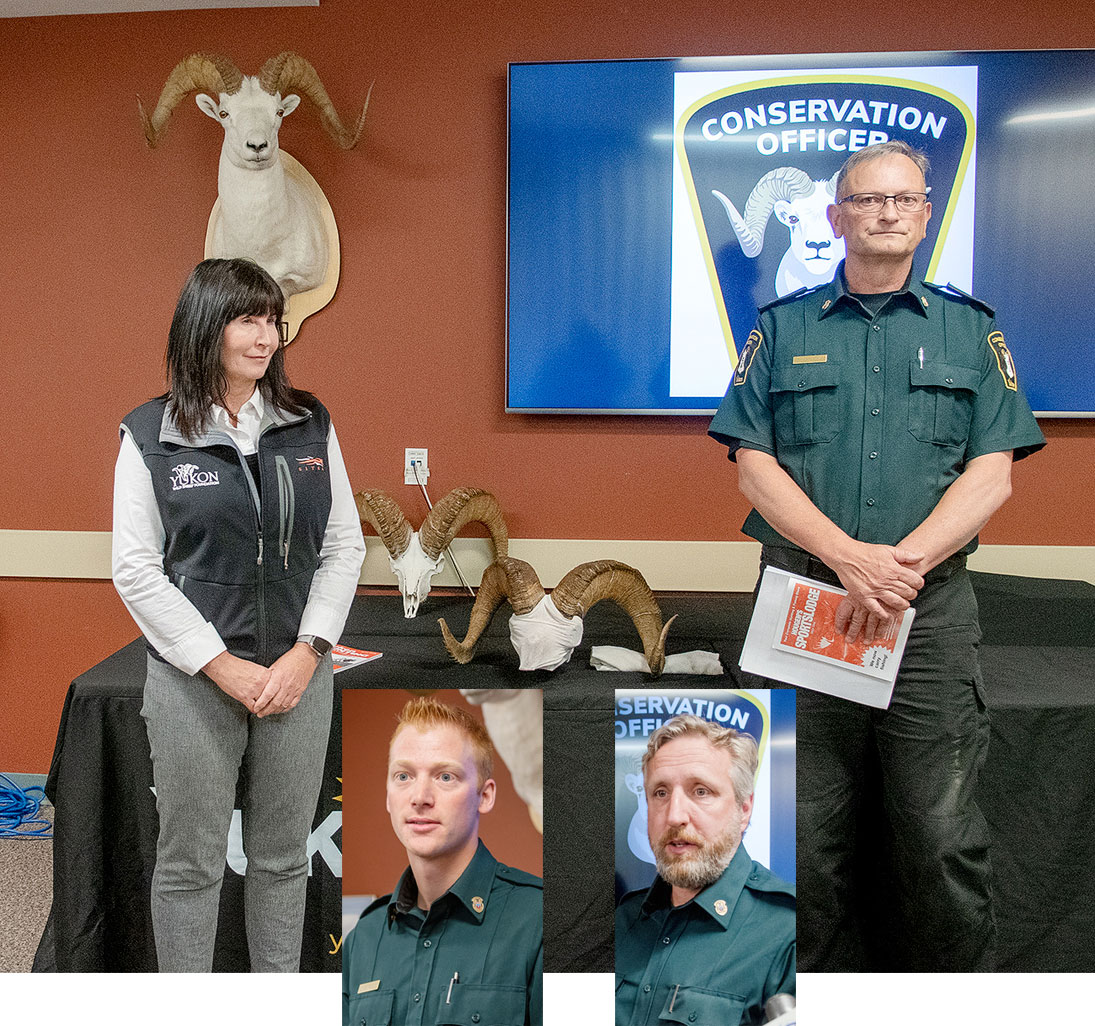
The Yukon Wild Sheep Foundation was presented with the horns and cape of a stone sheep seized from a hunter convicted of violating his hunting tags.
By Gord Fortin on July 29, 2019
The Yukon Wild Sheep Foundation was presented with the horns and cape of a stone sheep seized from a hunter convicted of violating his hunting tags.
The Yukon Conservation Office presented the foundation with the horns and cape on Friday.
The kills were confiscated from hunter Bradley Garret Vanhoose from Grand Rapids, Mich.
He had been hunting in the territory in 2018 with two guides. He killed two sheep under one tag, so was charged with violating the Wildlife Act.
Vanhoose was convicted in territorial court last March. He had to forfeit one of the sheep but was able to keep the other under a plea deal.
Helen Christiansen, the foundation’s president, said both organizations serve to protect sheep.
She said the horns and cape will be used in the foundation’s youth education program, which will take place in the spring.
Members and the public are invited to attend the adult-focused and youth-focused educational workshops.
It touches on various topics like sheep population, a hunter’s responsibilities and hunting techniques.
“It’s a variety of information regarding hunting and species,” Christiansen said.
The items will be used as a display at the foundation’s wild sheep night in April 2020. This fundraising event raises awareness of wild sheep
conservation.
Chief conservation officer Gordon Hitchcock said only the horns and cape are being donated. The confiscated meat will likely be donated to the
Whitehorse Food Bank, according to Erin Loxam, a Department of Environment spokesperson.
Hitchcock said the chalk marks used to identify the sheep’s age are still on the horns. According to the marks, the sheep was approximately seven years
old.
He said this sheep does have a full curl and thus is a sought after sheep by hunters.
Starting today, the signs along the border with British Columbia are being replaced, Hitchcock said. These are areas with high sheep population.
“We want to make sure that both B.C. hunters and Yukon hunters understand where the boundary is,” Hitchcock said.
This is a collaboration between both organizations.
Dave Bakica, a Whitehorse district conservation officer, went over some of the details on how to hunt a wild sheep legally.
He said hunters can only harvest the males, which must have a full-curled horn. In the territory, this means the animal must be eight years old.
Since it’s difficult to determine age in the field, Bakica said, the rule of thumb is to ensure that the curl breaks a straight line between the corners of the sheep’s eye and nostril.
This too can be difficult, based on the angle you observe from. He said you will want to be on an even plane to get a view of the side of the animal.
“You want to wait and really study your animal before you shoot,” Bakica said.
He reminds everyone that there is always the option to not shoot if you are not sure the sheep is legal.
There is an instrument that will measure the horn, he added. This is used when hunters turn in their kill.
Bakica encourages hunters to take a sheep hunting workshop, which the conservation office offers once every two years.
The focus is meat care, harvesting a legal sheep, ethical hunting and advising on what gear you should bring on a hunt.
He explained that in this case, the hunter fired at a sheep, but it did not go down right away. He shot at another sheep afterward. Bakica said this hunter
should have checked on the first sheep before making the second shot.
“You need to make sure it did go down and not just keep shooting,” Bakica pointed out.
This sheep would be a trophy sheep.
After the presentation, Hitchcock presented media representatives with the newest recruit to the conservation office, Logan Donovan. He is currently in
training at the Western Canadian Conservation Law Enforcement Academy in Hinton, Alta.
He will do some field mentoring for a couple of months before returning to the territory. Once he graduates from the program, he’ll be posted in Watson
Lake.
Donovan said he can’t wait to graduate and get to his posting.
“I am very excited to be in this position,” Donovan said. “I’ve worked really hard to get here.”
Comments (5)
Up 4 Down 1
Patti Eyre on Aug 1, 2019 at 3:18 pm
So this man from the United States comes up to our beautiful territory, kills 2 sheep when he's legally allowed only 1 and gets to keep one of them? And no mention of the guides who are paid to be responsible or the outfitter who hires them? Why not, these are Yukon's animals and we have a right to know!
Up 13 Down 2
Jacl O'Connor's Ghost on Jul 31, 2019 at 11:58 am
Fun trivia question.
How many members of the current Yukon chapter of the Wild Sheep Foundation's board of directors have been charged under the wildlife act while Sheep hunting?
Up 22 Down 2
BnR on Jul 30, 2019 at 9:34 am
Curious how the guides didn't get charged on this one. The guide is ultimately responsible for the outfitter.
Up 20 Down 2
David on Jul 30, 2019 at 8:41 am
hmm...so next time I'm out sheep hunting and I can't decide if the sheep I'm lined up on is legal or not I might as well just take the shot as if it ends up not being legal I can just shoot another one as long as I forfeit the first one? Something doesn't quite seem right here.
Up 15 Down 3
YT Hunter on Jul 29, 2019 at 3:41 pm
The Wild Sheep Foundation is just an outfitting industry/Safari Club International driven organization, just look at the board make up.
Why did they get it it? Where is it stated in the legislation that the WSF gets any seized trophies? What do they contribute to The Yukon?
I guess it's who you know.