Photo by Vince Fedoroff
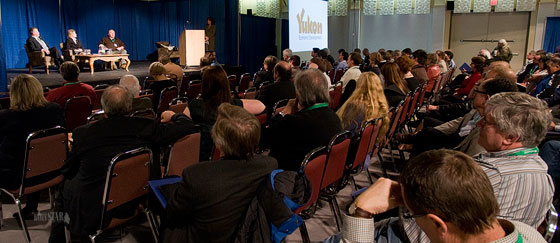
HEARING FROM THE EXPERIENCED – Audience members of the Opportunities North conference listen to former leaders of the Yukon government Wednesday afternoon. Left to right, they are Dennis Fentie, Pat Duncan and Piers McDonald.
Photo by Vince Fedoroff
HEARING FROM THE EXPERIENCED – Audience members of the Opportunities North conference listen to former leaders of the Yukon government Wednesday afternoon. Left to right, they are Dennis Fentie, Pat Duncan and Piers McDonald.
Energy was the word of the day Wednesday when the leaders of three former Yukon governments sat down to discuss the future of the territory's economy.
Energy was the word of the day Wednesday when the leaders of three former Yukon governments sat down to discuss the future of the territory's economy.
Piers McDonald, Pat Duncan and Dennis Fentie spoke on their time in office and what the current government has to do to harness the advantages of the territory's economic boom.
They were there as part of the Yukon Chamber of Commerce's three day Opportunities North conference. The ex-politicians sat in under bright lights in the High Country Inn's Exhibit Centre in what resembled a daytime talk show.
Darielle Talarico, the conference chair, reminded the audience that political history was in the making as the three ex-leaders sat down together with no advice from their former communication departments.
McDonald, who was an NDP government leader from 1996 to 2000, admitted he's been out of the game for a while, and that people "may take issue” with some of the things he planned to say.
When it came to energy, McDonald — who is the chair of Yukon Energy Corp.'s board— was loud and clear.
"There's no way of getting around hard realities,” he said.
McDonald suggested Yukoners are moving into a higher-cost environment.
"That's reality,” he repeated. "I wish I could tell you otherwise, but I can't.”
Fentie, who served as a Yukon Party premier from 2002 to this past spring, told the audience the biggest challenge for the territory right now is energy.
The Yukon, he said, is continuing to make great progress, but there is no doubt about it: we have challenges.
"We need to ensure that we can provide affordable, clean, energy so that we don't impede the territory in that progress, and more importantly to that growth and that continued investment,” Fentie said. "It's going to be a tough one, but we have to get it done.”
Earlier in the day, Dave Morrison, president of the Yukon Energy Corp., told Yukoners the same thing.
With new mines coming on board, the territory should see a 40 per cent increase in energy demand by 2014, he explained during a presentation.
Morrison explained that one of the biggest challenges is "load forecasting” and creating new energy projects that will provide Yukoners with just the right amount of power.
He used B.C. large-scale hydro development, Site C, as an example, explaining that if it produces too much power, B.C. can just sell it the the United States.
"When we do something, we need to do it right,” he said. "If we overbuild, we have no one to sell it to.”
Morrison said although connecting to B.C.'s energy grid is still a long-term option, for the near future, Yukon Energy is looking at smaller-scale projects like biomass, wind energy and natural gas.
And the president agreed with McDonald when it comes to how much it will all cost.
"There is no doubt that anything we do is more expensive than what's in place.”
When an audience member at the premiers' panel asked the three former politicians why a large-scale hydro project isn't in the works, Fentie took control of the show, appointing McDonald to be the first speaker.
"Want to start, Piers?” he asked, cheekily. The audience laughed.
McDonald said the problem is a financial one. Building a large-scale project would mean a huge mortgage which has to be paid, "no matter what the state of the economy.
"Whether it's big or small, the risk profile of a project is what we have to think about in the first place. Are we able to assume the risk of a large project without the customer base to support it?”
McDonald, who once sat with Fentie in the legislature when the latter was a New Democrat, said there may be time, and it might be in our lifetime, when a large-scale hydro project makes sense.
He echoed Morrison's words, saying that projects like wind, biomass and natural gas have risk profiles that make "business sense.”
"If we don't identify some generating options in the short term, we're going to default diesel, and diesel has the worst environmental footprint, and the highest cost.”
Fentie distilled his argument at the end by saying that we need to "bridge” to longer-term possibilities, and the answer to that is natural gas.
"And this is my opinion; I'm certainly not speaking on behalf of the government or the energy corporation,” he said.
Duncan, who held the premier's seat as a Liberal between 2000 and 2002, said that yes, energy is important, but Yukoners can't neglect the government's obligation to the social side of the equation.
She emphasized that the government has to have its financial and administration house in order, deal with regulatory framework for small business and always take care of the social sector.
"And then we have to open the door and invite business in,” she said.
See more conference coverage in Friday's Star.
In order to encourage thoughtful and responsible discussion, website comments will not be visible until a moderator approves them. Please add comments judiciously and refrain from maligning any individual or institution. Read about our user comment and privacy policies.
Your name and email address are required before your comment is posted. Otherwise, your comment will not be posted.
Be the first to comment