Photo by Whitehorse Star
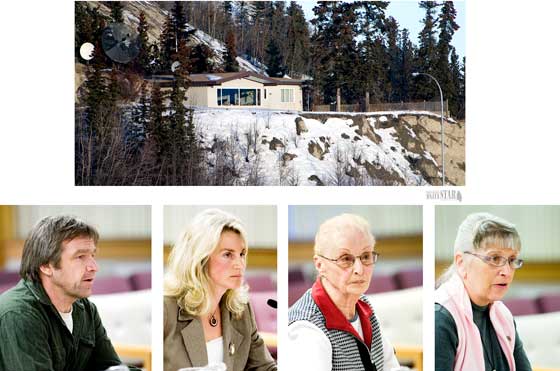
SUBJECT OF DEBATE – Edith Wienecke has applied to rezone her Drury Street property from Environmental Protection back toits residential zoning. BOTTOM: THOMAS TETZ, TAMARA GOEPPEL, CLARE STARKE and RUTH WHITNEY
Photo by Whitehorse Star
SUBJECT OF DEBATE – Edith Wienecke has applied to rezone her Drury Street property from Environmental Protection back toits residential zoning. BOTTOM: THOMAS TETZ, TAMARA GOEPPEL, CLARE STARKE and RUTH WHITNEY
There are many ways to describe the situation, but just how city council will deal with it is an unknown.
There are many ways to describe the situation, but just how city council will deal with it is an unknown.
"It's quite a unique issue,” Mayor Bev Buckway told reporters Monday evening after a council meeting which included a public hearing on the controversial rezoning of 609 Drury St.
Buckway had many descriptions for the situation, such as: "It's a big pickle” and "It's a tough one.”
As she spoke to reporters, however, she couldn't see how it might be dealt with in the coming weeks.
"I'm not sure how council is going to resolve it,” she said.
Edith Wienecke has applied to rezone her downtown property from Environmental Protection back to its residential zoning. For many former residents of the area, however, the issue goes beyond a simple rezoning.
During last night's public hearing, former residents of the area reminded council of their experience more than three decades ago, starting in 1974.
That's when the federal government and the city announced plans that would see buy-outs offered to property owners near the clay cliffs due to perceived safety issues at that time.
The first reports of those plans were delivered to residents through the media.
Whether it was expropriation or a voluntary buy-out plan, former residents who left at that time have made it clear they felt pressured to sell their homes and leave.
Last night, they told council they want fair treatment. If the rezoning at 609 Drury St., where Wienecke has lived since the 1950s, proceeds, some even want the option to buy back the land they sold.
"Unfortunately, this council (has) to deal with problems that should've been solved 30 years ago,” said Clare Starke, who lived at 605 Drury St. before being bought out by the government in the 1970s.
At that time, she was informed after all the residents were bought out and the homes bulldozed, that the area would become a space for parks and trails. That never happened, she said.
Rezoning 609 Drury St. would make it seem that council has no credibility, Starke said.
As Pat Ellis recalled, after the initial shock of learning she would lose the home she had paid for with cash in 1971, she was stuck looking for a new place in a very tight market.
"It wasn't easy at all to find another house in my price range,” she said. She made the remark after stating her own objection to the rezoning.
If it does go ahead , Ellis wants to have the opportunity to buy the title back to the lot – which is now part of the Downtown Urban Garden – at the 1975 market value.
While Ellis eventually found a home on Cook Street, Arla and Corky Repka found themselves moving up to Hillcrest, where they still live.
With their understanding that it was a three-year program that would see their property expropriated if they didn't sell to the government, the Repkas stopped the renovations they were doing on their house and moved.
Like Ellis and Starke, the Repkas said last night they would buy the property back if given the chance.
Ruth Whitney thanked the city for providing information that made it clear those like herself who moved from the area made the choice to do so. She also suggested the Wieneckes called the the city's bluff in choosing to remain all those years.
Whitney asked council if it would be fair for the Wieneckes to get market value on their property now compared to what others who left in the 1970s would get now.
After listening to the other speakers, Wienecke's daughter, Tamara Goeppel, who has been representing her mother, pointed out the issue before council is a rezoning application for one piece of property.
She also acknowledged the hurt former residents still have over feeling like they had to move.
"People were bullied to move,” Goeppel said. She recalled her own childhood experience in watching friends leave their neighbourhood, then seeing their homes bulldozed.
Had the same thing happened today,Goeppel said, things would likely have been very different.
"If we had Facebook back then, this wouldn't have happened.”
Goeppel argued the issue is about keeping the family home, not about getting market value.
If the family wanted that, they'd have negotiated with the city, she pointed out.
It was only in 2008 that she and her mother learned at a public meeting the property had moved into the protection zone ,which prevented any extensive work being done on the house, Goeppel added.
Since then, she's had a study done to show that with some landscaping work, the house is in no danger.
Coun. Florence Roberts, like the previous speakers, questioned the fairness of the rezoning, given that most residents felt they were being forced to leave.
Goeppel argued that discussions with all other owners focused on the price tag for the buy-out. There was never any correspondence with the city and owners on an agreement for those who remained, and there's nothing on the property's title about any agreement with the city, she noted.
"We just want it to be rezoned,” Goeppel said under further questioning from council.
After her presentation, family friend Thomas Tetz was quick to defend Wienecke as well, asking that the city look to the future, not the past.
"Think forward,” Tetz urged, arguing there's nothing that can be done to change what happened.
A report on the public hearing is scheduled to come forward in early April.
That will give council some time to consider the rezoning before the vote, Buckway told reporters.
Council generally votes on second and third readings of a bylaw a week after a public hearing, though members can also defer the vote.
In order to encourage thoughtful and responsible discussion, website comments will not be visible until a moderator approves them. Please add comments judiciously and refrain from maligning any individual or institution. Read about our user comment and privacy policies.
Your name and email address are required before your comment is posted. Otherwise, your comment will not be posted.
Comments (1)
Up 0 Down 0
Sue Greetham on Mar 15, 2011 at 9:14 am
regardless of mistakes made in the past regarding the property rights and privileges of the titled owners/occupants, the City has no legal or moral right to limit the onwers rights & privileges. I see no reason to consider rezoning, as the withdrawl and limitations imposed on the subject lands and their values were illegal, unconsulted and without agreed transfer of rights. Just correct the error made so that the titled owners and occupiers regain their rights; otherwise, the City will have a problem.