Food bank usage shocked anti-poverty activist
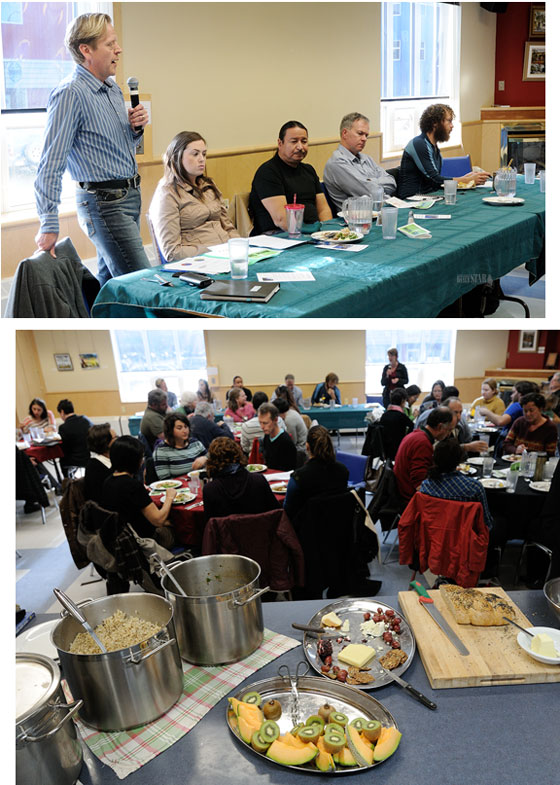
As part of Poverty and Homelessness Action Week, the Yukon Anti-Poverty Coalition hosted a luncheon and panel discussion on food security at the Francophone Centre on Tuesday.
By Ainslie Cruickshank on October 18, 2012
As part of Poverty and Homelessness Action Week, the Yukon Anti-Poverty Coalition hosted a luncheon and panel discussion on food security at the Francophone Centre on Tuesday.
On the agenda was discussion of new and ongoing programs in the territory aimed at improving access to food for the most vulnerable.
At the United Nations' World Food Summit of 1996, food security was determined to exist "when all people at all times have access to sufficient, safe, nutritious food to maintain a healthy and active life.”
Held to this standard, many in the territory are food insecure, as Stephen Dunbar-Edge, the executive director of the Whitehorse Food Bank, and the first speaker at the event, evidenced with the latest food bank usage statistics.
The number of people using the food bank is continuing to rise on an annual basis.
In its first year, 2009-2010, it served 368 clients, representing 759 people.
The following year, the food bank served 485 clients or 1,063 people.
And between 2011 and 2012, it served 528 clients or 1,176 people per month.
While most of the food bank's clients are on social assistance, Dunbar-Edge noted the second-highest contingent are the working poor – representing 14 per cent of the food bank's clients.
More coverage of the food bank's 2012 Hunger Count can be found in the Star's Oct. 4 archives online.
The second speaker, Kim Neufeld, a community dietitian with the Department of Health and Social Services, discussed a new pilot project just wrapping up.
As outlined in last Friday's Star, two schools, Grey Mountain Primary and Jack Hulland Elemantary, participated in a fund-raiser this year, selling boxes of fresh vegetables from the Yukon Grain Farm.
The boxes sold for $35 for about 20 lbs. of veggies; the profits were split 50-50 between the school and the farm.
On Tuesday, Neufeld didn't have the final numbers for Grey Mountain, as its students were continuing to sell throughout this week. Jack Hulland, however, had sold 360 boxes, raising about $6,000 for the school.
Neufeld also touched on a program which encourages farmers and gardeners to plant an extra row and donate the fresh produce to the food bank for distribution to families in need.
In 2011, the program was able to donate 200 hampers of fresh vegetables.
The third speaker at Tuesday's event was Joe Migwans, the co-ordinator of Skookum Jim's traditional parenting program.
Migwans noted the old saying, "Give a man a fish and you feed him for a day, teach a man to fish and you feed him for lifetime.”
He uses that concept in his programming, which often includes elders who share the traditional skills of hunting or gathering food.
These teachings not only keep the traditions alive, but also give parents a way to provide their children with healthy food.
"It's all about independence, helping the people become independent,” said Migwans. "The elders tell us everything to survive is out there, it's on the land, everything.
"You just need to know how to get it, how to harvest it, how to preserve it.”
Migwans noted there are workshops throughout the year including a berry camp held in September and a harvest camp in August.
Jason Watters, the former local Katimavik project leader, spoke about a new project he's involved with – the Chilkoot Food Rescue Society.
According to the group's Facebook page, their mission is "to collect excess food from local grocery stores to be distributed to students and people in need.”
Whitehorse's food rescue was inspired by a program in Yellowknife.
The goal is to save food nearing its best before date, or produce, from heading to the landfill, redirecting it instead to people in need.
"What constitutes as best before?” askd Watters.
"Is food still edible a week after, a month after, six months after, a year after? It's depending on how the food is packaged, what the food is packaged in, and if it's perishable or non-perishable.”
The Facebook page says the group is currently receiving about $1,000 worth of food donations a week from the Super A in Riverdale, but hopes to find more partners to reach $4,000 in donations a week.
The final speaker was Rob Rainer, the director of partnerships and development with Canada Without Poverty.
He expressed shock with the food bank statistics Dunbar-Edge shared at the beginning of the session, saying every politician in Ottawa should know about them.
"But part of the problem we have with these kind of issues is that data and statistics tend not to move people to action,” he said.
Rather, he suggested sharing the personal stories of people who do not have easy access to food.
What's happening in the city, he said, is "egregious” and "an affront to the right to food.”
See related coverage in Friday's Star.
Comments (3)
Up 0 Down 0
Jackie Ward on Oct 19, 2012 at 7:28 am
I grew up here. Moved away and came back. Yes, I had no choice to go on welfare. I hated it. Here's the kicker. I told them its just until I can get on my feet, which is why it's there. They couldn't kick me of it fast enough. And I'm talking about being on it for a few months, not years. Job searches every week to be handed in.
Why are some people on it what seems like their entire live's? I'm not talking about the ones who actually need it. We all know who I'm talking about here. Where is their job search forms? Entry level McJobs? Give me a break. That's why I will never donate to these bleeding heart organizations who facilitate a cycle of misery and a free rides. In the era of austerity, easy money to people who abuse the system should be the first to go. But common sense is nothing but a word in today's society. And when I see so many newer cars at the food bank it just cements my opinion. I'm sorry but anyone on SA already gets food for money. What the heck is going on?
Up 0 Down 0
Josey Wales on Oct 19, 2012 at 5:11 am
June, that post is the most sensible post I've ever read of yours...good job!
I certainly do not agree with you always, but unlike many others in this place.
I welcome opposing POV's to mine & others.
There are indeed many folks whom truly do need and cherish a leg up from a caring society as ours.
Flip side, so many others take bad advantage of others kindness.
Hunger and despair cross all cultural/social classes...and feels the same in all folks whom deal with it crappy to say the least!
ethnicity irrelevant, only politically motivated.
Up 0 Down 0
June Jackson on Oct 18, 2012 at 10:07 am
I don't want anyone to be hungry.. but I think its a fine line we're walking with easy welfare, free transportation tickets, free food and handouts beyond belief..free new coats, clothes, 500. of furniture and on and on.. There is certainly no encouragement for anyone to find a job. I'd rather top up an income for someone who is working and is in need; then let them buy their own groceries..
As I have said before I've seen people come out the back door and sell their bags of food..we want them to take that food and feed their kids and themselves, they want money for drugs and booze..no matter how much food you give some of them..their kids still don't have anything to eat.
The food bank is a good idea that I don't think works right. You want people to be independent..but you have created dependency.
On the other hand.. this IS Canada.. maybe it better to feed 20 people who abuse it to make sure that that 1 child gets fed..