Photo by Stephanie Waddell
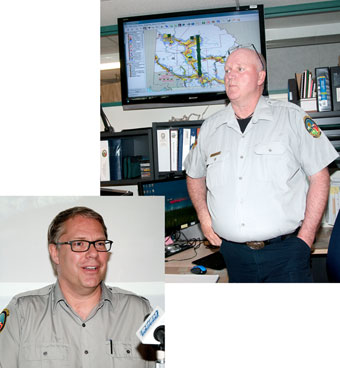
LOCALE IS THE KEY – Mike Sparks, a duty officer for Yukon Wildland Fire Management, says location is the most vital piece of information officials need when the public reports a blaze (right). Mike Etches
Photo by Stephanie Waddell
LOCALE IS THE KEY – Mike Sparks, a duty officer for Yukon Wildland Fire Management, says location is the most vital piece of information officials need when the public reports a blaze (right). Mike Etches
Yukon Wildland Fire Management officials are issuing an annual reminder that seems to need repeating in light of five human-caused blazes they've already had to extinguish this season.
Yukon Wildland Fire Management officials are issuing an annual reminder that seems to need repeating in light of five human-caused blazes they've already had to extinguish this season.
Speaking to reporters at a media briefing Thursday, fire officials said all five of the territory's fires this season, which have burned just under one hectare in total, have been human-caused and therefore preventable.
"One is too many,” said Mike Etches, director of Wildland Fire Management.
"We're always concerned about human-start fires because they tend to start close to communities.”
Typically, the Yukon doesn't experience a lot of human-caused fires. Last year, there were 21 throughout the whole season.
However, the fact that five have already started in the territory are cause for concern among officials.
They're reminding residents about the importance of properly extinguishing any campfires and using approved firepits in the city where open burning is not allowed.
It's also important for the public to report any fires they observe, Etches said, noting the role the public plays.
"Yukoners have been really good about reporting fires,” he said, though he also advised any firefighting should be left in the hands of firefighters.
The season's fire crews – totalling close to 60 firefighters throughout the territory – recently wrapped up their eight-day training sessions largely focused on leadership on the fireline. The fire crews are made up of groups of three with 10 Yukon government crews, 11 First Nation crews and one casual crew.
"We are ready now,” Etches said, noting air tankers are set to arrive in Whitehorse Saturday.
Meteorologist Mike Smith said it's expected the next three months will be slightly warmer and drier by approximately one or two degrees with occasional days of precipitation.
While 2014 does mark an El Nino year, Smith noted the impact of an El Nino is not normally seen in the territory until late summer, and generally means warmer, drier weather into the fall.
What is impossible to predict and can have a major impact on the fire season is lightning, Smith said, noting officials look at how dry it's expected to be.
In addition to getting ready for the firefighting itself, officials are also in constant use of technology.
A major part of the firefighting season is the technology used.
Inside the dispatch centre at Wildland Fire Management, spokesman George Maratos, dispatch staff and duty officer Mike Sparks staged what happens when a call comes in.
Maratos called on his acting skills to make a call as though he were a driver who had pulled over to report a wildfire he had spotted.
As he informed the dispatcher of the situation, he was asked for the location, the size, colour, whether there were any values nearby and other details of the fire.
"The location is key for us,” Sparks said when questioned about the most important piece of information needed.
Dispatchers have a script used to get the information needed.
As Sparks explained, residents reporting a wildfire are often in a state of excitement, and may struggle to know what they should be telling the dispatcher.
As Sparks explained after the demonstration, while Maratos spoke, details of the blaze were entered into the computer program which would allow the closest fire crew to ready for the attack on the blaze.
A beeping sound in the dispatch office indicated the Carmacks district acknowledged the alert.
The use of technology also allows for tracking of air tankers and can even be used to communicate directions such as a needed redirection to deal with emergencies, Sparks said.
Once a lengthy process of faxes and phone calls has been replaced with the use of computer technology, it allows things to be put into action sooner.
"It provides a huge safety element,” Sparks said.
Follow-up phone calls among officials continue to occur after incidents.
Pointing to a map shown on one of many computer screens in the room, Sparks noted the map shows other regions, enabling officials to know what's happening elsewhere.
As he noted, the Yukon has mutual aid agreement with neighbouring regions.
The territory has even gone to other parts of the continent, with some heading to the Lower 48 last summer to assist with fires there.
Wildfires can be reported to 1-888-798-FIRE.
Updates on Yukon wildfires are available at 1-800-826-4750.
See forecast for Alaska's fire season.
In order to encourage thoughtful and responsible discussion, website comments will not be visible until a moderator approves them. Please add comments judiciously and refrain from maligning any individual or institution. Read about our user comment and privacy policies.
Your name and email address are required before your comment is posted. Otherwise, your comment will not be posted.
Be the first to comment