Fish, game association ‘very disappointed’ by suit
The legal challenge by the Ross River Dena Council over hunting in the Ross River area is not sitting well with the Yukon Fish and Game Association.
By Chuck Tobin on August 6, 2014
The legal challenge by the Ross River Dena Council over hunting in the Ross River area is not sitting well with the Yukon Fish and Game Association.
“Very disappointed, very disappointed,” Gord Zealand, the association’s executive director, said in an interview this morning.
Zealand said the association anticipated there might be certain issues for the Yukon rising out of the June 26 decision by the Supreme Court of Canada regarding the aboriginal rights and title for the Tsilhqot’in Nation in B.C.
The association doesn’t know if it’s the same issue, and it is up to the First Nation whether it wants to launch a legal action, he said.
But at the same time, Zealand added, the association feels there is an acceptable and proven process for managing wildlife under the Umbrella Final Agreement that includes participation by all First Nations, even those without land claim settlements.
“Wildlife and fish are not static,” he said.
“They move and they change, and you need a large group to look after the issues that are going to rise through the Yukon.”
Zealand said it’s important to have a body such as the Yukon Fish and Wildlife Management Board that addresses wildlife management as a whole, and isn’t focused nor swayed by issues of particular interest groups.
“In our view, we thought the process was working and doing OK.”
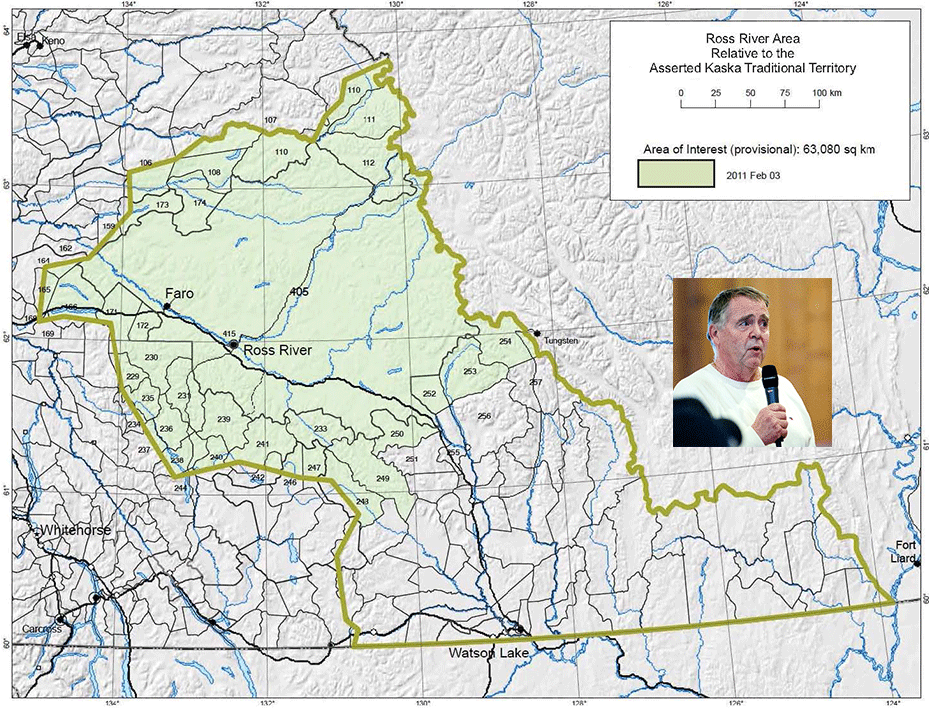
The Ross River Dena Council, one of three Yukon First Nations without a modern day land claim treaty, filed a lawsuit last Thursday in the Yukon Supreme Court.
It’s arguing it is unlawful for the Yukon government to issue big game hunting licences to hunt in the Ross River area without first consulting the First Nation.
Hunting pressure by non-members of the Dena council could impact on the ability of Kaska hunters to exercise their aboriginal rights to harvest big game, and therefore consultation is required, the First Nation argues.
Environment Minister Currie Dixon came out swinging Tuesday, vowing the government will do whatever it can to protect the rights of Yukon hunters.
He also said it’s bothersome that the First Nation would file the court action the day before hunting season began, and suggested the timing is meant to create uncertainty in the minds of hunters.
Dixon said he wanted to assure hunters the legal action will have no impact whatsoever on this season.
Whitehorse lawyer Stephen Walsh, who is representing Ross River, said this morning Ross River Chief Brian Ladue is on holidays, and he’s not in a position to respond to comments by Zealand or Dixon.
But, as he explained in an interview Tuesday regarding the lawsuit, the legal action arises out the long-standing concerns by the First Nation regarding increasing hunting pressure by hunters from Whitehorse and elsewhere in the Yukon.
Walsh said aboriginal rights and title include the right to harvest game, and the Supreme Court of Canada has clearly stated if there are issues with the potential to impact those rights, governments must consult with the affected First Nations.
That’s been the law of the land since the highest court decided the Haida and Taku River Tlingit cases in 2004. The message has been repeated by the court in aboriginal cases ever since, including the decision on the Tsilhqot’in case in June.
Walsh said he did, however, want to respond briefly to comments he heard from the Environment minister suggesting Ross River is trying to control who hunts in the Ross River area.
“Our point is not who may and who may not; out point is how many and where,” Walsh said.
The Ross River Dena Council was successful in its lawsuit against the Yukon government for allowing mineral claims to be staked in the Ross River area without consulting the First Nation.
The December 2012 decision by the Court of Appeal has resulted in the withdrawal of staking claims in the area until the First Nation and Yukon government can negotiate a satisfactory arrangement. The Court of Appeal decision has also prompted sweeping changes to Yukon’s mining legislation and regulations.
In the case involving staking claims, the Yukon Chamber of Mines sought and received permission from the court to be heard.
The executive director of the Yukon Fish and Game Association said if the same opportunity is available to the association, it will pursue it.
The courts, however, are not where Zealand wants to be.
He said sometimes when you start going through the courts, nobody knows where everybody is going to end up.
If there are concerns relating to wildlife management, Zealand suggested, it’s better to identify them and bring them forward for discussion and resolution.
“We respect the (wildlife management) board has to do certain things in certain areas to deal with problems and if it deals with conservation we will be the first ones to step forward and support whatever action may have to be taken.”
Zealand said of course there is hunting pressure from Whitehorse in the Ross River area, because 85 per cent of the Yukon population lives in Whitehorse.
Hunters also bring economic benefits to rural communities, he pointed out.
The wildlife management board is a provision under the Umbrella Final Agreement, the blueprint for modern day treaties signed by 11 of the Yukon’s 14 First Nations.
The 12-member board – six appointees by Yukon First Nations and six by the territorial government – is responsible for forwarding all wildlife management recommendations to the Environment minister for consideration.
It receives input from the general public, Environment Yukon and the local renewable resource councils – smaller management boards – established in all regions of the Yukon, including Ross River.
See editorial, See minister’s statement in opinion section.
Comments (4)
Up 14 Down 18
Max Mack on Aug 7, 2014 at 5:52 am
In the world according to that "progressively"-minded Veale, First Nations will hold the keys to every activity and decision in and about the Yukon. Good for First Nations. Good for Ron. Not so good for everyone else.
Up 37 Down 7
m on Aug 6, 2014 at 7:02 pm
I also know for a fact that RR members take cows, including pregnant cows. They are very glib and matter of fact about it as well. Just ask them. Maybe they better take a good long hard look at themselves before saying Whitehorse is the problem.
Up 66 Down 15
Truth Hunter on Aug 6, 2014 at 4:11 pm
"Walsh said aboriginal rights and title include the right to harvest game" Well no one is saying the RRDC citizens can't harvest game.... go ahead and harvest. If shooting cows off the side of the road or river year round is getting difficult, I'm sorry but what's the old saying, point a finger at someone else, there's three pointing back at you?
Here's a blow your mind idea... have the same rules and restrictions for all Yukoners.. FN or not, and you would see a drastic increase in wildlife population.
I hunt smack in the middle of RRDC territory every year, slightly off the beaten path. I have ONCE...I repeat ONCE bumped into an RRDC citizen.... Good guy, nice guy, shared some coffee; however I can think of 4 examples of seeing RRDC members cutting up moose cows shot along the Campbell Highway without so much as a wave when I drive by. These are not "stereotypes" these are facts.
Same rules for all, and the wildlife benefits... separate rules and the wildlife lose. So what are you really fighting for?
Up 20 Down 38
Spruce Woodland on Aug 6, 2014 at 3:51 pm
Instead of being so disappointed Mr. Zealand, why not simply call the Ross River Dena Council, one of three Yukon First Nations without a modern day land claim treaty, and ask a staff member why they chose to file a legal action.