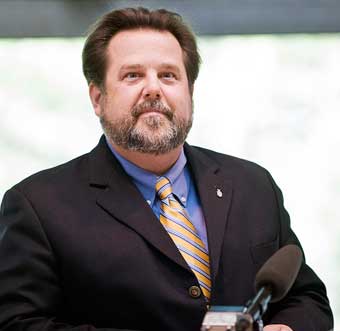
Photo by Whitehorse Star
PATRICK ROUBLE
Photo by Whitehorse Star
PATRICK ROUBLE
There's significant disagreement about the future of the Peel watershed, according to written submissions from the five governments party to the land use planning process.
There's significant disagreement about the future of the Peel watershed, according to written submissions from the five governments party to the land use planning process.
The four affected First Nation governments do not want to see any industrial development inside the watershed, according to a joint press release issued this morning.
The Yukon government, on the other hand, maintains the land use plan needs to provide for a mix of wilderness protection and resource development, along with road access.
On Monday, all five governments delivered their final, individual responses to the land use plan recommended by the six-member planning commission in December 2009.
Today's release by the chiefs of the four First Nations indicates they want to maintain the wilderness values throughout the entire 68,042 square kilometres.
"In the main, you got it right,” stated the First Nation leaders in a joint letter to the commission, in obvious reference to the recommended plan which was heavily weighed with pro-conservation measures.
"Though generally excellent, we believe your recommendation could be improved in a few areas,” reads the letter.
"We believe the entire region deserves the very highest level of protection. In our view, none of the land within the watershed should be open to industrial development.”
The letter was signed by Chief Eddie Taylor of the Tr'ondek Hwech'in First of Dawson City, Chief Simon Mervyn of Mayo's First Nation of Na-cho Nyak Dun, Chief Norma Kassi of Old Crow's Vuntut Gwitchin First Nation and Richard Nerysoo, president of the Gwich'in Tribal Council of Fort McPherson.
Energy, Mines and Resources Minister Pat Rouble also delivered a four-page cover letter to the commission Monday, in addition to the government's 16-page technical response to the plan recommended by the commission.
"We believe that there is an ability to accommodate mixed uses that meet society's need, while erring on the side of caution on the basis of a determined level of risk,” Rouble wrote.
"... We request that the commission re-examine the location, nature and potential extent of current and future conflicts between the values of conservation, non-consumptive resource and resource development.”
The individual responses and the two cover letters were delivered following a joint response by all five governments delivered last Friday.
The joint response asks the commission to rewrite the recommended plan while preparing the final recommendation, so that it's easier to understand and implement.
It also asks the commission to have its final recommendation complete by early July.
The planning commission is scheduled to meet next week for the first time in 14 months.
The development of regional land use plans for the entire Yukon is provided for in the aboriginal land claim agreements. The Peel planning exercise is the second to go forward, following the completion of a North Yukon Land Use Plan in June 2009.
While the Peel planning initiative began several years ago, it wasn't until January 2009 that the commission delivered three land use options for public review.
There's been a passionate debate over the future of the watershed ever since, with the pro-development camp lining up against the pro-wilderness conservation lobby.
When the commission delivered the recommended plan 14 months ago, it was mostly applauded by supporters of maximum wilderness protection, including the First Nations.
Industry, however, condemned it as a death knell for exploration and mining inside the Peel.
In addition to recommending outright protection with no road access to 80 per cent of the planning region, the commission recommended road access to a further 17 per cent be permitted in the winter only.
When the recommended plan was delivered, members of the commission explained that with overwhelming public support for wilderness protection, it was felt at this point it is better to side with conservation.
Development, it indicated, may go ahead in the future when more advanced technology is available to ensure minimal environmental minimal impact.
In asking the commission to re-evalute its pro-conservation approach, Rouble wrote in his cover letter: "The Yukon government recognizes that managing surface access (winter and all-season roads) can be a challenge but not impossible.
"We believe a ban on surface access is not a workable scenario in a region with existing land interests and future development potential.”
The four chiefs, however, have asked the Peel planning commission to consider expanding wilderness protection from 80 per cent of the region to a full 100 per cent, as it deliberates on its final recommendation.
In a schedule agreed to by the five governments last month, once the planning commission provides its final recommendation no later than early July, the parties have agreed to make their decision no later than the second half of October.
In order to encourage thoughtful and responsible discussion, website comments will not be visible until a moderator approves them. Please add comments judiciously and refrain from maligning any individual or institution. Read about our user comment and privacy policies.
Your name and email address are required before your comment is posted. Otherwise, your comment will not be posted.
Comments (2)
Up 0 Down 0
NYukoner on Feb 22, 2011 at 1:16 pm
Protect the Peel!!!
Up 0 Down 0
bedrock billy on Feb 22, 2011 at 9:27 am
I noticed the Star didn't print my comment on yesterday's story on the Peel Watershed issue. I guess it just didn't agree with the Star's leftist liberal ideology and had it censored. Typical.