Photo by Whitehorse Star
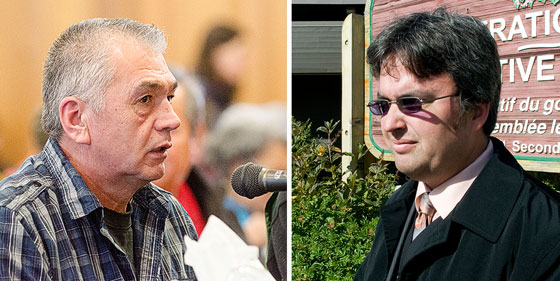
Carl Sidney and Liard McMillan
Photo by Whitehorse Star
Carl Sidney and Liard McMillan
Three Yukon First Nations have refused to give in to an ultimatum laid out by the territorial government last week.
Three Yukon First Nations have refused to give in to an ultimatum laid out by the territorial government last week.
The government threatened to rescind a new resource revenue-sharing deal if all 11 self-governing First Nations hadn't signed on by 10 a.m. Monday.
In an email sent last Wednesday, First Nations were told that if all 11 signed agreements were not received by the deadline, YTG would conclude that the agreement had been rejected. It would then consider the file closed.
The email, obtained by the official NDP Opposition, said there would "be no extension of this deadline, no further discussions and no conditional acceptance of the offer.”
Teslin Tlingit Council Chief Carl Sidney chose not to sign onto the agreement, which did not offer any revenue-sharing opportunities for unsettled First Nations.
Sidney noted Monday afternoon that he has only been chief since July 2012, and the discussions surrounding the new resource revenue deal were well underway by that time.
After consulting with his leadership, the council decided not to accept the deal based on the government's exclusion of the Yukon's three unsettled First Nations.
"We disagreed with that; we said, ‘that's not fair. Why should they be excluded?'” Sidney told the Star.
The Carcross/Tagish First Nations and the Ta'an Kwach'an Council also refused to sign the agreement, according to Sidney.
"The unity of the First Nations is more important than a couple dollars. We're not going to be getting any resource royalties anyway for 10 or 12 years, so what's the big rush?” the Teslin chief asked.
"Over in the Northwest Territories, they have a resource royalty-sharing agreement that is 25 per cent of the resource royalty and non-self-governing First Nations over there also have a part in it.
"But it's different over here in Yukon. So why's it different? It should be the same right across the board. That's how we feel.”
The new agreement would have provided the 11 self-governing First Nations with an additional 12 per cent share of resource royalty revenue once the Yukon began to generate sufficient revenue to warrant transitioning to a 50-50 split with Canada.
That option is included in the Yukon government's new revenue-sharing agreement with the federal government, Ross Burnett, a senior policy analyst with the land claims and implementation secretariat, explained in an email.
The new agreement could have seen Yukon First Nations share an additional $4.7 million in resource royalty revenue.
The new federal-territorial agreement, reached in August 2012, raised the Yukon's revenue cap from $3 million for minerals, forestry, water and land revenue and $3 million for oil and gas revenue to $6 million for all natural resource revenue.
As revenue from oil and gas is low compared to revenue from mineral mining, this new arrangement means revenue from mineral extraction exceeding the former $3-million cap will remain in the territory.
The new pact between Canada and the Yukon came with an option to adjust the revenue-sharing formula to a 50-50 split between the governments in the future.
Until the Yukon's resource revenues exceed $12 million annually, the territory benefits more from the $6-million cap than the 50 per cent option.
The additional 12 per cent share for Yukon First Nations would have only come into effect when and if the government opts to transition the 50-50 split.
The NDP raised the issue of the revenue sharing deal during question period Monday.
"My question is simple: Can the premier confirm that the ultimatum contained in the email last week holds and that the revenue-sharing agreement is no longer on the table?” party leader Liz Hanson asked.
Premier Darrell Pasloski did not indicate a hardline where the new deal is concerned in his response.
He explained a tentative agreement was reached last May which exceeded the government's obligations as laid out in the Umbrella Final Agreement.
"With this new agreement, we thought it was important for us, as partners in the economy, that we also share in this enhanced royalty capability.
"I know the First Nations are continuing to ensure that they have worked out an amenable agreement among themselves, and I'm sure we will continue to get an update on this. I look forward to signing that agreement one day soon,” he said.
On Monday, the Kaska Nations released a statement supporting Chief Sidney and his Carcross/Tagish and Ta'an Kwach'an counterparts.
"Precedence has been set in places like (the Northwest Territories). There is no requirement for non-settled First Nations to have a final agreement in order to enjoy the royalty benefits, and again we're seeing that in places like British Columbia,” Liard First Nation Chief Liard McMillan told the Star this morning.
"The Talhtan Nation, they don't have a final agreement and yet they're able to negotiate a royalty deal from the province of British Columbia. So what's wrong with following those examples from other jurisdictions?” he queried.
"The only reason why the premier and his government has chosen not to do that is this government's motivated by greed.
"We know that the majority of oil and gas royalties over the past couple decades has come as a direct result of oil and gas development within the southeast Yukon and Kaska traditional territory,” he continued.
"The Kaska have gotten next to zero in terms of benefits from that.”
The government's ultimatum is simply contributing to an already deteriorating relationship between itself and First Nations, McMillan argued.
"I think it's going to take a long time to repair that damage, and it's going to take a major attitude shift by this government in order for any progress to be made,” he said.
"The premier's to blame for this scenario, and who's going to hurt for it at the end of the day? Ultimately, it's going to be the resource industry and the economy that's going to suffer as a result of this.”
Ruth Massie, the Council of Yukon First Nations' grand chief, could not be reached for comment by deadline this afternoon.
In order to encourage thoughtful and responsible discussion, website comments will not be visible until a moderator approves them. Please add comments judiciously and refrain from maligning any individual or institution. Read about our user comment and privacy policies.
Your name and email address are required before your comment is posted. Otherwise, your comment will not be posted.
Comments (6)
Up 0 Down 0
not impressed on Mar 27, 2013 at 11:20 am
Yep, the Yukon Party is selling out the Yukon for a pittance, the money comes from the feds at $30000/yukoner, not the imported workers who have the higher paying jobs at the mines and spend very little here because they go "home" on their weeks off.
Up 0 Down 0
Jackie Ward on Mar 27, 2013 at 8:55 am
@bobby @community
When you say "we" and "us" are you referring to the fact you are First Nations? If that's the case don't mind me over here shaking my head. Being born a certain race is not an accomplishment nor a skill. And if I took your comment the wrong way then I apologize. But even if you didn't mean what I was implying, a lot of natives do view themselves as "we" and "them". All that does is divide us further. But I'm glad someone lucked out and was born native. I could only wish for all the free education and affirmative action policies that are given to First Nations. I guess being born white is a disadvantage in today's society.
Up 0 Down 0
Arn Anderson on Mar 27, 2013 at 8:19 am
We need Pasloski TV, most of these politicans love telling us what to do and how to do it. Well lets hook up 24 hour surveillance on him, record everything said, done, heard, the whole 9 yards, compile all the good stuff and go prime-time with it, NOW thats entertainment of high quality.
Up 1 Down 0
Not In The Community on Mar 27, 2013 at 8:02 am
What part of, "We are not going to go away!" doesn't the government understand? More and more of us are going post secondary. With education comes more options ect...
Stop trying to hold all Yukoners hostage for industry.
I know all three chiefs and they have my respect.
Up 0 Down 0
Nothing is nothing on Mar 27, 2013 at 12:13 am
Hey! Her Harper was here not long ago telling Yukoners they will keep more of the resources royalties.
And my say was "a little more of nothing still amounts to nothing"
Up 0 Down 0
bobby bitman on Mar 26, 2013 at 7:59 am
Am I reading this correctly that we are not even getting anywhere near $6 million in royalties from the mining industry? And Pasloski said a few days ago that $450 million dollars worth of 'mining production' was extracted from the Yukon last year.
Exactly how much of that was returned to the Yukon in royalties? It appears that we have not even hit our former 'cap' of $3 million. The percent that went to the Yukon thereforer is less than 0.6% in royalties.
For this the Yukon Party is pandering to the mining industry in the Peel?! For 0.6% of the value of the minerals being extracted?
All this talk of big dollars being generated by mining in the Yukon, but where is the wealth flowing to? The Yukon is not being paid anywhere near what we should be for these companies that are hauling away the family jewels.