Photo by Vince Fedoroff
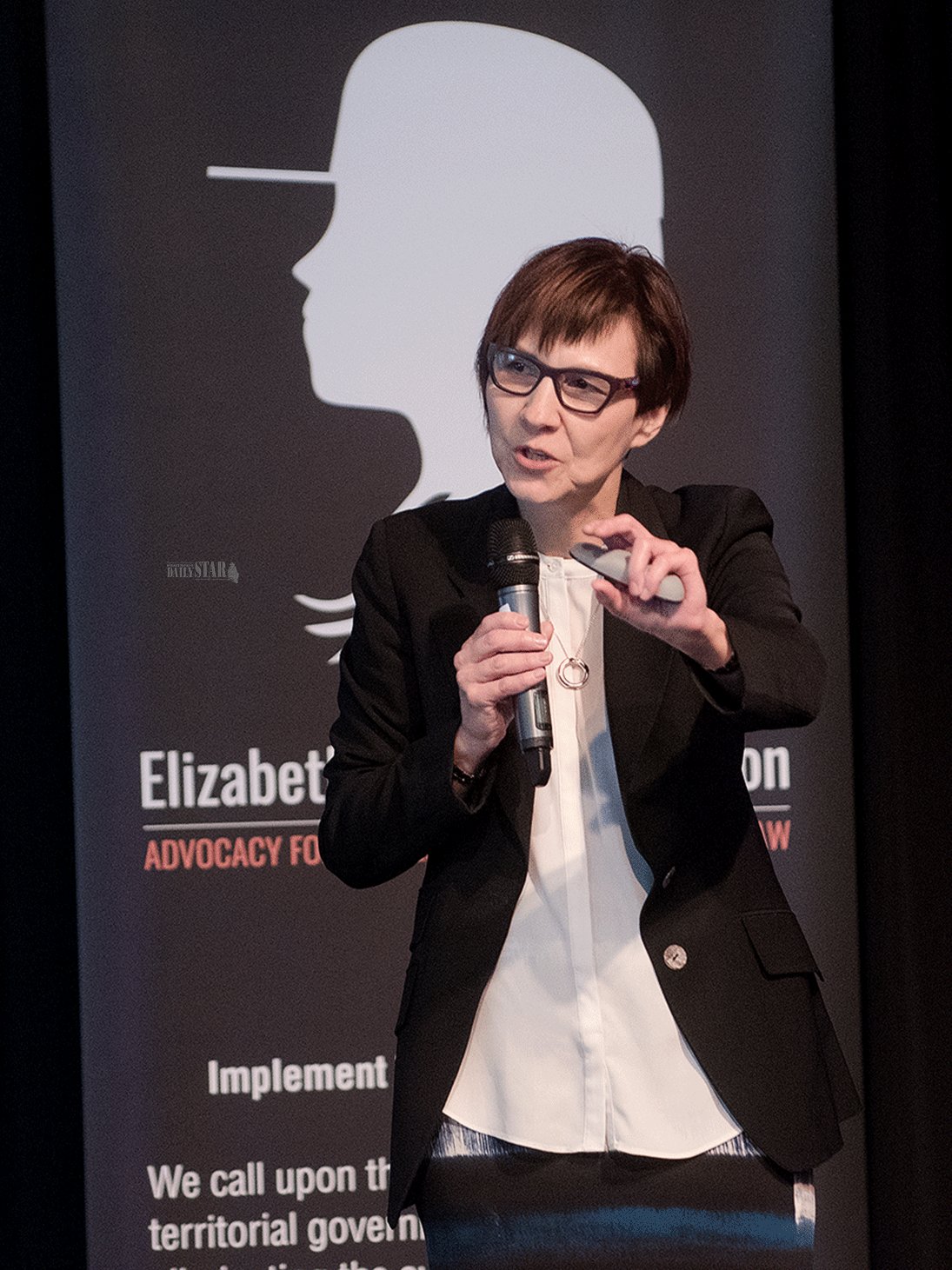
KEYNOTE SPEAKER – Cindy Blackstock, the executive director of the First Nations Child and Family Caring Society of Canada, speaks Monday in Whitehorse.
Photo by Vince Fedoroff
KEYNOTE SPEAKER – Cindy Blackstock, the executive director of the First Nations Child and Family Caring Society of Canada, speaks Monday in Whitehorse.
The Re-Visioning Justice in the Yukon conference kicked off Monday with a keynote address from Dr. Cindy Blackstock.
The Re-Visioning Justice in the Yukon conference kicked off Monday with a keynote address from Dr. Cindy Blackstock.
Blackstock, executive director of the First Nations Child and Family Caring Society of Canada, spoke about Canada’s legacy of discrimination against First Nation’s children.
“Since Confederation, the federal government has consciously, and I want to underscore this, consciously provided less funding to First Nation’s children because they’re First Nations. And that has not stopped,” Blackstock said in her address.
Blackstock helped launch the 2007 human rights complaint alleging that the federal government discriminates against 163,000 First Nations children on the grounds of race and national and ethnic origin.
In a landmark decision on Jan. 26, 2016 the Canadian Human Rights Tribunal agreed and found that the government was failing to provide the same level of child welfare services for First Nations children.
The Tribunal has since issued three non-compliance orders to the federal government.
“Our kids experience cross-cutting and very deep inequalities and they’re judged by a Canadian public that doesn’t know any better as if we get more,” Blackstock said.
In an interview with the Star, she noted that the funding formula INAC uses for the Yukon provides the least amount of federal funding for First Nations child welfare.
“There shouldn’t be a higher burden and a whole pile of weights put on First Nation’s families that no one else experiences,” she said.
Blackstock noted that for every dollar government spends on a child it saves $20 in the long run.
She also stressed the need to target factors that drive children into the child welfare system including housing, poverty, education and substance misuse.
“We see a lot of strengths in the Yukon even among First Nation’s youth who are in care and they have a lot of ideas about how things could be made better. People just need to talk to them,” she said.
In her keynote, Blackstock noted that Canada 150 is a good time for the government and Canadians to ask what they’ve learned from their relationship with First Nation’s children and what they are doing differently.
“If I was prime minister, I would only do one thing, there would only be one campaign promise and that would be to reduce the inequalities in our own country,” she said.
She noted reducing inequality leads to a reduction in criminal justice rates, child welfare rates, teen pregnancy, and substance misuse.
As well as an increase in education outcomes, trust in the communities, and the well being and mental health of all people.
But she noted there have been many reports and recommendations on the issue over the years that have not been implemented by the Canadian government.
Blackstock said this dates back to a 1904 survey by Dr. Peter Henderson Bryce, medical officer for Indian Affairs, on the health of First Nation’s children in residential schools.
There were “horrendous findings”, Blackstock said, including disproportionate mortality rates, and the city of Ottawa was getting three times the funding for TB prevention and treatment of all First Nations people across Canada.
But while Bryce found it would cost only $10,000 to $15,000 to prevent the disproportionate deaths of residential school children across Canada, the federal government would not commit the funding.
“Child welfare is not in the mess it is today because we don’t know the answers. Child welfare is in the mess it is today because we’ve never implemented the many recommendations that have been on the books for decades and for centuries,” said Blackstock.
She also spoke about the Jordan’s Principle, a child-first principle intended to resolve disputes within and between governments over who should pay for services for First Nations Children.
It was named in memory of Jordan River Anderson, a child from Norway House Cree Nation with Carey Fineman Ziter Syndrome, a rare muscular disorder.
Jordan spent more than two years unnecessarily in a Winnipeg hospital while the federal and provincial governments argued over who should pay for his home care. Jordan died in hospital in 2005 at the age of five.
Blackstock detailed a number of cases since the principle was enacted where First Nations children have not received timely care because of their status.
One example she gave was a mother who was forced to rewash catheter tubes due to Health Canada policy that only allowed for a fixed number.
Having to rewash tubes caused her daughter to get urinary tract infections that resulted in kidney scarring.
“That’s not atypical of the way our child welfare system works,” said Blackstock.
“Sometimes these rules become just guidelines and we forget about the person on the other end of it.”
On Jan. 26, 2016, the Canadian Human Rights Tribunal ordered the federal government to stop applying a “limited and discriminatory” definition of the principle. The tribunal has since issued three non-compliance orders.
Details and updates on the tribunal decisions can be found on fnwitness.ca.
The case is documented in Alanis Obosawmin’s 2016 documentary We Can’t Make the Same Mistake Twice. The film was screened Sunday night at the Kwanlin Dun Cultural Centre (KDCC).
Blackstock encourages people to get a hold of their member of parliament and demand that Canada comply with the legal orders.
And she said if anyone knows of a First Nations child who has been denied a government service they should report it immediately to their Indian Affairs office. If the office doesn’t respond within 48 hours, she said, the person should contact the Caring Society.
“Equality in this country needs to come in a leap, not in a shuffle, and we the people of the period need to demand that that happens,” she said.
“Governments don’t create change they respond to change.”
Re-Visioning Justice in the Yukon is presented by the Yukon’s Elizabeth Fry Society, Kwanlin Dün First Nation, Council of Yukon First Nations, and the Yukon Human Rights Commission.
A number of speakers addressed child welfare and reconciliation yesterday, and the conference continued today at the KDCC.
On Wednesday, the centre will play host to Preventing and Managing Opioid Addiction/Misuse Through Innovative Models of Care.
In order to encourage thoughtful and responsible discussion, website comments will not be visible until a moderator approves them. Please add comments judiciously and refrain from maligning any individual or institution. Read about our user comment and privacy policies.
Your name and email address are required before your comment is posted. Otherwise, your comment will not be posted.
Comments (5)
Up 4 Down 29
Joe et jean on Jun 1, 2017 at 9:44 pm
@ Pierre, Yukon people get a billion dollar handout per year from Canadian taxpayers. The Canadian taxpayer base is comprised of over 25% francophones, which means Yukon people get about $250 million dollars per year from francophone taxpayers....not sure if you don't understand the Canadian constitution or if you have trouble with math, either way its a very narrow view. Oh and inferring a religious reference as a curse is sacrilegious and disrespectful.
Up 39 Down 6
Pierre on May 31, 2017 at 8:26 pm
Maybe the 14 million they just gave the Yukon to enhance French language services could be used to help ALL kids, what a tabernacle joke!
Up 59 Down 13
The Reality Is Different on May 31, 2017 at 7:00 pm
FN people get more benefits, funding and breaks than any other residents of this territory, all they have to do is take what is offered. Case in point is my FN friend who failed university entrance exams down south but was admitted anyways and obtained a fully funded degree at zero cost to himself specifically because of his FN ancestry. I mean who can argue with a break like that being given to you, non FN people could only dream of being given an opportunity like that!
Up 14 Down 61
Adax Ayamdagoot on May 31, 2017 at 2:11 pm
Colonization, racism, oppression continues since the implementation of the Indian Act of 1876 - This act made us "wards of the state", the Crown took away everything we knew who we were as a people (governance, culture, ceremonies, language, way of life, land/resources etc). As First Nations become self-reliant, we are still hindered with by the political systems, the legal systems and educational systems.
Canada's native population is 4% of the over all population, yet we are still over presented in jails, child welfare, illness (physical, emotional & mental), poverty, homelessness, lack of adequate housing, water and resources for health/healing. Numerous resources (money/people) have expended in order to study the needs of the First Nations (Royal Commission, Truth and Reconciliation and Murdered & Missing Indigenous Women & Girls) with little reaching the grass roots people (north, remote & rural).
When is the government going to spend some real money on the inequalities of programs/services. Aboriginal people of Canada have said time and time enough is enough - we are human beings not stock animals. TRC, Idle No More & Murdered & Missing Indigenous Women & Girls is our voice against the continued colonization, racism and oppression of our people.
Up 48 Down 11
Anonymous on May 30, 2017 at 8:49 pm
I honestly feel all people are equal. It should not be a more than or less than system according to who you think has more value or what you think someone did 100 years ago. All people, no matter what race have good people and bad people.