Photo by Whitehorse Star
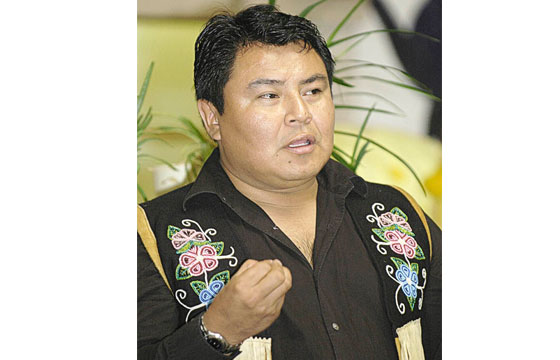
BIDING THEIR TIME – ‘We are not going to make any decision until we absolutely have to,' Joe Linklater, chief of the Vuntut Gwitchin First Nation, says of the controversy over the future of the Peel River watershed.
Photo by Whitehorse Star
BIDING THEIR TIME – ‘We are not going to make any decision until we absolutely have to,' Joe Linklater, chief of the Vuntut Gwitchin First Nation, says of the controversy over the future of the Peel River watershed.
The Vuntut Gwitchin First Nation is intentionally maintaining a low profile in the debate over the Peel River watershed, says Chief Joe Linklater.
The Vuntut Gwitchin First Nation is intentionally maintaining a low profile in the debate over the Peel River watershed, says Chief Joe Linklater.
Since the Vuntut Gwitchin has a relatively small piece of traditional territory inside the planning region, Linklater said, it hasn't come out with a firm position, unlike the three First Nation governments which have larger interests.
But the Vuntut Gwitchin do want to make sure the proper process is followed, and that whatever is decided fits with the provisions of the Umbrella Final Agreement, Linklater said in a recent interview.
"It is a difficult position for us to be in,” Linklater said. "People look to us and say, ‘what is your position?'
"We really do not want to go against anybody so we are looking to the UFA as our guiding light.”
The Umbrella Final Agreement sets out the guidelines for settling aboriginal land claim settlements in the Yukon, which include the goals and principles of regional land use planning throughout the territory.
The three other First Nation governments affected by the Peel planning exercise have called for maximum wilderness protection of the 68,042 square kilometres.
Vast protection with some provision for continued mineral exploration and other industrial development was recommended by the Peel Watershed Planning Commission in December 2009.
The Yukon government announced shortly before Christmas it could not accept the commission's recommendation.
It also indicated, however, that it would continue to work with the First Nations to see if the parties can agree by the end of February on a joint response to the commission's recommendation.
There is no obligation to provide a joint response if one cannot be agreed to.
If consensus cannot be reached, the Yukon government will ultimately have much of the final say on land use throughout the watershed as 97 per cent of the area is territorial Crown land.
While the entire planning area is covered by the traditional territories of the four First Nations, less than three per cent is titled settlement land.
Of the four First Nations, the Vuntut Gwitchin has the least amount of traditional territory in the watershed.
Mayo's First Nation of Na-cho Nyak Dun has the most, followed by the Tr'ondek Hwech'in Han Nation of Dawson City and the Gwichin Tribal Council of Fort McPherson.
The Vuntut Gwitchin will the follow the lead of the other four parties to the process in trying to reach common ground, Linklater said.
He said he believes a key issue in the debate will revolve around what is meant by sustainable development inside the watershed.
Guidance from the committee of senior officials representing the five governments along with a technical working group will be essential as the parties try to reach agreement, said Linklater.
"That is what they are there for,” he said. "But at the end of the day, it will be a political decision, and it will be a complicated one.
"We are not going to make any decision until we absolutely have to.”
The chief of 12 years said with so many different interests in the Peel watershed, it's important to have a land use plan for the region.
While the land use plan recommended by the commission was applauded by the pro-conservation sector, it was condemned by the mining community.
Even with some provision for continued industrial activity in 20 per cent of the watershed, the commission might as well have shut down the entire region to development, given the tight access restrictions also recommended, the industry indicated.
Linklater will leave office next week after not seeking re-election in November. Former NDP MLA Norma Kassi is his successor.
In order to encourage thoughtful and responsible discussion, website comments will not be visible until a moderator approves them. Please add comments judiciously and refrain from maligning any individual or institution. Read about our user comment and privacy policies.
Your name and email address are required before your comment is posted. Otherwise, your comment will not be posted.
Be the first to comment