Photo by Whitehorse Star
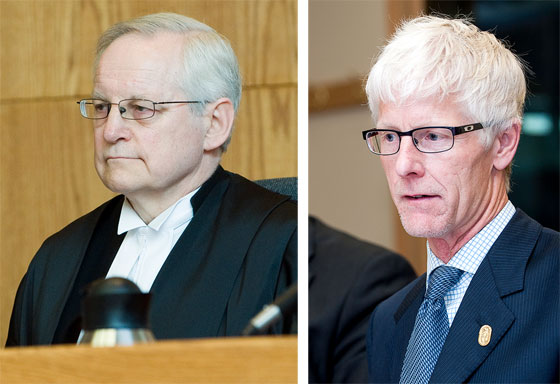
Ron Veale and Tom Ullyett
Photo by Whitehorse Star
Ron Veale and Tom Ullyett
A Yukon Supreme Court judge has thrown out a Yukon government decision approving a mining project south of Beaver Creek.
A Yukon Supreme Court judge has thrown out a Yukon government decision approving a mining project south of Beaver Creek.
The judge has also ordered the government to have more "deep and meaningful” consultation with the White River First Nation (WRFN).
On March 19, 2012, Tarsis Resources Ltd., a Vancouver-based, early-stage exploration company, applied for a five-year Class III Mining Land Use Approval permit for its White River Quartz Exploration Project.
Six months later, the government's director of mineral resources approved the project.
In making his decision, the director disagreed with a recommendation by the Yukon Environmental and Socio-economic Assessment Board (YESAB).
The board had recommended the project not be allowed to proceed because it would have significant adverse effects both on wildlife and wildlife habitat.
Concerns specifically surrounded the Chisana caribou herd and the WRFN's traditional land use and culture.
In his decision, Justice Ron Veale rules that the director "breached his duty to consult and accommodate the White River First Nation by failing to provide a meaningful process to provide feedback on the government's basis for rejecting the recommendation that the White River project not proceed.”
The judge ruled consultation after a recommendation is rejected "must be deep and meaningful. While the First Nation has no power to require the evaluation report to be accepted, it should have an opportunity to address the government's basis for rejecting it.”
The government argued it had done enough to consult with the First Nation, including by routinely reviewing concerns online and through a meeting on Aug. 12, 2012 — weeks before the decision was made.
Veale disagreed.
"I disagree with the characterization of the discussion with the White River First Nation on August 21 as "far-reaching”. Unlike the Liard First Nation consultation, where conflicting substantive views on the need for baseline data were exchanged and considered by acknowledged experts on each side, the decision body in the case at bar did not reveal any basis at the consultation meeting on which it might reject the recommendation.
"The basis of its rejection of the evaluation report was disclosed on August 29, 2012, after the consultation meeting and only days before its September 5 decision document rejecting the recommendation of the evaluation report.
"In my view, the process amounted to "tell us what you think of the evaluation report but we will not give you any idea where we have problems with it.”
Veale made it clear very early on in his 49-page ruling that it was not up to the court to decide the merits of the director's decision – only to discuss whether the First Nation had been properly included.
He has ordered both sides back to the consultation process, as outlined by the law. After "deep consultation” regarding the director's stance, he can issue his decision again, Veale said.
Tom Ullyett, with Yukon's Department of Justice, said Tuesday the courts play an important role in helping to clarify the laws surrounding consultation.
"The area of aboriginal consultation is an evolving one, and a complex one,” he said.
"Of course, when you go to court, you know that a decision can go one way or the other.
"Obviously, the government was hoping for a different result, but that was not to be the case here.”
Ullyett said the department is still reviewing the decision and has not decided if it will appeal.
In statements Tuesday, the WRFN was critical of the government's handling of the situation and the YESAB process.
"WRFN asks the fundamental question: If YTG at the political level and EMR are going to demonstrate so little faith in their own YESAA (Yukon Environmental and Socio-economic Assessment Act) process that they would overturn their recommendation, why should First Nation governments and industry invest their time and money participating in YESAA?
"It makes a sham of the regulatory regime in the Yukon Territory.”
Veale acknowledged that White River has a claim to its traditional territory even without an official land claim agreement.
"The Yukon government is well aware of the claim of the White River First Nation to its traditional territory,” he said.
"The Council of Yukon First Nations entered into the Umbrella Final Agreement on behalf of White River First Nation, among others, to negotiate a final agreement. Canada, Yukon and White River First Nation negotiated for many years, and although no final agreement was reached, it is disingenuous to suggest that the First Nation has a weak claim. It is a strong claim.”
That recognition by Veale was highlighted by the First Nation's deputy chief, Dwayne Broeren.
"We have been asking the premier for a real process of engagement to resolve our issues.
"We have made reasonable proposals to the premier to provide certainty for our nation, the government and industry, which YTG have continued to refuse. WRFN is unaware of any legal reason why they won't engage with us – they just don't seem to want to,” he said.
"They act like we are not here, that our territory is empty. Justice Veale has recognized that we have strong claim to rights within our territory. We did not want to go to court, but the premier left us no choice.
"Yet again, the YTG's refusal to deal with our concerns and the concerns of other First Nations is hurting the Yukon economy.
"There will never be the kind of certainty that will encourage mining exploration or prevent layoffs like those at Yukon Zinc and Alexco; or see mines like Brewery Creek or Victoria Gold go into production, until First Nations issues are properly addressed.”
Cabinet spokesperson Matthew Grant said the government is not commenting on the decision because it is currently being reviewed by legal counsel.
In order to encourage thoughtful and responsible discussion, website comments will not be visible until a moderator approves them. Please add comments judiciously and refrain from maligning any individual or institution. Read about our user comment and privacy policies.
Your name and email address are required before your comment is posted. Otherwise, your comment will not be posted.
Comments (4)
Up 0 Down 0
Naomi Fraser on Jul 12, 2013 at 10:33 am
@ Jackie Ward if the treaties that were signed aren't worth the paper they are printed on then the Queen of England does not hold any title to any inch of this land. Furthermore, what you fail to understand is that there is still Aboriginal Title, which is even further strengthened if the treaties are not worth they are printed on as you claim. Truth hurts doesn't it. Spare us your racist rhetoric and "amateur hour" legal understanding of these matters.
Up 0 Down 0
Jackie Ward on Jul 12, 2013 at 4:51 am
I enjoy facts. And the fact is the Queen of England owns every inch of land in Canada. You can argue all you want with semantics. The treaty's that were signed aren't worth the paper they are printed on. And please spare us the rhetoric of First Nations and their protection of the land. They are as bad as white man and just see dollar signs. Truth hurts doesn't it?
Up 0 Down 0
marilyn sanford on Jul 12, 2013 at 2:07 am
I am a member of wrfn and I am very proud to say thank you to our team who won this important decision for us.
We are finally going forward at last. A lot of people were against this but they don't know how crucial it was.
Only a phone call away.
Up 0 Down 0
observingNlearning on Jul 10, 2013 at 2:09 pm
I have been observing Pasloski's work ethics and his efforts in working with our Yukon First Nations Government since he was elected; I feel in my own opinion that he is very uneasy and conniving. He is often indirect with his decision making; when it's indicated that he consulted with First Nations, it may often be only a phone call and not a full community consultation.
His actions tell me that maybe he doesn't think our First Nations governments and citizens will catch him in his sneaky ways, but I will say this. When it comes to protecting our natural resources, it is often our Yukon First Nations who take the stance. The Self Government Agreements are in place for a very important reason and is a legal document. If you take a look at history and our First Nations in the Yukon you will quickly see that they play a very important role is contributing to our Yukon economy, they are protectors of our natural resources and are motivated to protect what they can for their future generations, our future generations.
Many of us non natives have come and gone from the Yukon and it's the First Nations who have stayed and continuously deal with the impacts of what we leave behind. I am not First Nation but I am very thankful to the Yukon First Nations for working towards preserving and protecting what they can in the Yukon. They are powerful people who use their power in a respectful way. I would put my faith in to the First Nations than I would in to Pasloski because I'm sure the First Nations will play a stronger role in being honest and direct rather than beating around the bush and avoiding what cannot be answered.
Pasloski may have his party to speak for him but the First Nations speak for themselves and that is powerful. Thank you.