Photo by Vince Fedoroff
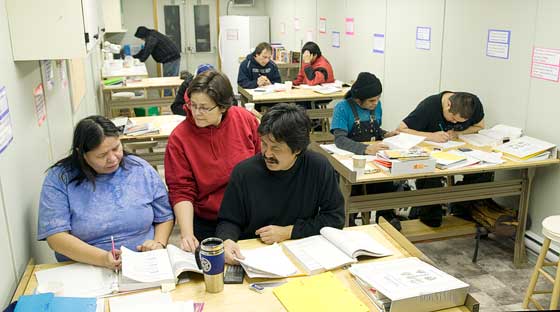
TOILING TOWARD A CAREER - Students work during a recent apprenticeship preparation class in the Kwanlin Dun First Nation's mobile classroom.
Photo by Vince Fedoroff
TOILING TOWARD A CAREER - Students work during a recent apprenticeship preparation class in the Kwanlin Dun First Nation's mobile classroom.
It's shortly after 8:00 on a Tuesday morning in a small trailer behind the Kwanlin Dun First Nation's health centre.
It's shortly after 8:00 on a Tuesday morning in a small trailer behind the Kwanlin Dun First Nation's health centre.
Inside, pages printed with quotes about science and math line the side walls beside the desks that are set up to face a chalk board at the front of the trailer.
Students - employees of Kwanlin Dun's housing department - wander in for the 8:30 a.m. class where they learn the math and science skills they will use in their trades.
Many show up before their instructor, Simone Rudge. They grab a coffee at the back of the class and sit down at a desk to look over their textbooks or write some notes before things get started.
The program is part of the ongoing partnership between the first nation and college, Shelagh Rowles, the college's dean of applied science and management, told the Star.
Over the years, the college and first nation have worked on a number of education programs.
As the first nation moved forward with some major housing work this year, it became clear the housing department would need a crew with a basic understanding of the trades.
Thus, the college and first nation developed the program specifically for its staff who come to class in the morning and head to work in the afternoon.
"It's very focused," Rowles said.
The math book is designed specifically for the trades, with word problems, geometry and algebra dealing specifically with things that would come up in working in carpentry or electrical work.
"It's clear, right? They can say, 'We've done this,'" she said. "It's easier to make sense of why you're doing certain math."
Starting out with basic math, the course then moves into geometry, some algebra and then two- and three-dimensional geometry used heavily in carpentry.
"It's not something that a lot of math courses do a lot of anymore," Rudge said of geometry.
The science component of the work, meanwhile, focuses mainly on physics and how it applies to trades.
Unable to find a textbook that fit the course work, Rudge put together some modules for the work.
"It's a collection of things from various sources that cover what we wanted to cover," she said.
An instructor at the college in math, science and computer for 20 years, Rudge has taught a variety of courses on the subject.
Asked how students respond to the pre-apprenticeship program over more general programs, she eyed her students seated at their desks reading over their notes and said: "Look how hard they're working already. It's not even 8:30."
Among those students is Steven Shorty, who's taking a pre-apprenticeship course for the second time.
"We started working and they kind of wanted us to start going for our apprenticeship," he said.
This time around, he said, he has a better idea of what he's doing in the course. He will likely pursue his apprenticeship in carpentry, though he's also looking at focusing on mechanics during the exploratory section of the course.
That section allows the students to look at a particular trade such as electrical or mechanical work. By working in the housing section, most are already involved in carpentry, Rudge said.
The program isn't set to continue after this, Rowles said. It was designed specifically to meet the current needs of the housing department at Kwanlin Dun, given the current circumstances, she added.
The college's work with the first nation will no doubt continue so the needs of the first nation are met, Rowles said.
In order to encourage thoughtful and responsible discussion, website comments will not be visible until a moderator approves them. Please add comments judiciously and refrain from maligning any individual or institution. Read about our user comment and privacy policies.
Your name and email address are required before your comment is posted. Otherwise, your comment will not be posted.
Comments (1)
Up 0 Down 0
Mike Peltier on Feb 12, 2009 at 4:43 pm
Courses like this at the high school level would go a long way to solving the Yukon's education problems which have grabbed so much news recently. Make school relevant to the real world and the students will come because they want to be there. Too much emphasis in high school is placed on college and university, and those who are not interested in that are often treated as losers. Our society already has enough unemployed liberal arts degree people and not enough people who fix things, build things, and keep the plumbing working.