Fire risk to city can’t be overstated: report
A report has linked the potential of biomass as a source of renewable energy to greatly improving the safety of Whitehorse with a comprehensive fuel reduction program.
By Chuck Tobin on April 5, 2019
A report has linked the potential of biomass as a source of renewable energy to greatly improving the safety of Whitehorse with a comprehensive fuel reduction program.
It says Firesmarting 4,000 hectares over 10 years would create private sector jobs and economy while displacing greenhouse gas emissions from diesel fuel by providing a reliable stream of woodchips to heat buildings.
The report suggests there is nothing about the technology that’s a mystery. The Austrian woodchip boilers discussed in the report are in common use in northern Austria – and have been for 20 years.
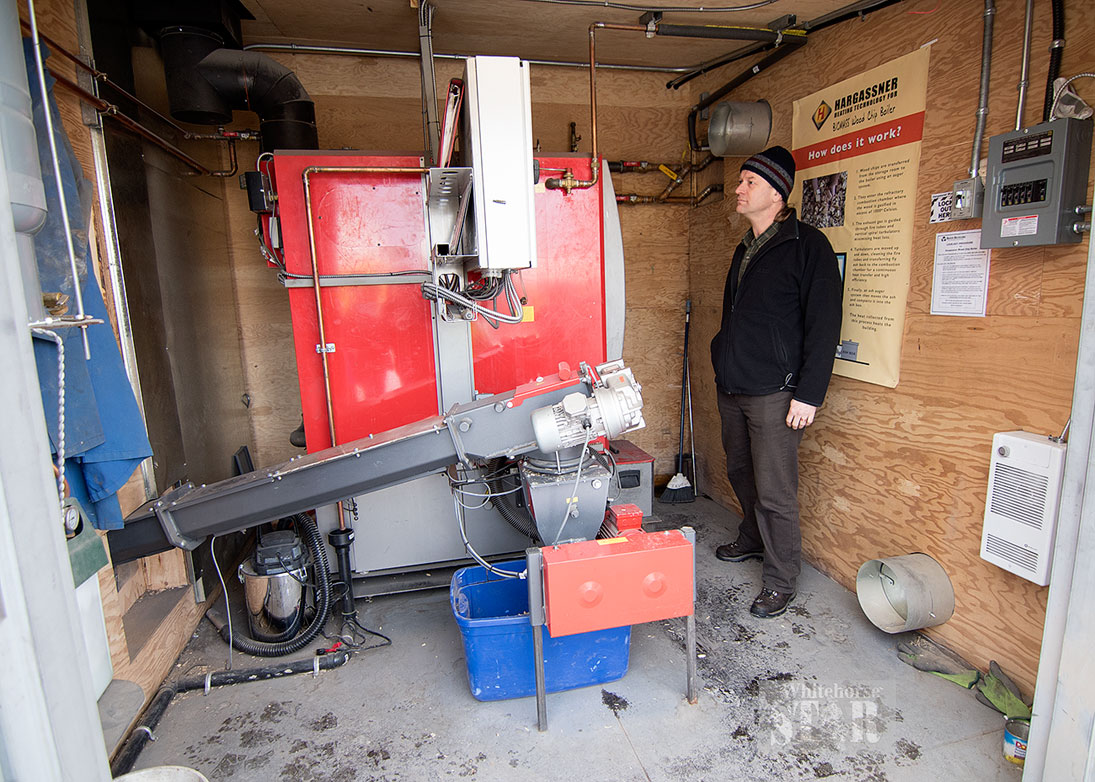
They are the same type of woodchip boilers the Teslin Tlingit Council is using to provide district heating, and the same as the Raven Recycling Society and Yukon Gardens are using.
But creating a biomass economy while Firesmarting the city would require the Yukon government and the City of Whitehorse to buy in as anchor customers for the woodchips if the proposal is to be viable, the report insists.
Local consultant Dave Loeks was commissioned by the Yukon Development Corp. to provide a discussion document looking at the viability of biomass as a form of renewable energy. The draft report was delivered to the corporation in late March.
Corporation president Justin Ferby said Thursday officials have received feedback from the different government departments and are in contact with Loeks to address some questions and assumptions.
The intent is to have the Biomass Fuels Development Strategy finalized before the end of the month, he told the Star.
Ferby said what Loeks provided was an example of an industrial application for biomass as a renewable energy.
The document suggests it’s not a matter of if Whitehorse will face the threat of a destructive wildfire some day. It’s a matter of when.
“It is generally understood that Whitehorse is positioned at the end of a forest fire blowtorch created by topography, prevailing winds, and abundant forest fuels,” says the introduction to the 40-page document.
“The fate of Fort McMurray, AB, and recently, Paradise, CA (Calif.) as a result of forest fire is not just possible here, but in time, probable. It is difficult to overstate the seriousness of this risk.... Whitehorse is no less vulnerable than these two examples.”
The report suggests commercializing the Firesmart program would generate the revenue to support a program that is comprehensive. Doing what needs to be done to make the city safer can’t be done under the current Firesmarting model, because it’s just too expensive.
The 10-year timeline to reduce forest fuels in the areas identified on a map included in the report would cost $30 million if done by hand, like it is now. If it’s done by machine, the cost would drop to $18.4 million, says the report.
To do the same amount of fuel abatement at the current pace would take 35 years, or long enough to question its usefulness, says the report.
A comprehensive Firesmart program would require some annual maintenance to ensure there’s no return of spruce and other coniferous trees that are volatile and feed the spread of wildfires. It may mean encouraging the growth of deciduous trees like popular and aspen that act as natural fire breaks.
The report says the anticipated amount of biomass energy generated by comprehensive fuel abatement would be substantial.
A minimum of 77 units of the same boiler Raven Recycling is using would need to be in place to make a biomass heating industry viable, but it’s completely doable, the report suggests.
It says it is entirely feasible to convert government buildings to woodchip boilers, while leaving the diesel fired system in place as back-up.
(It’s happening this summer at the Elijah Smith Elementary School as the result of a private sector proposal to install, maintain and supply three of the Austrian boilers under a heating contract.)
The report says the expertise to grow a biomass heating industry in the Yukon is here – and Whitehorse could serve as an example of the potential for other communities.
“Clearly there is a convergence of interests: the public has a pressing need for fuel abatement, there is an economic opportunity for biofuels, there is an intent to replace fossil fuels, there is an abundant local source of wood, and there is a private sector that is prepared to furnish a biofuels product and service,” says the report.
“But there is a “chicken-and-egg” problem. The private sector cannot gear up without secure access to wood in volume and without solid customers purchasing biofuels in volume.
“Moreover, public fire safety will not much be improved by incrementalism in forest fuels abatement. Conversely, the public sector cannot make significant accomplishments in fuel abatement with limited budgets and an inability to deal with the serious volumes of wood that must be removed.”
The city and the Yukon government must become “anchor customers,” the report insists.
It says a real opportunity exists to reduce the territory’s carbon footprint while keeping the money spent on heat in the local economy.
It’s a real opportunity to grow private sector investment in supplying biomass energy while making communities safer, the report insists.
It also emphasizes that in addition to Firesmarting public land, private property owners must do their part as well.
Not part of the report:
• In the three years since firing up its woodchip boiler, which is fed automatically by a conveyor system from the storage bin, Raven Recycling has cut its heating bill by half, with more to go.
• Teslin has 10 functioning units of the same make which heat 10 buildings, including the school, and they will add two more this summer to heat eight new duplexes.
They’re also bringing in a different woodchip unit that produces both heat and electricity.
It will be attached to the community’s heritage centre. When the unit is needed for heat outside the summer months, it will also be supplying the heritage centre with all of its electricity.
Teslin has not cut one stick of wood specifically to supply its district heat. Rather, all of it wood has so far come from clearing areas required for community development – new lots, new roads.
• The private sector initiative to put Elijah Smith Elementary School on woodchip heat was initiated by a company formed by experts in forestry, logging and heating systems.
• The city’s massive new operations building off Range Road will be heated by a diesel-fired boiler, although provisions have been made to accommodate a biomass boiler in the future. But the city has no current plans to heat the building with local wood.
Comments (21)
Up 1 Down 0
Peter Cambridge on Apr 11, 2019 at 4:41 pm
Detrich
I was thinking the same thing about the dump fire. Drop a pump or two in with booster pumps and use free water.
I have this concern that unless there are well thought out plans a wildfire could overwhelm our firefighting forces then it's a situation where we have to leave as soon as possible,
Up 1 Down 1
Wilf on Apr 11, 2019 at 3:50 pm
Folks we need to get our ducks in a row in Whitehorse but they're swimming all over the place. We need a person who understands the subject. Wild fire is an issue in Whitehorse and some other communities like Haines Junction.
Residents in Fort Mac did not want any trees cut and look what took place.
I studied forestry at UFA but have very little experience in wild fires but worked on them in Alberta.
From the people in the know Whitehorse could be a fire trap for a number of reasons. One road in, one road out. Look at Fort Mac which was dangerous.
No fire break structures to control wild fires, which Fort Mac did not have either. If we have a dry summer like 2004 and have all the fires we had back then, we can be in deep trouble as a city.
I don't understand why the City mayor and city council does not want to protect our residents from harm like this. The Yukon Government has information on dangerous situations but we are sleep walking into a situation that could harm Yukoners like Fort Mac and other fires in Canada and US.
Up 20 Down 3
Detrich on Apr 10, 2019 at 12:57 am
Don't expect the city to be doing anything intelligent regarding heating of their buildings or any other undertaking for that matter.
Here's how they handled a fire at the dump which happens from time to time so no surprise there. Bill was quite content to use trucks to haul water up there to put out the fire and to spend upwards of 2 million dollars which we didn't have because the 'Surplus emergency Fund' had already been spent on capital projects like the funding of the new administration building.
A simple wildfire hose running up the hill from Porter Creek proper to where the dump fire was and hook on a suitable water pump for under $10,000.00 total cost (and would be there for future fires which are going to happen) would have solved the situation. No, instead we had city officials cater wauling about 2 million dollars worth of trucking to put out just this one fire. I have trouble with the city's judgement.
Up 5 Down 3
Josey Wales on Apr 9, 2019 at 4:40 pm
Great Slave lake mega fire?
Absolutely arson!
Fort McMurray fire, still toiling on sanitized report thus far human caused.
I suggest that BOLE played a role, as the enabling governments wish to not offend or speak truthful.
Given how BOLE has destroyed this community so, so EFFECTIVELY, and continues so with impunity, funding, NGO’s
We will burn, metaphorically or not ...due to so so many willfully ignorant enablers.
Doomed, you read as a classic idiot...see I can do that too.
Up 16 Down 4
Werner Rhein on Apr 9, 2019 at 2:56 pm
Wonderful finally some people woke up and trying to something, at least on paper and with voluminous studies.
But as far I can judge none of them involved has actually any idea what to do.
Yes you can do fire smarting with whatever means you think you can apply but what these people want to do is using heavy machinery. Which some of them probably still have standing around from their long time ago clear cut logging ventures.
Then they want to make pellets out of what ever they can harvest.
Because if you just make chips they can’t be used before the chips have a moister content of less the 15% to a maximum of 19%.
What is their plan how and where to dry the harvested chips?
Steep slopes can’t be fire smarted with heavy machinery, but exactly these slopes are the biggest danger. That is where fires advance the fastest.
There is small machinery available, which can go into steep areas and can go though in-between trees 2m to 3m apart. But that is what some of the business people don’t like. The small machines need more of them and more people to operate.
But a large part of fire smarting will be always manual labour, hard labour and whom wants to do that and who want’s to pay for it?
The other big unknown is where is the labour force who can and will to this kind of work, certainly not the writers of voluminous studies.
Yukon has the lowest unemployment rate in all of Canada. But it has a large number of people on social assistance who are still fairly healthy, to what my experience is with these people.
As we can see what the Study is telling as, it is a fairly big area that has to be fire smarted and it has to be done in a continuous pattern and not just in little patches here and there. Also it has to be done as fast as possible, because fires won’t wait till we are done.
That means, if it can be done, there will be a large amount and volume of fuel accumulated. That cannot be used right away. It needs to be stock piled and dried for about two years, to reach the proper moister level.
Where and how? There is my next assumption that the writers of these studies have no idea how to do that.
The next challenge is who is trained enough here in the Yukon to install wood biomass burning, or hopefully gasifying, equipment and operate and maintain it? In an expedient time, so the stock piles of chipped materials would not get to large.
The study is talking about 77 units in Whitehorse alone.
What about the other communities in the Yukon that need protection from forest fires?
So far the talk is only to used the harvested materials for heating and maybe producing domestic hot water.
What about wood gasification, which can be used to produce even base load electricity and some heat. Heat that could be used to dry the feed stock year-round.
The man standing so leisurely beside the boiler at Raven Recycling tell the public that this is not possible even as he has no knowledge about wood gasification.
He said that the Yukon needs more diesel generators to keep up with base load and as emergency back up. That is not true. Wood gasification can do that; here is the proof that it can work when the O&M people are trained and educated to run a complicated machinery. Even as they could have gone to Germany for 2 weeks for free to get trained. But they didn’t or the selling company was not telling them.
https://www.canadianbiomassmagazine.ca/news/green-gas-kwadacha-nation-installs-wood-gasification-system-6699
This one was installed by Borealis, Canada a subsidiary of a large fossil fuel corporation. As soon as the installation was installed and running, Borealis disappeared???
Now it seams this installation doesn’t run properly anymore, Why???
Maybe people were involved who wanted this to fail.
Gasifiers like the once in Fort Wade are running for 20,000 hours absolutely problem free and could solve the problem for the Yukon to become a CO2 economy.
If the transportation in the Yukon will become fossil fuel free, and it will, we need more clean electricity and it just can’t come from solar and wind alone.
But we have all the energy we need in our back yards, ready to be gasified.
Up 5 Down 16
Sally Wright on Apr 9, 2019 at 10:33 am
I support this approach 100%. It is an emergency. The people of the Whitehorse Valley are surrounded by a forest ready to burn, unpredictable winds and once the spark flies anything could happen. We will not benefit by sticking our heads in the sand. All the wood harvested will be used to heat our homes, businesses and offices.
Thank you to Mr. Loeks for his work and I look forward to reading it and learning how we can develop a biomass industry that benefits all. As Raven Recycling and the Teslin people have illustrated, these are local jobs, that reduce emissions and it reduces risk. And thank you Mr. Gladish for educating us further about the challenges and solutions that have been found collaboratively. This is the beginning of an education for Yukon people. This is what adaptation is.
Considering the tired old trolls that continue to minimize the problem 150 years of burning fossil fuels has got us, I think public education is paramount. We need all hands on deck moving forward to stop burning fossil fuels. Climate Change is upon us, the time is now to act.
Up 10 Down 1
CJ on Apr 8, 2019 at 11:23 pm
Too bad they had to get clever and tie in a business enterprise with the dire warnings. Now I'm all confused -- so we need to Firesmart but we need this machine to do it now? (And I share Russ Hobbis' bemusement.)
I don't dismiss concerns about fire, but I do wonder why every single time the threat is mentioned as Gladish describes it -- that nothing but fire suppression has been the norm for half a century. We've been firesmarting for at least 20 years, yet we keep hearing that conditions remain hopeless.
Loeks did another report about 8 or so years ago where this clearcut/conversion came up (and it looked pretty sweeping on his maps), now he's attached technology to it. Seems like he should be able to point to at least one project by now that followed that report.
I suggest they clean up their messaging and stop trying to convince people by scaring them and selling them something at the same time. Calling anyone stupid because they'd appreciate hearing a more coherent strategy isn't helping your cause, David Loeks.
Up 9 Down 1
My Opinion on Apr 8, 2019 at 9:01 pm
I used to burn wood once upon a time but had to quit because of the Bureaucracy of trying to get a place to cut. Clearly this is all going to be let to someone and you will use their heater and buy their chips. GOOD GIG.
Up 8 Down 1
My Opinion on Apr 8, 2019 at 8:58 pm
So. Now we know Mr. Gladish is involved in this as well. Based on his comments.
Up 4 Down 1
My Opinion on Apr 8, 2019 at 8:55 pm
@Wes
It is exactly the same stuff. Just no Road Tax. Good Lord Man.
Up 9 Down 7
Doomed on Apr 8, 2019 at 6:11 pm
Reading comments from mad max/north of 60/ and the ever interesting Josey Wales, makes me come to the conclusion we are not long for this world. These type of people are throughout Whitehorse, experts in everything, and contrarian to the bone. They will sit in the middle of a fire completely denying its existence, claim afterwards there was nothing we could do, and then blame the nearest left winger for its financial results. In this regard, our government will drag its feet. These pedantic folk have many representatives in both left and right bodies, not too mention middle management at the YTG/COW level. Forget the experts in wildland fire have been raising the alarm bell for years, forget the city fire chiefs see this as a major concern. Nope, the fools writing in political forums and who like to use anecdotal information to counter any organized information or statistics.
Up 4 Down 3
Groucho d'North on Apr 8, 2019 at 1:44 pm
And here we are back to burning wood for home heat again. Anybody remember when all the wood stoves in Riverdale were outlawed due to smoke pollution? And how does wood or Biomass as it's called today get a pass from CO2 emissions?
But these are all long-term arguments to be fought another day. In the mean time, when a subdivision like Riverdale or Wolf Creek requires wholesale evacuation due to fires - where is everybody going to go? There is not adequate facilities to temporarily house all the people in one of the seniors' residences for a week or two, so where will an entire subdivision's populace of residents find a place to stay while rebuilding gets underway?
Up 17 Down 7
Max Mack on Apr 8, 2019 at 10:48 am
Mike Gladish - being part of a "volunteer" group does not mean that your agenda is neutral or unbiased or without personal gain or gain for others allied with your cause. Claiming that you and your like-minded buddies are "volunteers" does not impress me one whit.
Your group appears to have had backing from key government players all along and this made me very suspicious about what's going on here. Not to mention the apparent commercial gain in play.
"Local employment" etc. You sound like a politician. Local employment can only come about through financial incentives - which means you and your allies getting money from various levels of government, which means the rest of us have to pay for that through tax increases or suffer a reduction in other services.
Reduction of fossil fuels. Pfft. What? Wait! Didn't you say this isn't about climate change?
Bottom line - your groups proposals, if enacted, will result in a large and sustained increase in costs to government operations, with a drastic change to the environment.
And, by the way, Whitehorse is neither Fort Mac or California. Quit fear-mongering.
Up 16 Down 7
North_of_60 on Apr 7, 2019 at 7:43 pm
The Ft Mac fire was set by humans and quickly got out of control because of government incompetence. The contract for water bombers was cancelled by the NDP govt two weeks before the fire, and fire suppression crews were told to stand down instead of aggressively fighting the fire when it first broke.
Let that be a lesson that's never going to happen here.
Up 11 Down 3
David Loeks on Apr 7, 2019 at 2:34 pm
As Mr. Max's has not read the report, he has also not read the proposed prescriptions for fuel management treatments, or their locations. They are certainly not for a "massive clearcut swath around Whitehorse." In fact they call for revegetation of these sites with less flammable deciduous species such as aspen or birch. The major objective is to reduce fire risk. Biomass fuels is an affordable means to this end. Few, if any, knowledgeable people would dispute that Whitehorse faces serious objective hazards at this time.
Up 19 Down 10
Mike Gladish on Apr 7, 2019 at 10:33 am
Comments about this article indicate an ongoing need to raise awareness about the real risk of a catastrophic forest fire and the ways that we can mitigate the risk. I am a member of a group called Citizens for a Firesmart Whitehorse. We are volunteers, working to raise awareness about reducing the risk of wildfire in our backyards and in the forest surrounding Whitehorse and all Yukon communities. We are advocating for the use of all cut trees as heating fuel to replace the use of fossil fuels. And we are advocating for a coordinated emergency plan that is understood by all residents. We have met with all levels of government over the last few months to encourage collaboration in all aspects of fire risk management.
The risk of fire is a potential emergency that will result from a combination of our climate and our human activities. It is a natural event that has occurred in this area for thousands of years. The Whitehorse and Southern Lakes area is very dry, with annual precipitation totalling about 25cm. That means about 1 inch per month. We are also subject to long periods with no precipitation and occasionally, we have hot spells, especially in May and June. Hot and dry weather is possible every year, although in my research, we have significantly hot weather about one in 10 summers.
For the last 60 years or more, we have done a very good job of suppressing forest fires, whether caused by lightning or careless human behaviour. The result is a mature pine and spruce forest that covers the area from Marsh Lake to Bennett Lake to Laberge and Kusawa Lakes. All of the accumulated forest debris has created a significant amount of fuel for any future fire. Under the right conditions, the fuel load, combined with mature trees will create a very intense fire that will threaten our communities.
Current levels of fuel reduction and fire-smarting are not enough. All homeowners need to take responsibility and governments need to collaborate on aggressive measures to protect our communities from the inevitable risk of another Ft McMurray scenario.
As for the comments posted to date:
Climate change is irrelevant to this real and present danger. Our weather, our behaviour and our location in the boreal forest are the most important factors.
Mr. Loeks’ report is not hype. It is a proposal about how we can realistically remove trees and convert portions of the forest to a more resilient landscape made up of aspen, birch, willow and poplar. The proposed area to be treated is 4,000 hectares. That is not a clear-cut swath around Whitehorse. It is 10% of the area of Whitehorse and it would be located strategically in order to be as effective as possible.
The use of the by-products of landscape modification is not about free money or personal gain. The appropriate level of management of the fire risk would result in private sector employment and a reduction in our use of fossil fuels. Heating our buildings with local biomass will keep millions of dollars in our local economy.
The ‘massive’ new building being built by the city, is plumbed to accept a biomass boiler. The city would like to have a reliable private sector source for biomass fuel before installing a biomass boiler. This is part of the chicken and egg problem mentioned in the article. All governments and private sector players should lead the way.
Anybody who is not convinced about the dangers and the management options should read the Ft McMurray study and various reports about the California and BC fires that burned in 2017 and 2018.
Up 32 Down 4
Russ Hobbis on Apr 7, 2019 at 9:36 am
My company has been contracting fire smart projects in Yukon for 19 years. Very few areas are accessible for chipping. Chippers have a high center of gravity and easily tip over. In addition, the cost per hectare to chip the brush is greatly increased and that is with spreading it in place. To remove it would mean creating roads through our green spaces and trucking over terrain that you would be unable to even get a chipper into let alone trucks.
This is another example of something trying to be used here without consulting people in the industry. If you want biomass then log the beetle kill around Haines Jct before it spreads throughout our whole boreal forest as it has done in BC.
Up 17 Down 2
Wes on Apr 6, 2019 at 9:37 am
Not to be pedantic, but "The city’s massive new operations building off Range Road will be heated by a diesel-fired boiler" it's not a diesel fired boiler, it's an oil fired boiler. Nobody in the industry calls them diesel boilers. Heating oil is cheaper than diesel because of the taxes, so if you start running diesel in your boiler or furnace, you're going to be in pain a lot.
Up 31 Down 13
Max Mack on Apr 5, 2019 at 11:48 pm
Essentially Loeks is recommending a massive clear-cut swath around Whitehorse. ARE YOU KIDDING ME?
The same Loeks is tied to the very guy in the picture proposing "Austrian woodchip boilers" to burn all that clear-cut wood. So, what's Ferby's connection?
Simply put, the report by Loeks is hype and the proposal is sickening. This is all about free money for certain interests.
Up 29 Down 10
Josey Wales on Apr 5, 2019 at 5:34 pm
Hmmm...reads more like these forests belong to the government as does the firesmart by product.
I suspect there are heaps of poor folks out there that could use their own trees, to offset the costs of the bloat, taxation, epic epic waste etc.
Nope us mere peasants can fund this deal, but not DARE harvest a stick...without fines, eco terrorist charges.
Why not just feed old government studies into those boilers, when ya run low in a few decades, just shovel pure cash into instead?
A climate emergency, what a bunch of morons...seriously!
Up 20 Down 5
Peter Cambridge on Apr 5, 2019 at 4:47 pm
This is so true and we are not prepared.