Photo by Whitehorse Star
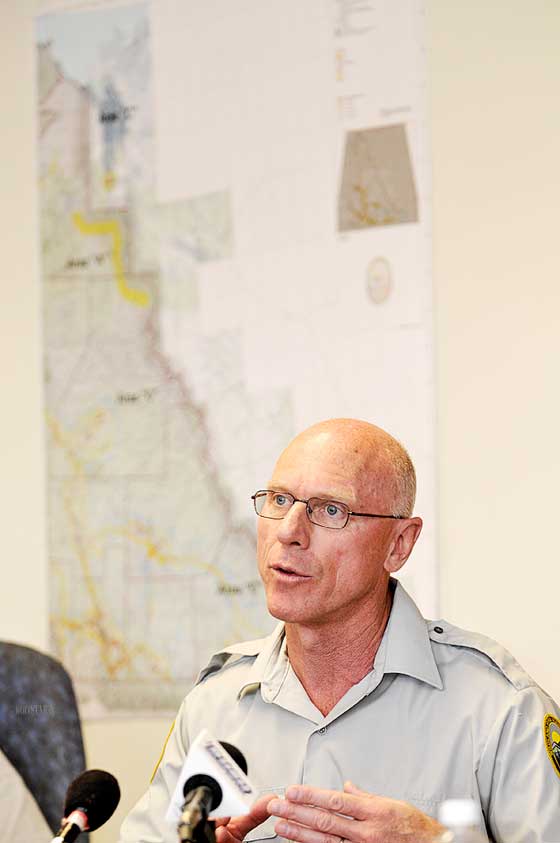
HEADING DOWN UNDER - Al Beaver, seen at work in the Yukon in May 2008, will take his vast forest firefighting experience to Australia next week.
Photo by Whitehorse Star
HEADING DOWN UNDER - Al Beaver, seen at work in the Yukon in May 2008, will take his vast forest firefighting experience to Australia next week.
When Al Beaver arrives in Melbourne next week,
When Al Beaver arrives in Melbourne next week, parts of the Australian city's suburbs and surrounding region will be in the throes of a cleanup following massive brush fires that killed more than 180 residents.
"It will be trying times, definitely," Beaver, a former fire management supervisor for the federal and Yukon governments, told the Star Tuesday.
"In my 32 years in the business, my greatest fear was to be involved in a wildfire situation where there's any loss of life. I'll be going right into the middle of my worst nightmare."
Retired for seven months, the 56-year-old was lured back to work, but by the government of Victoria State, where Beaver will provide expertise to its bush fire risk management program for the next three years.
"Down there, the forest is called the bush," Beaver explained, adding while some terminology may differ, the basic tenets of fire control do not.
"You can't just automatically apply things that work in North America, but even having said that, the methodology of controlling and suppressing bush fires has not changed in more than a century."
Bucket brigades of yesteryear, trudging into the burning forest armed with shovels ready to pass water onto the flames have been replaced by bulldozers, helicopters with giant water buckets and the strategic placement of firefighters.
In terms of forestry management, what has changed, according to Beaver, is the idea that wildfires must be put out at all costs.
"When I first started, there was kind of an interventionist attitude that nature had a good plan but we could always improve upon it," Beaver said. "All fires had to be extinguished at any cost."
But strategies have evolved, and forest management practices came to embrace nature taking its course. Only in extreme circumstances, where person or property is at risk, do fire crews in Canada attempt to mitigate wildfires by intervention.
"Unless you have a very profound reason to suppress the fire, you shouldn't be interfering. (Fire) is a critical part of nature," said Beaver. "The forests, all the boreal forests in Canada, would cease to exist as they do if it weren't for fire."
When a wildfire does threaten to overtake a residential area or crucial infrastructure, as it has in Australia, Beaver believes readying communities and residents beforehand is a much better practice then waiting for the fire crews to save the day.
"What the homeowner does to prepare is far more important than anything the fire suppression team can do," continued Beaver. "The firefighter gets to work after the fire has started and there's a lot of pressure to go into these impossible situations that are often created by the homeowner."
Some absolute no-nos many homeowners engage in include leaving fuel for snowblowers or lawnmowers underneath the deck, and the same goes for piling fire wood against the side of the house.
Nestling a dream home against a stand of beautiful spruce trees is another bad idea, as well as using cedar shakes for roof shingles -- a recipe for disaster.
Beaver said many homes are destroyed by a passing forest fire not because the flames jumped from trees to buildings but by flying embers that ignited roofing or improperly stored fuel.
Thinking of the bigger picture, building fire breaks around a community goes a long way towards protecting it but, said Beaver, managing the forest from the inside out can offer the best insurance.
Conducting prescribed burns, whereby crews intentionally light forest fires, can be one method and manually removing fuel -- dead wood on the forest floor -- another.
"You can do it through logging practices, where after you take off the (useable) material, you remove the slash left behind," Beaver said.
"European countries take everything off the site and turn the branch wood, all that logging residue, into bio fuels."
But any forestry management exercise with an eye to reducing the risk of an out-of-control wildfire is multifaceted, according to Beaver, and never completely protects against the power of nature.
"The big problem we face in this business, across the nation and all around the world, is everyone is looking for their own silver bullet, and there isn't one," he said.
"There's much more involved than going in and fighting fires - proper zoning, proper house construction, proper type of fuel management, those sort of things.
"There's not one person or organization that can provide all-encompassing protection for wild bush fires. Everyone has a role to play."
See update of Australia's fire disaster in today's World section.
In order to encourage thoughtful and responsible discussion, website comments will not be visible until a moderator approves them. Please add comments judiciously and refrain from maligning any individual or institution. Read about our user comment and privacy policies.
Your name and email address are required before your comment is posted. Otherwise, your comment will not be posted.
Be the first to comment