Fire disaster was high on western premiers’ agenda
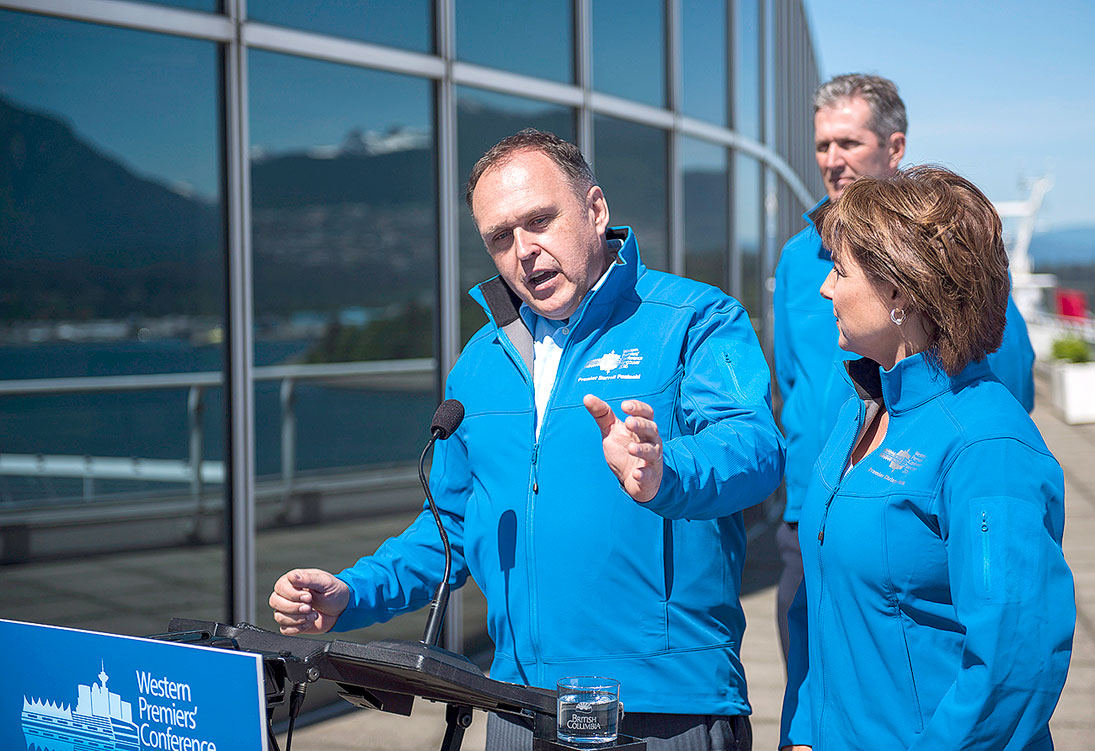
The Fort McMurray wildfires cast a pall over the annual meeting of Canada’s western premiers in Vancouver last Thursday and Friday.
By Sidney Cohen on May 9, 2016
The Fort McMurray wildfires cast a pall over the annual meeting of Canada’s western premiers in Vancouver last Thursday and Friday.
As a massive blaze laid waste to the Alberta city and surrounding areas, emergency management rose to the top of the agenda at the conference for government leaders from the three territories, British Columbia, Alberta, Saskatchewan and Manitoba.
The premiers called on the federal government to reclaim responsibility for certain emergency support costs, which were downloaded to the provinces and territories in 2015 in their first day
of talks.
They also called “insufficient” the 2014 National Disaster Mitigation Program – a $200-million investment over five years to address the risks and costs of flooding across the country.
They said the program should be expanded to include forest fire mitigation.
Alberta’s premier was notably absent from the Western Premiers’ Conference.
Rachel Notley skipped the meeting to deal with the wildfires in her province that prompted an estimated 90,000 residents to flee.
Sarah Hoffman, Alberta’s Deputy Premier and Health Minister, went in Notley’s stead.
The western leaders also welcomed Conservative Brian Pallister, the newly elected premier of Manitoba.
Apart from disaster prevention and relief, the provincial and territorial leaders covered much ground during the conference and pushed for more federal funding and collaboration in health care, immigration and employment insurance.
Special attention was paid to strengthening the economy through supporting the oil and gas industry.
Despite vocal opposition from environmentalists and U.S. President Barack Obama’s rejection of the Keystone XL pipeline last November, the western premiers reaffirmed their shared belief that getting Canada’s resources to market via pipelines is important to growing the economy in the long term, and to creating jobs.
The fires in Fort McMurray, which have significantly hampered Alberta oilsands operations, have led BMO’s chief economist, Douglas Porter, to cut his second-quarter GDP growth estimate for Canada from 1.5 per cent to zero.
Porter said Friday that, “based on what we do know at this point about the production curtailments, and based on the hit to GDP five years ago from the best parallel we have (fires at Slave Lake in May 2011, when energy sector GDP fell 3.6 per cent), we have cut our Q2 GDP estimate to zero.”
Premier Darrell Pasloski used the BMO report to reinforce his government’s pro-resource development position in an interview with the Star on Friday afternoon.
“The BMO has changed Canada’s growth estimate: it’s gone down to zero because of Fort McMurray,” he said. “It shows how important resource development is.”
Pasloski added that, “Especially in the North, when we talk about resource development we also talk about infrastructure, and cleaner, less expensive forms of energy for projects.”
The premiers discussed climate change and agreed that governments must “pursue a range of actions,” while at the same time, allow for flexibility so that industry can “respond where actions are most cost-effective,” said a Friday news release about the conference.
Pasloski has repeatedly stated his staunch opposition to carbon pricing in the Yukon.
At the conference, the premiers called on the federal government to ensure they are consulted before it firms up a national strategy to reduce greenhouse gas emissions.
“One size doesn’t fit all, one approach across the country doesn’t work and we need to look from a regional perspective about how we can reach our goals,” Pasloski told the Star.
“We need to focus on technology and adaptation.... We already have a high cost of living (in the Yukon).”
The premiers cited reducing dependency on diesel in remote communities, investing in electric vehicles and alternative fuels such as biolfuels and natural gas, and expanding renewable energy (solar, wind and hydroelectricity) grids as viable courses of action in Western Canada.
The conference also covered the value of building economic partnerships with indigenous communities and businesses.
“We talked as well about building prosperity with First Nations, and knowing how important that is,” said Pasloski.
“I had a line about asking the feds for resources to implement self-government agreements.”
The seven premiers called on Ottawa to “fulfill its constitutional obligations to indigenous peoples, including implementation of self-government agreements and modern treaties.”
Pasloski will host a meeting of leaders from Canadian indigenous organizations in July.
“It is about realizing that we have a great opportunity to develop a strong, skilled labour force, and the opportunity to work with First Nations development corporations,” he said.
“I want to make sure that First Nations benefit from these economic opportunities.”
The 2017 Western Premiers’ Conference will take place in the Yukon.
Be the first to comment