Fire crews braced for summer's challenges
The overall forecast for the 2008 fire season is neither "catastrophic" nor a "wash-out" according to Al Beaver, a science and planning supervisor with Wildland Fire Management, an agency of the Yukon government.
By Will Johnson on May 28, 2008
The overall forecast for the 2008 fire season is neither "catastrophic" nor a "wash-out" according to Al Beaver, a science and planning supervisor with Wildland Fire Management, an agency of the Yukon government.
Either way, fire brigades are constantly ready. This year, there are 21 crews across the Yukon, including 11 first nations crews and 10 from YTG.
Each crew typically has three members. On top of that, there is a weather station in every major community (and most small communities) and there are fire towers around the entire territory.
The budget for Yukon Wildland Fire Management this season is $12.9 million, which is the same amount allocated last year.
Two air tanker groups will be stationed in Whitehorse and Dawson City over the summer, and will move around as required.
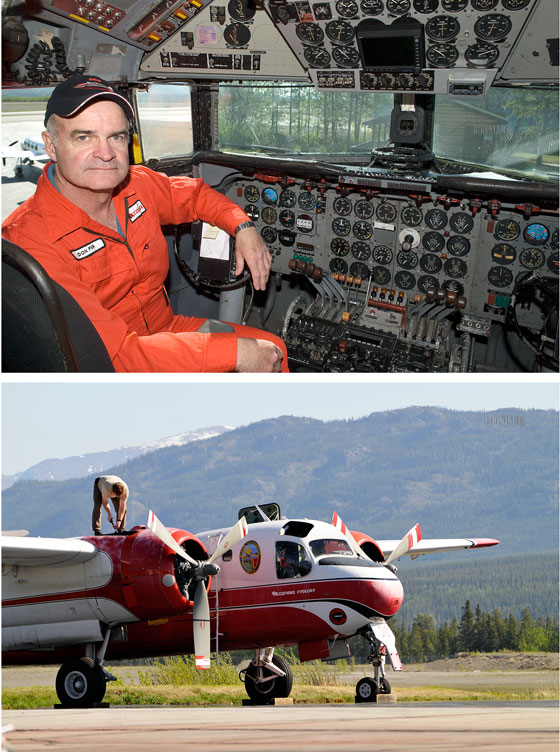
These are comprised of a fleet of various aircraft, including a DC-10 bomber and a smaller planes like the Birddog and the Firecat.
The bombers drop retardant on forest fires to aid firefighters on the ground and to help keep fires contained.
As well, fire crews in the Yukon often use resources from the surrounding area, with British Columbia, Alaska, and Alberta being the primary support in times of an emergency.
"We're trying to predict what the fire season will look like," said Beaver, noting that many predictions are unreliable.
Experts are constantly compiling data and interpreting weather patterns, but there is never a way to know for sure where or when a fire will break out, he said.
He said many people think snowfall during the winter affects the fire season, but the bigger element is rainfall during the summer.
"There's no real silver bullet," he said.
The key is to always be prepared, no matter what the conditions or the forecast.
Beaver has come up with three keys to avoiding fires: control fires, control ignitions, and control fuels.
All burning permits in the territory have been suspended and they are working to educate the public on potential dangers.
"If people would behave, and there wasn't any lightning, we'd be doing a lot better," said Beaver.
He said many fires are started by natural causes like lightning, but more often they are entirely preventable.
"We're all into this together," he said.
Homeowners should ensure their houses are protected by continually watering their lawns, watching out for potential fuel for the fire, and being aware of their building materials, he said.
"You don't want to make a path for the fire to march up to your front door," he said.
The most notorious mistakes homeowners make are stacking woodpiles around the sides of their house or storing flammable materials under their decks, he said. People should be aware of how close trees are, and the condition of the surrounding landscape.
At a news briefing held Tuesday, Beaver showed a picture of a Kelowna, B.C. home that survived a recent wild fire. The neighbouring home was razed to the ground, and Beaver credited the builders for using the right materials and saving the house.
On the tarmac of the Whitehorse Airtanker base, pilot Don Fair gave the media a run-down on his aircraft.
Originally a commercial airliner 50 years ago, his DC-10 has been gutted and a 2,500-gallon tank has been added to the belly.
"It used to be pretty posh, if you can believe it," he said.
Inside, the only indication that the plane ever held passengers is a small sign that reads "No Smoking. Please Fasten Seatbelts".
The main compartment is an empty metallic cavern stripped of any excess equipment that was no longer needed-the seats, the insulation and the auto-pilot system. Some metal struts have been added to off-set the weight of the tank.
The tank has 12 compartments, and can either be opened all at once or spread out over several drops.
Fair said it takes approximately eight to nine minutes to put the load on the plane.
"This is a glimpse into the aviation of the ‘40s," said Fair, motioning to the windows in the cockpit.
He said the windows would not be certified nowadays, and compared it to "flying a house while looking through a mail slot."
However, he has used the plane on countless missions.
"This is an expensive way to fight a fire," he said. "You can't waste anything."
The main duty of the bombers is to contain the fire, and keep it from spreading.
They are usually the first on scene, but are unable to completely extinguish the flames. Instead, they help co-ordinate the on-ground efforts and work as a team to come up with a firefighting strategy, while repeatedly spraying the forest with special retardant chemicals.
Fair has been working for Conair for 24 years. He has fought fires all across the continent-in B.C., Alaska, Saskatchewan and New Brunswick, to name a few. Originally a pilot in the air force, Fair said he finds firefighting very rewarding.
"When a drop goes well, you can tell if it's effective right away. You can look down and you can already see a change. That's a really good feeling," he said.
Along with his team, Fair will be ready to respond to emergencies all summer long.
Be the first to comment