Feedback sought on local food strategy
The government’s agriculture department is looking for feedback on the recently released draft strategy with one main objective in sight: let them eat locally.
By Aimee O'Connor on August 6, 2015
The government’s agriculture department is looking for feedback on the recently released draft strategy with one main objective in sight: let them eat locally.
“Creating a Yukon-specific Local Food Strategy will lead to greater production of local food and more resilient farms and farm-support businesses,” Energy, Mines
and Resources Minister Scott Kent said Wednesday.
While the research phase for the strategy really only started last fall, the road to concocting local food legislature has been a long time coming.
A motion aimed at increasing the production and consumption of locally grown produce and meat was introduced in the Yukon Legislative Assembly in May 2012.
In April of last year, Klondike MLA Sandy Silver put forth another motion to “investigate the merits of introducing a Local Food Act,” such as the one passed in the Ontario legislature in 2013.
“There might be some political jostling about whose idea it was,” Kate White, the NDP MLA for Takhini-Kopper King, said in an interview this morning.
“(But) it belongs to the farmers of the Yukon, the visionaries who said we could do this decades ago.”
The food strategy released yesterday, White said, reflects what resident farmers have been looking for.
The objective is to make locally produced food “accessible, affordable and convenient,” Tony Hill, the acting director of the territorial agriculture branch, told the Star.
“We can’t change the fact that we have a three- to four-month growing season,” he said.
What producers can change, through the strategy, is coming up with better means for preserving harvested goods for longer periods of time.
The territory currently suffers from a “feast and famine” effect – having an abundance of produce at the end of the growing season and then shifting into a winter season devoid of local products.
Jim Tredger, the NDP critic for Energy, Mines and Resources, has discussed this problem with local farmers in the past, White said.
“They can grow what Yukon needs, but they don’t have the ability to store it,” she said.
The development of cold storage facilities, Hill said, would be an answer to this.
The strategy suggests increasing food processing capacities during the fall season as a way of extending products’ shelf-lives as well as an initiative to provide funding to non-profit organizations to establish community kitchens to process local food.
Meeting regulatory standards is another roadblock for local farmers who wish to put their products on the shelves of grocery stores.
Silver said a recurring problem in his constituency is “a lot of red tape” between inspectors and legislation for restaurant owners to access local foods.
“It just seems very onerous to the business itself to the point where they’re just fed up,” he said this morning.
The strategy includes an initiative to provide funding for producers “requiring specialized infrastructure” to reach retail markets – this would include egg and meat grading facilities and milking and pasteurization equipment.
“If people have backyard chickens, you may be able to sell them in a farmers’ market but you can’t sell them in a grocery store without federal inspection,” Hill said.
For White, who started growing her first crop of “grown-up” potatoes about three years ago, there’s a feeling of triumph that goes hand-in-hand with harvesting your own food.
If we nurtured that sense of accomplishment, she said, we could be closer to encouraging more people to join the locally grown movement.
Other potential motivators in the food strategy include establishing an online market, coupon programs for local food and reducing the initial land purchase cost for agricultural land.
The local food distribution model in the strategy is based off of a “food hub” concept used in other North American jurisdictions.
The body in charge of the “hub” acts as a food aggregator, bringing smaller producers together and making food available and convenient to both consumers and retailers.
Farmers’ markets are a good step in this process, Hill said.
He also pointed to community gardens in the territory showing good success in the 15 or so years they’ve been running.
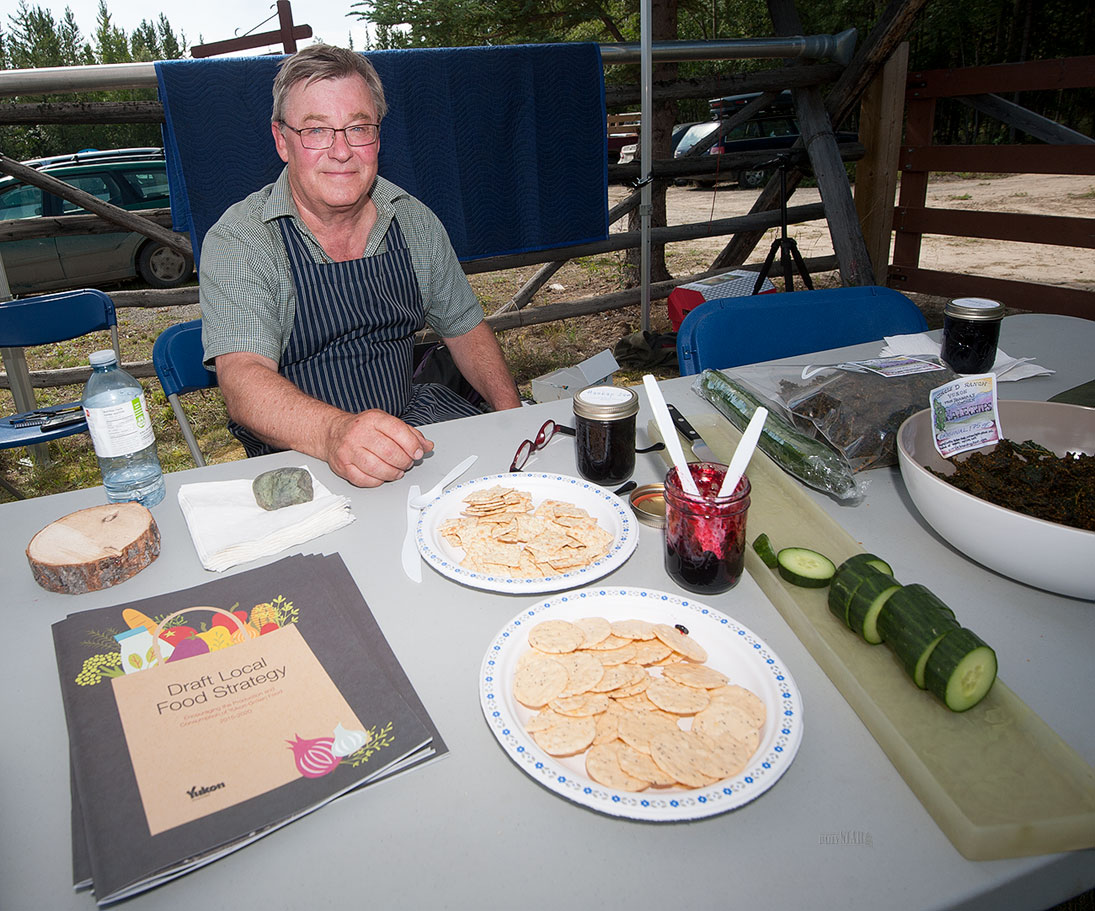
At a demonstration barbecue held Wednesday afternoon at the Gunnar Nilsson and Mickey Lammers Research Forest north of Whitehorse (see photospread, p.
4), Hill said, many people were inquiring about who was producing the food and where it can be sourced.
For people looking for this information, Hill points to the department’s Yukon farms products and services guide, which can be accessed online at http://
guide.yukonag.ca.
These types of questions are exactly what the agriculture branch is seeking during the public consultation stage, which will wrap up at the beginning of October.
“We probably haven’t thought of everything,” Hill said.
From there, the branch will compile a “what we heard” document before finalizing the initiatives in the strategy and releasing a final action plan.
This will hopefully be completed before the spring of 2016, Hill said.
“Agriculture branch staff will be seeking input later this summer in meetings and at farmers’ markets,” Kent said in a press release Wednesday.
The local food strategy draft is available online for comment until Oct. 5.
The Yukon government website indicates that paper copies are available upon request.

Comments (4)
Up 38 Down 0
Salar on Aug 8, 2015 at 12:51 pm
@Yukoner......you 'nailed' it. Cheap land to grow willow and subdivide....a great 'investment' when you see all the grant money available for application to 'farm'.
It's so Yukon to develop policy after things have gotten out of hand....I mean how do you get any land to work with now that it's all gone and how do you invoke all the 'farmers' re new ag policy that requires them to actually farm?
So Yukon.
I grew up on a farm where the garden and animals were your grocery store, only flour, salt and molasses came from the store....it would be nearly impossible to create that here in the Yukon without creating an indoor environment for all....no matter what any politician or 'Yukon farmer' says.
Up 88 Down 9
Yukoner on Aug 7, 2015 at 7:43 am
The big issue to growing and eating locally is agricultural land availability. The whole "Ag Lease" thing has been a failure IMO. It has become a means for a small number of land owners to simply make a pile of money out of "land development" as opposed to the original idea of making agricultural land available. Drive out on the Ak highway North, Takhini river road etc and look at the open fields with either nothing in them, or just hay, and I don't know many people sitting down to a heaping meal of Yukon hay. Yeah, it's a cash crop for the people growing the hay for other country res people with horses etc, however, it's doing nothing for the original intent of providing locally grown food. So the original few land owners who accessed this land have made minimal improvements, and have been able to sell the land for market value as opposed to the land being made available for true farm use. But really, this is the fault of YG policy and political connectivity.
Up 9 Down 2
lorraine on Aug 6, 2015 at 9:59 pm
I think this new store called Farmer Roberts is going to be selling local produce etc. also gluten free flour .
Up 46 Down 7
June Jackson on Aug 6, 2015 at 3:52 pm
I really like this idea. Eating fresh and clean. With climate change our weather has become more temperate, still cold, but less so these days. I remember -50 and -60 for weeks in 1965. I think local agriculture has become a feasible idea.
Unfortunately, I think our legislators might beat it to death before anything positive gets done, but if enough people encourage this maybe they will move their a**** and get it done in my lifetime.
There is a lot of land in the Yukon, and a lot of water. I'd rather see potatoes, cows and vines than fracking.
I would buy local given the opportunity.