Photo by Vince Fedoroff
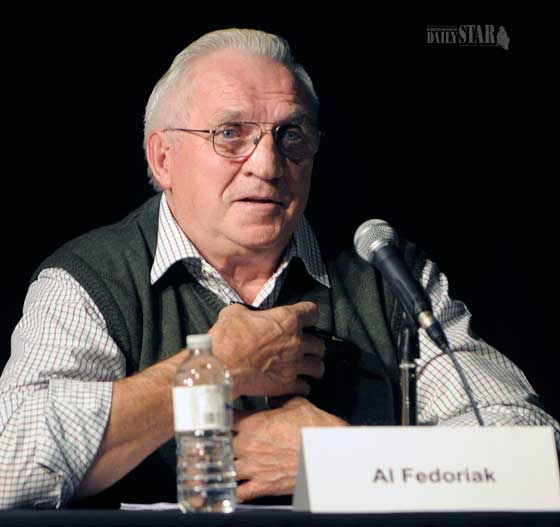
LISTEN TO LEARN – City councils can achieve more by listening to their electors, rather than learning by costly mistakes, says mayoral candidate Al Fedoriak.
Photo by Vince Fedoroff
LISTEN TO LEARN – City councils can achieve more by listening to their electors, rather than learning by costly mistakes, says mayoral candidate Al Fedoriak.
Turning off Wann Road onto Basswood Street, one is immediately drawn to the canary yellow and royal blue campaign sign perched in the front yard of mayoral candidate Al Fedoriak.
Turning off Wann Road onto Basswood Street, one is immediately drawn to the canary yellow and royal blue campaign sign perched in the front yard of mayoral candidate Al Fedoriak.
It's a nice yard, with a garage, a modest shed and enough lawn for the kids to romp around.
It's the size the candidate has in mind when he speaks of the need for city council to revisit its approach to the Whistlebend development, Fedoriak explains as he sits down to coffee for a pre-election profile interview.
"You know when you buy a lot and you are young, you may not be able to build the house you want,” says the retired businessman, the only challenger for mayor in next Thursday's municipal election.
"But if you have room, you can make adjustments in later years, like people up here did.”
Fedoriak says with 20 metres (66 feet) of frontage, at a depth of 43 metres (143 feet), the lot he paid $4,600 for in 1976 isn't sprawling, though it's comfortable.
Providing similar sized lots in today's market would not be unreasonable, nor would the development cost approach anything close to overbearing, he says.
From an environmental perspective, says Fedoriak, even the size of his lot is large enough to leave the door open for homeowners interested in pursuing the use of geothermal heat as an alternative to heating fuel.
Fedoriak says Yukoners are an outdoor breed, and frankly, they want enough room to store their boats and snowmobiles.
What city council has in mind for the Whistlebend development isn't what Whitehorse residents want. Fedoriak is so convinced of that, he would push to have the plan opened up for further discussion if he's elected.
He says the downtown core is where city council should be focusing its efforts to increase housing density, to invigorate what he describes as the heart of the city.
It may be appropriate to remove the four-storey restriction on building heights next to the escarpment, not only to expand housing options but to increase affordability through the economies of scale, he says.
Fedoriak doesn't want a downtown core full of skyscrapers blocking everybody's view, but there may be perfectly acceptable areas where taller is better, and not obtrusive.
"There are people who have a lot of money invested in the downtown area, and there are people who have solutions,” he says. "I think I would be inclined to perhaps put together a think tank comprised of people who are impacted by what happens downtown.”
Listening to the voice of the community is essential, and he's convinced the current council isn't doing enough of it these days.
Fedoriak's first brush with the Yukon was back in 1953 while working in at the Cassiar mine in northern B.C., and by 1959, he'd found his way to United Keno Hill Mines.
He joined the Canadian military in 1959 and served there until 1965, when he was honourably released to join the Edmonton police force.
Fedoriak moved back north in 1974 to take a job with the Yukon government as a field inspector, and in 1985 moved into the private sector as general manager of Diversified Transportation Ltd., which provided the school bus service in the Whitehorse for many years.
Now retired, the dedicated Rotarian who's travelled extensively says he's seeking the mayor's office to give back to a community that's been home to his four children and seven grandchildren.
He says experience in the private sector has given him the financial background and tools to lead a fiscally responsible city council.
Managing issues relating to busing is what he's done for more than two decades.
Life experience, he says, has enshrined in him the importance of listening.
"If you are a taxpayer and you live in this city, you are actually a shareholder in the company and your investment is the value of your property,” says Fedoriak.
"Rather than draw down dividends, you are paying taxes, so I think we have to listen to the people.
"I have not got all the answers,” he continues. "I think the most important thing is knowing what you don't know, and knowing where to get the answers.
"There are lots of people out there; you just have to listen to them, ask them.”
Fedoriak says the solution to the city's transit woes is relatively straightforward: load up service during the peak hours to encourage greater use, and stop sending empty buses around town through the day hoping somebody wants to get on.
Instead, he adds, implement a more efficient and cost-effective system modeled on something like a dial-a-bus service that won awards for the community of Sherwood Park, near Edmonton.
"Bus scheduling is not rocket science.”
Fedoriak says he was a tad miffed on a recent Saturday when he attended a service to celebrate a friend's life downtown.
He put two hours' worth of coins in the meter. The celebration went a little longer than expected, and when he came out, his vehicle, only one of two on the entire block, had a $10 parking ticket pasted on it.
The city, he says, should view parking meters as a means of encouraging traffic circulation for the betterment of downtown businesses, not as a source of revenue.
With the Yukon government policy on the sale of urban lots, and now the city policy, requiring the lots be sold for market value, and not the lower cost of development, city council is somewhat restrained when it comes to reducing lot prices, he admits.
Fedoriak says what council can do is put a freeze on the market value until the day or year when the cost of development catches back up.
With the Yukon government about to update its property assessments, which generally means greater tax revenue for the city, council members should not be looking down the road with dollar signs in their eyes, he says.
Fedoriak says what council needs to do is offset the increase in property values with a decrease in the city's mill rate to neutralize the hit on taxpayers.
It also needs to look at its spending priorities, he adds, suggesting the $300,000 going toward resurfacing the parking lot at the Rotary Peace Park – which wasn't in bad shape – would have been much more useful for surfacing the dirt roads in the Marwell and McDonald Road industrial parks.
"Fifteen years ago, I did a petition, we all signed it, that said, ‘please chip seal these roads for us because we are tired of washing our vehicles everyday,' " Fedoriak recalls.
"And we did not get a response, and we were willing to pay for it. And it's still not done.”
Most of all, he emphasizes again, residents want elected leaders who are approachable, who will listen to what they have to say.
"I think we can learn and achieve more by listening, rather than by mistakes,” says Fedoriak. "It is surprising what people can do if they are given an opportunity to be part of the solution.”
In order to encourage thoughtful and responsible discussion, website comments will not be visible until a moderator approves them. Please add comments judiciously and refrain from maligning any individual or institution. Read about our user comment and privacy policies.
Your name and email address are required before your comment is posted. Otherwise, your comment will not be posted.
Be the first to comment