Federal minister endorses chinook plan
Federal Fisheries Minister Dominic LeBlanc has agreed to support the development of a long-term management plan for Yukon River chinook salmon.
By Chuck Tobin on June 28, 2017
Federal Fisheries Minister Dominic LeBlanc has agreed to support the development of a long-term management plan for Yukon River chinook salmon.
LeBlanc met Tuesday in Whitehorse with representatives of the Yukon Salmon Sub-committee. He formally accepted the sub-committee’s recommendation for the management of the chinook stock this season.
Among the recommendations forwarded earlier this month for the minister’s consideration is the call for the development of the long-term plan.
“Given the sustained low productivity and several years when spawning escapement objectives were not achieved, the development of a longer-term Canadian management strategy for this stock is recommended,” says the recommendation.
“A number of First Nation governments have already incorporated long-term objectives into local management approaches.”
In addition to supporting the sub-committee’s recommendation, the federal minister has also put money on the table for the Porcupine River sonar project.
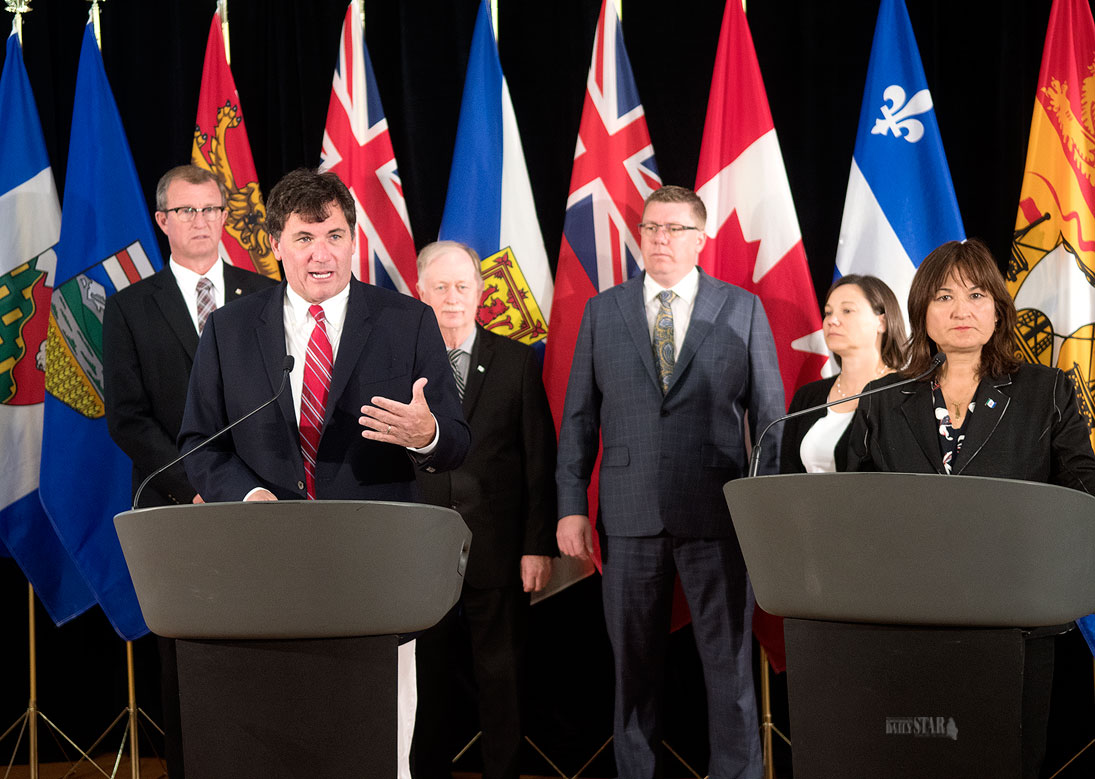
LeBlanc arrived in Whitehorse on Monday and was scheduled to leave today following a press conference held to sum up the results of the annual meeting of the Canadian Council of Fisheries and Aquaculture Ministers.
The federal minister acknowledged much has been done by the Department of Fisheries and Oceans and Yukon First Nations to manage the troubled chinook
stocks
But more can be done, he said.
“We think a lot of the science our department has done, and is doing, can be enhanced,” LeBlanc said during the press conference. It was co-hosted by Yukon
Environment Minister Pauline Frost, who is also a former chair of the Yukon Salmon Sub-committee.
LeBlanc said he announced to the salmon sub-committee the funding required to make the Porcupine River sonar project a permanent counting station.
The sonar project is a joint effort between DFO and the Vuntut Gwitchin First Nation government. They rent the sonar and the project is dependent on the parties being able to secure annual research and enhancement grants.
The minister told the salmon sub-committee he would be providing $300,000 to purchase a sonar and $150,000 annually to fund the work.
In addition to meeting with representatives of the sub-committee, LeBlanc also met yesterday with Yukon First Nation leaders and both he and Frost met with
Alaska Lieutenant Governor Byron Mallott.
Frost said this morning it’s of the utmost importance that steps to manage fish and fish habitat are taken collectively and collaboratively among provinces and
territories across the country.
Working with Alaska on the management of the Yukon River salmon stocks is an an example of the success collaboration can bring, she suggested.
Fish, said Frost, do not stop swimming when they reach international or provincial borders.
LeBlanc emphasized how for the first time leaders of the country’s national indigenous organizations were invited to participate in the council’s annual meeting.
He described how the meeting of ministers responsible for fisheries and aquaculture touched upon a number of issues of national importance, including the commitment by the federal Liberals to expand protection of marine coastal areas.
Expanding protection to achieve the five per cent target by the end of this year and 10 per cent by the end of 2020 will be achieved, LeBlanc insisted.
He said it’s important that all provinces and territories share in that commitment, that the burden not fall upon just a few.
The federal Oceans Act, he said, will be amended to streamline the process to create protected areas.
Commercially, not only is it important for Canada to strengthen ties with existing markets for seafood, but also to pursue new markets, the minister said.
LeBlanc pointed out that Canada exports $6 billion of seafood – fish, shrimp, etc. – every year.
There is potential to expand exports, and the free trade agreement with Europe has has provided Canada with an open door to one of the largest seafood markets
in the word, he said.
The minister pointed out 50 to 60 per cent of the world’s seafood is provided by the commercial aquaculture industry.
“Canada can be a global player in the aquaculture business,” LeBlanc told the audience that included ministers from across Canada and their support staff.
He highlighted the $30-million federal fund to help provinces and territories develop access to commercial markets.
And while he was here, the federal minister announced the creation of a Northern Integrated Commercial Fishery Initiative designed specifically to foster
participation in the commercial seafood industry by First Nations in the three territories.
Comments (1)
Up 7 Down 1
Matt Newhart on Jun 28, 2017 at 7:03 pm
Nice to see the minister direct some funding to the Yukon.
I think the best management practice and most effective stock enhancement scenario is to close all fisheries and allow the stocks to rebuild. Come to think of it, it's also likely the cheapest way to go.