Photo by Vince Fedoroff
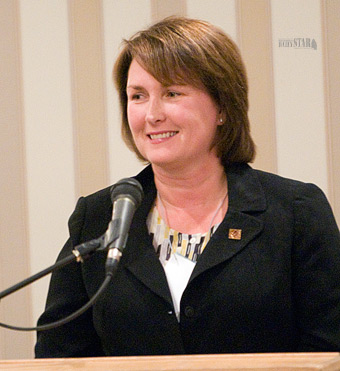
TALKING FASD - Addressing a Whitehorse audience Wednesday evening, former judge Mary Ellen Turpel-Lafond (above) spoke forcefully about the injustices experienced by people with Fetal Alcohol Spectrum Disorder.
Photo by Vince Fedoroff
TALKING FASD - Addressing a Whitehorse audience Wednesday evening, former judge Mary Ellen Turpel-Lafond (above) spoke forcefully about the injustices experienced by people with Fetal Alcohol Spectrum Disorder.
When Mary Ellen Turpel-Lafond told a Whitehorse audience last night that "people with FASD have no problem accessing the justice system," her comment was met with wry laughter from the 100 judges, lawyers, aboriginal leaders and others in the room.
When Mary Ellen Turpel-Lafond told a Whitehorse audience last night that "people with FASD have no problem accessing the justice system," her comment was met with wry laughter from the 100 judges, lawyers, aboriginal leaders and others in the room.
They had come to the opening night of a national conference on Fetal Alcohol Spectrum Disorder (FASD) and the legal system.
"The problem is for people with FASD to access justice," continued Turpel-Lafond, a former judge.
The public health agency of Canada website describes FASD as "a term used to describe a range of disabilities that may affect people whose mothers drank during pregnancy."
This rather vague definition of the term is almost a metaphor for the dearth of hard facts that exist about the condition.
FASD itself is not a diagnosis; rather, it is an umbrella over several other conditions brought on by drinking during pregnancy. It covers everything from imperceptible to severe brain damage caused by alcohol absorbed while in the womb.
People with FASD are often small, with distinct, almost elvish facial features.
They often suffer from retarded intellectual development, which can include difficulty learning to read, write and do basic math; to comprehend complicated concepts and to understand basic cause-and-effect logic.
This last point is what lands many young people and adults with FASD in trouble with the law.
A youngster with FASD may not understand that picking something off the shelf at a grocery store and putting it in her pocket is stealing, even after she has been told time and again.
People with FASD may exhibit "inexplicable behaviour" that can be frightening or off-putting to people around them.
There is no cure for FASD.
There are no Canadian statistics on how many people in the country are affected by the disorder, nor how much FASD costs the Canadian government each year - only estimates.
A 1985 survey of Yukon aboriginal children with disabilities estimated that almost five per cent suffered from FASD.
Health Canada estimates that nine in 1,000 children are born with FASD.
But most provincial and federal health agencies note that the statistics should be read cautiously because FASD often goes undiagnosed or misdiagnosed.
FASD children are sometimes referred to as million-dollar babies because of the amount of care they require throughout their lives.
One of the major problems that people with FASD encounter throughout their lives is that the effects of the disorder are often not recognized as anything else than simply bad behaviour.
As Roderick Macdonald, a law professor at Montreal's McGill University pointed out during his address this morning, "Many people with FASD appear to understand more than they do."
This is especially troubling in the justice field, where people are expected to direct their own defence.
People with FASD, said Turpel-Lafond, will often plead guilty to a crime, regardless of whether they commited it.
Hailing from the Muskeg Lake Cree Nation in Saskatchewan, Turpel-Lafond is the representative for children and youth in British Columbia.
A graduate of Cambridge and Harvard, Turpel-Lafond spoke plainly and passionately about the injustices experienced by people with the disorder.
"I don't want to get into all the war stories," she told her audience last night, "but I will tell you about one young man whose story shows many of the problems people with FASD experience."
She went on to relate the story of a boy who came into her courtroom the day after his 12th birthday, the first day that the police could pick him up.
Barely into his adolescence, the boy was already barred from most public facilities around Saskatoon and was well-known to local cops.
He was represented by a legal aid lawyer and pleaded guilty to some menial crime. Having already spent a night in jail, the boy was sentenced to time served and sent on his way.
Over the next four months, he came before the court 12 times, pleading guilty every time.
"He would take a guilty plea because he thought it was in his best interest," Turpel-Lafond said.
"He could have been charged with a murder he didn't commit, and plead guilty without ever understanding."
Eventually, the boy was declared unfit to stand trial "because he didn't understand the system - he didn't understand what he was taking responsibility for."
This inability of FASD sufferers to understand the workings of the justice system, which Turpel-Lafond admitted is difficult for most people, is at the crux of this week's conference.
How can people who do not understand the justice system access their rights within it? The first part of the answer is clear: the system itself must change to accommodate the special needs of FASD sufferers, but how it must change is what remains to be decided. That's what the justice professionals at this week's conference hope to figure out.
In her keynote speech, Turpel-Lafond touched on several aspects of the justice system she thinks need adjustment for FASD sufferers to be better served.
She started at the very beginning, with pregnant mothers.
"Most women in jail have babies," she said. "A woman should not go to the hospital in shackles, have her baby immediately apprehended and return to the jail in shackles. Jails should have a mum and baby program."
She then drew a parallel between FASD sufferers and youth, saying lawmakers had recognized that youth needed a specialized system because they have different needs from adults.
FASD sufferers are also different than other adults, she said, and need their own niche within a larger justice system.
They do not respond to a system of punishment, because often they do not understand what they are being punished for or how to avoid being punished again.
At the end of the evening, Turpel-Lafond left her audience with two questions to answer over the next two days:
What is the problem we are solving?
What goal are we trying to reach?
She called on her colleagues to use reason over passion when considering these questions, but with more scary stories available than hard evidence, they likely have a long road ahead of them.
In order to encourage thoughtful and responsible discussion, website comments will not be visible until a moderator approves them. Please add comments judiciously and refrain from maligning any individual or institution. Read about our user comment and privacy policies.
Your name and email address are required before your comment is posted. Otherwise, your comment will not be posted.
Be the first to comment