Families have high expectations, minister says
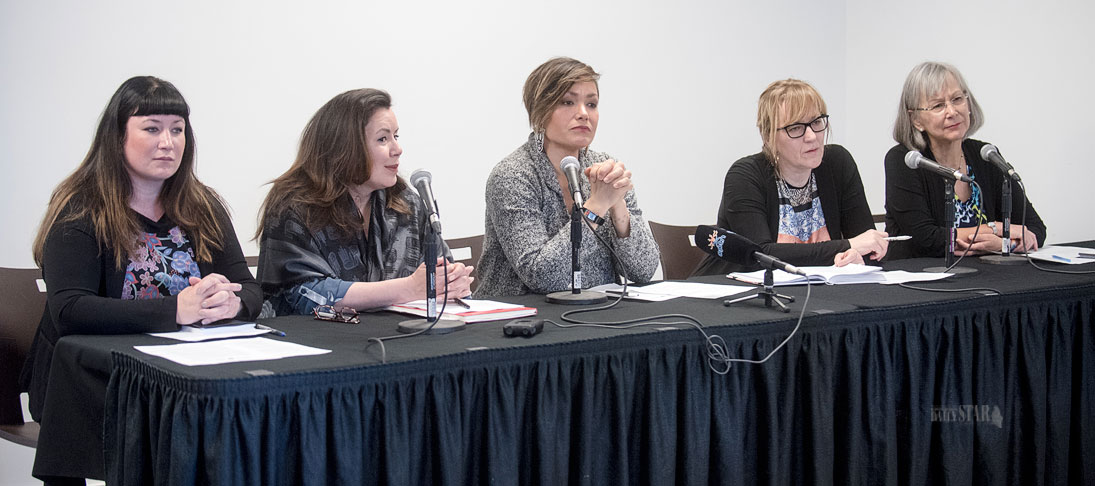
Commissioners of the National Inquiry into Missing and Murdered Indigenous Women and Girls (MMIWG) were in Whitehorse this week.
By Sidney Cohen on April 13, 2017
Commissioners of the National Inquiry into Missing and Murdered Indigenous Women and Girls (MMIWG) were in Whitehorse this week.
They met with more than 50 family members of indigenous women and girls who have been killed, gone missing, or experienced violence.
Chief Commissioner Marion Buller, Commissioner Marilyn Poitras, researchers and members of the commission’s legal team consulted with families, friends, community organizations and government officials on how best to conduct the inquiry in the Yukon, and to gain a clearer picture of systemic issues specific to the North.
Holding these preliminary, regional meetings is “the right thing; that’s the indigenous thing,” said Buller.
“To consult with people, to understand their protocols, their rules of proper conduct, to understand their languages and their issues.”
The commission started its work in Whitehorse on Wednesday.
Events were attended by more than 100 people, including 50 family members, friends and survivors, said Aimée Craft, director of research with the inquiry.
Today, between 10 and 12 organizations will give their input to the commission.
This week’s regional advisory meetings are separate from the pre-inquiry process, which informed the design of the inquiry. They are also distinct from the official hearings.
The hearings, or truth-finding gatherings, are where information and stories will be collected. Those will begin in Whitehorse on May 29.
As Craft put it, the advisory meetings are meant to help the commission gain insight into “some of the systemic issues relating to this particular region ... and how the process should unfold in this particular region.”
One of the northern-specific issues the commission has heard is geographical isolation experienced by small communities that don’t have year-round roads and year-round support services, said Buller.
The commission also learned to use radio to reach people in northern communities, because residents may not have reliable phone or Internet services.
The number of missing and murdered indigenous women collected by the commission has grown since the commission arrived in Whitehorse, and it continues to grow, said Poitras.
So far, the commission has more than 250 people registered to testify at its inquiry hearings, she said.
The inquiry has been criticized for the small number of people it has registered, considering the large number estimated of missing and murdered indigenous women and girls.
For example, an RCMP report found 1,181 police-reported homicides and missing persons cases involving indigenous women and girls between 1980 and 2012.
Some, including the minister of Indigenous and Northern Affairs Canada, Carolyn Bennett, say the number actually is much higher than that.
“The commissioners, in order to do their job, are relying on families of the heart to come forward,” said Karen Snowshoe, a lawyer with the commission.
The fact-finding portion of the inquiry is looking to hear from what the commission calls “families of the heart”: people with close ties to victims of violence, such as family members, foster or adoptive family, friends and survivors.
Snowshoe encouraged anyone who wishes to participate to call 1-844-413-6649, email profile@mmiwg-ffada.ca, or reach out on social media.
During the inquiry, testimony can be given in public or private, orally, through writing, or through artistic expression.
One family in Ross River created a song dedicated to missing and murdered indigenous women, said Snowshoe.
Another set of hearings will be held for institutions, such as governments, the RCMP, coroner services and child welfare agencies.
The commission will also hear and from experts, such as members of the LGBTQ2S community, elders, youth and experts in aboriginal law.
Jeanie Dendys, the minister responsible for the territorial Women’s Directorate, commended families who participated in this week’s events.
The families have had to tell their stories a number of times now, she said today.
“It takes a lot of courage to continue doing that.”
Dendys is co-chair of the Yukon’s advisory committee on MMIWG, along with Chief Doris Bill of the Kwanlin Dun First Nation, and Doris Anderson, president of the Yukon Aboriginal Women’s Council.
The families have high expectations of the inquiry, said Dendys.
“We have this mix of people that really looking for justice for their family members; they’re looking to change systems, they’re looking for answers that they’ve never had before.”
The inquiry will not reinvestigate cases, nor will it award any financial compensation to victims and their families.
It also won’t make legal findings of fault, for any unsuccessful police investigation or prosecution.
Considering all this, it’s uncertain whether families and communities will get the justice and closure they seek.
But Dendys is confident that the inquiry will achieve its goals, which are to explore the underlying causes of violence against indigenous women and girls, and to make concrete recommendations for remedying those causes and increasing safety.
The inquiry will also recommend ways to commemorate victims of violence.
“They’ve made really good choices of the commissioners and they’re listening, and that’s what’s most important,” said Dendys.
“This inquiry is about indigenous people, by indigenous people, for indigenous people,” said Buller, a retired B.C. provincial court judge and member of the Mistawasis First Nation in Saskatchewan.
The commission has heard positive stories too, in the Yukon, she said.
It’s heard stories of community safety, empowerment, and changes that were driven by the families who have been touched by violence.
The commission received a warm welcome in Whitehorse, said Buller.
“People are grateful that we’re here and that we’ll be starting our hearing process here in Whitehorse later on.”
Comments (9)
Up 24 Down 0
Max Mack on Apr 18, 2017 at 6:28 am
It is a sad indictment of Canadian values that missing/murdered aboriginal men and boys are not deemed worthy of inclusion in this so-called inquiry.
Aboriginal boys/men experience violence at rates that are simply astonishing. Published statistics of reported violence don't even come close to the truth of the situation. Still, society considers males to be responsible for whatever happens to them. And, so, men and boys will continue to go missing, suffer violence, and die at unseemly young ages - by the thousands - unacknowledged, ignored and blamed for their plight.
Up 25 Down 2
jc on Apr 17, 2017 at 9:38 pm
As long as the governments keep cutting cheques, there will be no definitive solution to this circus. I say, make the lawyers work for volunteer pay. The whole thing would be solved in a weekend. I also think the Chiefs should pay a good portion of the expenses from their hundreds of tax free dollars a year salaries.
Up 23 Down 3
June Jackson on Apr 17, 2017 at 1:57 pm
As they say on CSI.. "follow the money." and then we will find out what this is all about.
Up 27 Down 2
Groucho d'North on Apr 16, 2017 at 5:04 pm
I wonder how long this entire process would last if jobs were not attached to it? The official website is an interesting read. http://www.mmiwg-ffada.ca/en/
Up 38 Down 3
Former Resident on Apr 16, 2017 at 4:58 pm
"This inquiry is about indigenous people, by indigenous people, for indigenous people"
And funded by?...
Up 45 Down 3
Elmer Vasko on Apr 16, 2017 at 10:30 am
"Families have high expectations, minister says"
REALLY ?
Expectations of what exactly ?
Someone please tell what this navel gazing exercise is going to accomplish.
Another report identifying problems that we already know about and making
recommendations that have been made 100 times in the past ?
Up 37 Down 2
ProScience Greenie on Apr 16, 2017 at 9:27 am
Re: Stella's observation about endless pre-meetings about meetings- bingo! Exactly the way it works up here Stella and it is one big gravy train that wastes tax dollars but more importantly results in poor delivery of what these departments, boards, committees, NGOs etc are tasked to do.
Up 44 Down 2
yukon56 on Apr 14, 2017 at 8:24 pm
Over 85% of all murder victims were known to their killers. Time to look in all our backyards.
Up 49 Down 3
Stella on Apr 14, 2017 at 2:26 pm
So a pre-meeting for a pre-meeting before and actual meeting with no actual objective.