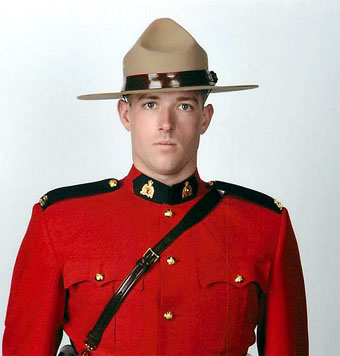
Photo by Whitehorse Star
Const. Michael Potvin
Photo by Whitehorse Star
Const. Michael Potvin
A tiny piece of wood stuck in the fuel filter system, an engine that was too heavy, a motor well with holes and a broken bilge pump.
A tiny piece of wood stuck in the fuel filter system, an engine that was too heavy, a motor well with holes and a broken bilge pump.
Individually, each of these deficiencies on a boat can be dangerous.
Together, they combined to become deadly.
The Whitehorse inquest into the drowning death of Mayo RCMP Const. Michael Potvin heard from a B.C. RCMP marine specialist and an expert marine architect Thursday.
Both were hired to examine the boat that capsized in the Stewart River on July 13, 2010.
Potvin, originally from eastern Ontario, died while attempting to swim to shore. He was 26.
Marine architect Alex Brydon and B.C. RCMP marine specialist Blake Ward spent two weeks examining the different parts of the boat and taking it through various tests, both on land and in the water.
A piece of wood was found inside the filter system partially blocking the intake of fuel to the engine, the men said.
The small piece of debris — measuring 12 mm long by five mm wide — would not have been visible during an external inspection of the motor.
Brydon testified he only discovered the obstruction after taking the system apart and attempting to blow through the piece.
"Had that not been there, I doubt we would be here today,” he told the inquest.
Brydon said the twig only caused a partial blockage. There was enough fuel reaching the engine to get it started but not enough to keep it from stalling out.
The inquest has already heard from Cpl. Brent Chapman, who was in the boat with Potvin when it capsized.
Chapman testified that the motor stalled multiple times, and that the boat began taking on water over the transom in the back before it flipped.
Ward and Brydon disagreed about how the wood may have gotten into the system.
Ward suggested the porous wood may have been sucked up through improperly installed copper pipes connected to the fuel tank.
Though the tubing and wood are very similar in size, Wade suggested the vacuum created in the fuel system was enough to pull the wood through.
Brydon said he didn't believe that was possible, pointing to kinks in the tubes.
"That twig has bothered me since the day I discovered it,” he said.
Brydon speculated that someone may have been trying to clean the filter by poking it with a stick.
The amount of weight in the back of the boat was also "fundamental to the whole accident,” Brydon said.
The jury has heard the boat went through multiple engines since 1985, beginning with a 50-horsepower motor and ending with a 150-horsepower version.
The original motor weighed 115 lbs., Ward said.
When the boat capsized, its larger motor weighed 470 lbs. plus an additional 115 lbs. from the auxiliary motor.
"It makes the boat heavier…it tips the stern down and the bow up,” Brydon said.
Having a smaller motor would have made "a huge difference,” he said.
Much of the work done on the boat since it was purchased would not meet any of the current standards set out in Canadian law, both men said.
The national standards for commercial boats, known at TP 1332, did exist in 1985 but was not written into federal legislation until at least 2001, Brydon said.
Holes in the motor well also affected the equipment's integrity.
The holes were cut in the side of the motor well to make room for the fuel lines and other wires.
That was something Brydon said he has never seen before and would "not at all recommend.”
The holes allowed more water to enter the back of the boat.
Wade pointed out that the large tub containing safety equipment, blocked much of the view of the well from the front of the boat.
Tests showed that 105 litres of water could be added to the back of the boat before the liquid became visible.
When it came time to examine the non-functioning bilge pump, Brydon testified, he found a pump that was full of mud and had a cracked case.
Under Canadian law, these pumps are not required equipment on a boat like the one Potvin was riding in.
Once the system was cleaned of the mud, it worked while attached to a battery, Brydon said.
The fuse powering the pump had shorted out, he said.
Wires to power the pump had slipped behind one of the fuel tanks on the inside of the boat.
The tank had a broken bracket meant to hold it to the floor.
Brydon showed a photo of the charred wire that had lost all its safety insulation and shorted out against the aluminum boat.
The bilge pump and the fuel gauge were on the same fuse, so were also not functioning.
Current national standards require that wiring be clipped up out of the way to avoid getting trapped behind things, Brydon said.
He described a rusty fuse box, including some wires that were not being used, and engine control wires being held together with electrical tape.
"Was this a professional job?” asked coroner's counsel Cindy Freedman.
"Not at all,” Brydon said.
After looking at all the equipment, Brydon and his team took the boat out on the water.
A boat should be able to float upright after it is fully swamped, he said.
But a video of tests done on the Mayo RCMP riverboat showed that it capsized before it was half-way full.
"We're trying to fill the boat with water,” Brydon said. "We don't even get close.”
The officials also took the boat out on the water and killed the engine to simulate a stall.
Hundreds of litres of water came into the boat.
Without the auxiliary motor, much less water came in, Brydon said.
Questions about RCMP national policy also came up.
At the time of Potvin's death, the Yukon division did not have the required Basic Water Transport Co-ordinator.
This person would have been required to approve all boats before they are passed to go on the water.
He or she would also have been helpful in finding out more information about the boat's history.
Chapman has testified to struggling to find any record of the boat's history or past maintenance.
Brydon continued giving evidence today.
The inquest, which began on Monday, will have to go into Saturday, the jury was told Thursday.
Karen Ruddy, a territorial court judge, is acting as coroner in the proceedings.
In order to encourage thoughtful and responsible discussion, website comments will not be visible until a moderator approves them. Please add comments judiciously and refrain from maligning any individual or institution. Read about our user comment and privacy policies.
Your name and email address are required before your comment is posted. Otherwise, your comment will not be posted.
Be the first to comment