Photo by Vince Fedoroff
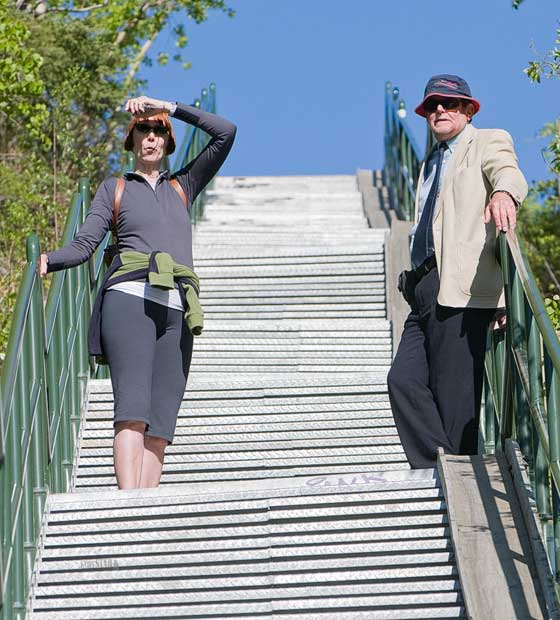
STEPPING INTO THE STUDY - Jacky Kennedy, left, from Canada Walks, and Rodney Tolley, from Walk 21, check out the stairs in Puckets Gulch this morning.
Photo by Vince Fedoroff
STEPPING INTO THE STUDY - Jacky Kennedy, left, from Canada Walks, and Rodney Tolley, from Walk 21, check out the stairs in Puckets Gulch this morning.
The most used, but also the most ignored form of transportation when it comes to planning and engineering is walking, says Jacky Kennedy, director of Canada Walks and an expert with the Canadian Walking Master Class.
The most used, but also the most ignored form of transportation when it comes to planning and engineering is walking, says Jacky Kennedy, director of Canada Walks and an expert with the Canadian Walking Master Class.
"Everybody can walk," she said, noting that those in wheelchairs are included in considering pedestrians' needs.
She's one of three experts in town this week to do an assessment of Whitehorse's pedestrian infrastructure, primarily in the downtown area.
This morning, she and her co-workers, Bronwen Thornton and Rodney Tolley, walked to the staircase at Puckett's Gulch.
Kennedy said the city is one of four the group is looking at to get a sense of what is happening throughout the country in terms of pedestrian infrastructure and where improvements need to be made.
There isn't much information available about best practices across the country when it comes to pedestrian infrastructure. A number of cities have brought in experts from other countries or look to Europe for planning guidance.
The information collected from the case studies in Moncton, N.B., Hamilton, Ont.; Kelowna, B.C. and now Whitehorse will be compiled and available through the Canada Walks website, Kennedy said.
For the most part, communities are designed and engineered around motorized traffic, with some thought given to accommodating cyclists, but little thought around pedestrian traffic, she argued.
"We pay no attention to it," Kennedy said. Walking is the most important form of transportation - something everyone has to do at some point, even just to get from where they've parked their vehicle to their destination, she said.
There's also a whole demographic of people - in many cases, young and old - who can't drive and who use their feet to get where they're going.
Issues of climate change, air quality and ever-rising gas prices have made alternative transportation more important, she said.
Building primarily for vehicle traffic can also often mean a sense of community is lost as residents simply drive to and from wherever they're going.
It can also take its toll on the local economy as drivers stay away from the independent retailers in favour of the big box shops that include large parking lots, she noted.
Kennedy used an example of pedestrians or cyclists out on a riverfront trail on a weekend afternoon. They would be more likely than a driver to stop at a hot-dog stand for lunch, with some of that money going back to the city in taxes, she said.
"People don't realize how important that is to the local economy," Kennedy said.
At the time of the interview, the trio had yet to complete the tour of downtown, so Kennedy had not yet formed a full opinion on the city's pedestrian infrastructure.
However, she said she was pleased with what she'd experienced so far.
"A lot of it is really good," she said, noting she, Thornton and Tolley had walked from where they were staying in Riverdale to the downtown this morning, making use of the Millennium Trail on the way.
Based on what she saw this morning, the city has a lot of cyclists, Kennedy said.
The group also explored the area around F.H. Collins Secondary and Selkirk Elementary schools and will continue exploring the city into this afternoon before making a presentation at tonight's city council meeting.
Over the next two days, the trio will continue to meet with city officials and others about planning for pedestrian traffic and will provide an assessment report to the city.
"This assessment from our visitors will provide us with valuable input as the city moves forward with our sustainable initiatives," Mayor Bev Buckway said in a statement. "This input will be incorporated into our Official Community Plan review process, which is currently underway."
In the other cities they've looked at, Kennedy noted sprawl is one of the issues found in all three.
In Hamilton, the downtown has suffered from sprawl, but the city is fixing up its waterfront and making pedestrian connections from there to the downtown.
Though a small city, Moncton has also seen its downtown fade as the city has developed with few pedestrian routes from the newer areas to the downtown.
The riverfront area, on the other hand, has some "fantastic" walkways and efforts are being made for pedestrian connections from the university to the city's core.
While Kelowna is doing a lot to improve its downtown, the B.C. community is facing some unique issues as it tries to work around large agricultural areas and first nations land, Kennedy said.
The assessments are part of the Walk 21 initiative (www.walk21.com), an international effort aimed at promoting healthy and sustainable communities where residents have the option of walking.
In order to encourage thoughtful and responsible discussion, website comments will not be visible until a moderator approves them. Please add comments judiciously and refrain from maligning any individual or institution. Read about our user comment and privacy policies.
Your name and email address are required before your comment is posted. Otherwise, your comment will not be posted.
Be the first to comment