Photo by Vince Fedoroff
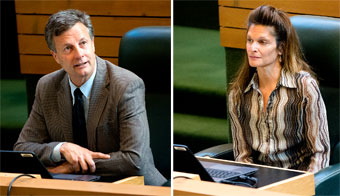
OPINIONS OFFERED – Mark Jaccard, a professor from Si mon Fraser University, addresses the Yukon legislature's se lect committee Tuesday (left). Latlia Bharadwaj, right
Photo by Vince Fedoroff
OPINIONS OFFERED – Mark Jaccard, a professor from Si mon Fraser University, addresses the Yukon legislature's se lect committee Tuesday (left). Latlia Bharadwaj, right
A B.C. environmental economist says if it were up to him, he wouldn't develop natural gas infrastructure in the Yukon.
A B.C. environmental economist says if it were up to him, he wouldn't develop natural gas infrastructure in the Yukon.
"I would be exploring my renewable options, my zero emission options for your energy system,” Mark Jaccard, a professor from Simon Fraser University, said Tuesday.
"You're a fairly small population and a very large resource base.”
Jaccard was speaking before the legislature's select committee regarding the risks and benefits of hydraulic fracturing.
The committee is hearing from a series of experts this week during its second round of public proceedings in the legislative assembly.
Jaccard was the first of two experts to present Tuesday morning.
He noted that when only final use emissions are considered, natural gas produces 50 per cent less carbon dioxide than coal, when used to produce electricity, and 25 per cent less than gasoline, when used to power vehicles.
But the analysis must be expanded to garner a true understanding of the costs and benefits of natural gas
development, he argued.
All energy uses and all energy supply options need to be considered, he explained, using the potential development and use of natural gas in China as an illustrative example.
To determine the net effect of lower-cost natural gas, China must consider what alternative energy sources it will displace, the committee heard.
If natural gas displaces coal, it's likely the country's greenhouse gases would decrease. If natural gas replaces investment in nuclear power or other renewables, however, GHGs would rise.
Lower electricity prices due to low-cost natural gas could also mean higher GHGs because they wouldn't encourage energy conservation measures.
"You see how complicated it is,” Jaccard noted.
He added he's skeptical of the argument that natural gas can act as a bridge to a renewable energy economy, poking holes in a well-used Yukon Party line.
"I tend to be somewhat skeptical of the argument ‘let's rapidly expand natural gas of all kinds because it will be a nice bridge to this ultra low-emission future.' You need to have natural gas demand start to fall pretty rapidly after 2050,” Jaccard said, noting that's a mere 36 years away.
If the government is to permit hydraulic fracturing and the development of a Yukon natural gas industry, Jaccard said, it should develop a strong environmental regulatory regime upfront, and not invest public monies in natural gas infrastructure.
"Let industry do it,” he said, arguing that if industry sees an economic case for pursuing natural gas development, it should be able to do so without a government subsidy.
Industry should also have to prove it can develop the industry while meeting the territory's environmental goals.
If it can't, maybe it's not an industry that should be developed in this economic environment, the professor suggested.
Jaccard explained that there's currently a price gap between the East Asian and North American markets that's created competition among Canada, the U.S., and Australia to supply gas to Europe and Asia.
The price for natural gas in East Asia has ranged from $13 to $15 per million cubic feet, Jaccard said.
He noted that most western Canadian producers need a price of $10 per million cubic feet or more to make supplying natural gas to China economical.
But he forecasts that price gap between the North American and East Asian markets will close in the next five to 15 years, especially with lower costs of production in countries like Russia and OPEC members.
Governments should be careful not to absorb these risks; rather, companies should be forced to account for them, he said.
The committee also heard from Lalita Bharadwaj, a toxicologist with the University of Saskatchewan.
Bharadwaj highlighted the overwhelming lack of information surrounding public health impacts of hydraulic fracturing.
There are knowledge gaps surrounding baseline information of air, soils, and water, poor understanding of the chemical mixtures used in hydraulic fracturing, and poor understanding of the magnitude, frequency, and duration of exposures of humans and animals to those chemicals, she said.
Bharadwaj noted that while 98 per cent of fracking fluid is water, approximately 200,000 cubic metres of water are used per well, which means even small percentages of chemicals can amount to significant volumes of chemicals that in such large quantities could be harmful to human or environmental health.
Bharadwaj highlighted concerns that while companies have knowledge of the chemicals going into the ground, what's coming out in the flow-back could have different properties, as it's unknown what impact the pressure and heat have on the fluid underground.
Potential airborne emissions from diesel engines, natural gas compressors, and possible fluid evaporation from stored waste water could include nitrogen oxides, sulfur oxides, and volatile organic compounds.
There's also the potential for the release of ground level ozone – a significant respiratory irritant, Bharadwaj noted.
What's not well understood is the exposure routes of these emissions: how and where they are released and how they are distributed.
While there is some air monitoring in places like Alberta, Bharadwaj notes that as it's government-run, there's little confidence in the results.
She suggests transparent, independent monitoring could improve public confidence.
This morning, the committee was to hear from the Yukon's chief medical officer of health, Dr. Brendan Hanley, as well as New Brunswick's chief medical officer of health, Dr. Eilish Cleary, and the regional medical of health for B.C.'s northeast health service district.
Donald Reid, a conservation zoologist, and John Hogg, the vice-president of MGM Energy Corp., were to offer their comments on hydraulic fracturing this afternoon.
The proceedings are open to the public and broadcast live online at www.legassembly.gov.yk.ca.
See letter, more coverage in Thursday's edition.
In order to encourage thoughtful and responsible discussion, website comments will not be visible until a moderator approves them. Please add comments judiciously and refrain from maligning any individual or institution. Read about our user comment and privacy policies.
Your name and email address are required before your comment is posted. Otherwise, your comment will not be posted.
Comments (2)
Up 5 Down 1
Thomas Brewer on May 29, 2014 at 7:33 am
"Lower electricity prices due to low-cost natural gas could also mean higher GHGs because they wouldn't encourage energy conservation measures."
That's a GREAT argument to keep burning diesel fuel in our homes.
Run back to SFU where you don't have $800 a month heating bills. Tosser.
Up 16 Down 6
just Say'in on May 28, 2014 at 2:45 pm
Who cares what this self proclaimed expert says. He just hangs around getting about 200,000 per year as a professor and we should all listen to him because of course "wait for it" he knows. These guys went to school their entire life they have never done anything value added, nothing to raise the standard of living for their fellow man. Just another talking head.