Photo by Vince Fedoroff
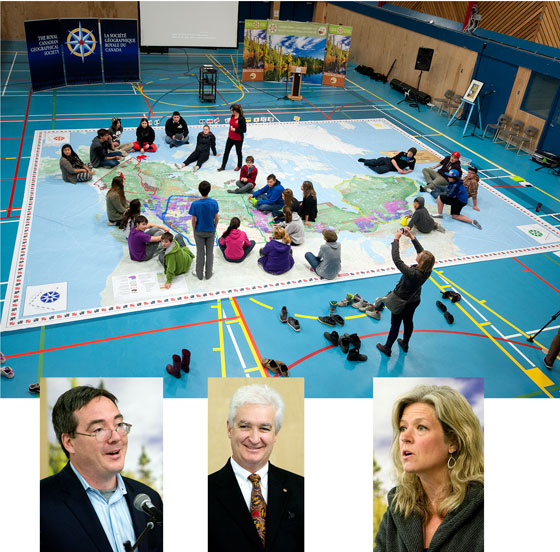
MAMMOTH MAP – Porter Creek Secondary School students take part in the On the Move campaign Wednesday morning at Yukon College. ARAN OCʼARROLL ANDRÉ PRÉFONTAINE FIONA SCHMIEGELOW
Photo by Vince Fedoroff
MAMMOTH MAP – Porter Creek Secondary School students take part in the On the Move campaign Wednesday morning at Yukon College. ARAN OCʼARROLL ANDRÉ PRÉFONTAINE FIONA SCHMIEGELOW
Whitehorse students got the chance to learn a little bit more about Canada's boreal forest Wednesday using an interactive floor map that's large enough to hold 24 caribou on its surface.
Whitehorse students got the chance to learn a little bit more about Canada's boreal forest Wednesday using an interactive floor map that's large enough to hold 24 caribou on its surface.
The map and accompanying chest of resources is travelling among schools with the intention of engaging students in the issues of the boreal forest.
The On the Move campaign, of which the map is a key component, was developed by the Royal Canadian Geographical Society and the Canadian Boreal Forest Agreement (CBFA) Secretariat. The goal is to teach school children and the general public about the CBFA and more broadly the ecosystem it seeks to protect.
"There are few issues facing Canadians today that are as vast, as vital as the boreal forest,” André Préfontaine, the society's executive director, told a news conference in the Yukon College gym.
"For us at the society, the issue is so big that we needed to respond with something equally large.
"The map makes it possible for students to explore the immensity of the boreal forest and discover the complexity of the issues it faces ... it allows students in interaction with their teachers to consider a range of questions from wildlife conservation to biofuels, from the economy to the environment, from exploitation to sustainability and in the true spirit of the boreal forest agreement to do this in concert, not opposition,” he said.
Aran O'Carroll, the secretariat's executive director, offered a glance at the boreal forest agreement's history.
"Looking back a few years, there was an awful lot of conflict in the forests across Canada; a war in the woods, if you will, between forest companies and conservation groups,” he said.
The forestry industry, he continued, was focused on developing Canada's forest resources into products people need and demand.
"There's more than half a million people who rely on the industry for their jobs across the country, and last year, the forestry sector generated almost $60 billion in revenues,” O'Carroll said.
The environmental groups, in the meantime, were focused on protecting Canada's wilderness and the species that call the boreal forest home, including the woodland caribou.
The woodland caribou is an "important species,” said O'Carroll, explaining that it's an indicator of an ecosystem's overall health.
"Caribou populations have been in decline, and that tells us, amongst other things, that the boreal forest ecosystem is facing major challenges,” he said.
"Both forest companies and environmental communities goals' – protecting jobs and communities and protecting the environment – are vital objectives. But these groups were not working together to achieve the goals,” O'Carroll said.
The CBFA sought to change that pattern.
In May 2010, the Forest Products Association of Canada and its member companies, as well as leading environmental groups, signed the CBFA, which now applies to more than 73 million hectares of public forest across Canada.
As part of the agreement, environmental groups agreed to stop organizing campaigns and boycotts against the forestry industry.
In return, the forest industry committed to set aside 29 million hectares of boreal forest – virtually the entire boreal woodland caribou habitat.
"These reciprocal commitments to each other were intended to create a space for finding solutions, and they continue to do that,” said O'Carroll.
"The agreement really provides a new model for collaboration that says it's no longer required for the business community to sit at the table and argue for jobs while the environmental community often stands out on the street protesting for conservation.”
The secretariat and the society were also in Whitehorse for the 15th North American Caribou Conference, held this week at the Kwanlin Dun Cultural Centre.
Fiona Schmiegelow, the senior science advisor for the CBFA and the director of the college's environmental sciences degree program, highlighted one of the conference's key messages: the importance of partnerships.
The CBFA, she said, is a true partnership that moved the issue of boreal forest and caribou conservation from a point of conflict to one of collaboration.
Schmiegelow noted that many challenges facing southern portions of Canada's boreal forest resulted from "thoughtlessness.”
"Many of the strategies that were developed to develop resources in the South were very much focused on a single resource, and they didn't consider the many other values of the boreal forest when planning those development activities.
"We now, due to considerable scientific research and observation, understand the implications of these decisions for the broad range of values the boreal forest provides, and we can avoid many of these negative consequences through much more careful planning,” Schmiegelow said.
In order to encourage thoughtful and responsible discussion, website comments will not be visible until a moderator approves them. Please add comments judiciously and refrain from maligning any individual or institution. Read about our user comment and privacy policies.
Your name and email address are required before your comment is posted. Otherwise, your comment will not be posted.
Be the first to comment