Erik Nielsen co-piloted plane's final flight
It appears what's been talked about since the early 1980s is finally coming to fruition.
By Stephanie Waddell on March 6, 2009
It appears what's been talked about since the early 1980s is finally coming to fruition.
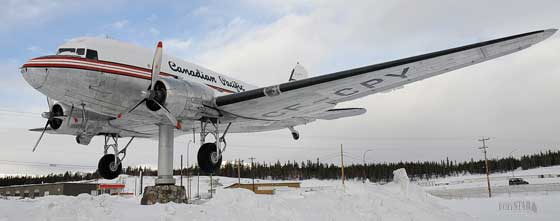
As part of the improvements underway at the Erik Nielsen Whitehorse International Airport, the DC-3 windvane, also called weathervane, will need to be moved as the airport's north access is realigned, Doris Wurfbaum, a spokeswoman for the Department of Highways and Public Works, explained this morning.
The Canadian Pacific plane, which arrived in the Yukon after the Second World War, will be moved to the northwest corner of the nearby Yukon Transportation Museum's lot toward the end of June at an estimated cost of $100,000, she said.
That cost also includes the installation of a new pedestal for the aircraft.
Though still visible from the Alaska Highway, Wurfbaum said it won't be as close to the road as it currently sits.
Plans for the move were included in the public consultation done on the changes to the airport parking lot.
Wurfbaum said there were no public concerns expressed then, but the museum wanted to ensure it was protected in transit and before it's mounted again.
Bob Cameron, who was part of the Yukon Flying Club which originally restored the Canadian Pacific plane in the 1970s, said today there's been talk of moving the plane since it was placed at the airport.
The local aviation historian said his opposition to moving what some have deemed the largest weathervane in the world (Cameron was quick to note it was the media that originally called it a weathervane) has softened over the years.
However, he continues to have concerns about moving the massive structure.
It should be placed in a location where visitors can see it as they travel from or to the airport.
Cameron also expressed concern that after the plane is removed, the pedestal would likely have to be demolished, given its base of concrete that's 20 feet by 20 feet and somewhere around three feet deep.
"You'd have to demolish the base, I suspect," Cameron said, adding it would be a shame if, after that demolition, a new mount for the plane wasn't reconstructed.
"It's a world-class monument," he said.
After serving Canadian-Pacific for years, the DC-3 was sold to Connely Dawson Airways, which later became Great Northern Airways, doing local runs in the territory.
It was in 1970 that the plane was grounded due to engine failure on take-off, with Erik Nielsen, the former Conservative MP who died last September, sitting in the co-pilot seat.
For years, the plane sat grounded near the current site of the museum and was used for parts.
In the mid-1970s, Cameron recalled, it was sold to the Yukon Flying Club for $1 to restore and put on display.
With the help of three teams of youth involved in the Katimavik program, the flying club restored the plane in what Cameron remembers as being a cold hangar.
"At the time, our ideas were less grandiose," he said, recalling that though restored, the plane was to sit on the ground as a display.
It was the ingenuity of Ed Jacobs and Keith Byram that saw the DC-3 lifted into the air again, on top of its pedestal, built with the help of Parks Canada, in 1981.
To this day, Cameron will not reveal how it is the plane can act as a windvane except to say it has something to do with its internal structure.
Over the years, he said, he's gotten calls from around the world asking how it works.
"I act vague," he said.
The most recent incarnation of the plane came in September 2001 when the "re-restored" windvane removed three years before was put back on its pedestal.
As Cameron noted, the restoration done in the 1970s was completed with little money in the cold hangar, and by the late 1990s, was looking a little weathered.
This time around, a new, largely volunteer crew had a heated facility and more cash to spend on paint, fabric and other materials.
"Hopefully, it will be good for another 20 years," Cameron said.
Be the first to comment