Photo by Whitehorse Star
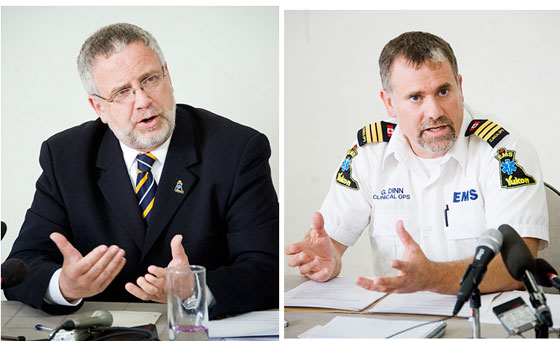
Pictured Above: MICHAEL MCKEAGE and GERARD DINN
Photo by Whitehorse Star
Pictured Above: MICHAEL MCKEAGE and GERARD DINN
A report issued by the territorial government's audit services branch has made 13 recommendations to improve the Yukon's Emergency Medical Services (EMS).
A report issued by the territorial government's audit services branch has made 13 recommendations to improve the Yukon's Emergency Medical Services (EMS).
Among the ideas, which were approved earlier this month and released Thursday, the committee suggested EMS "take steps to improve its financial management capacity.”
The report notes that from 2010 to 2011, EMS spent 114 per cent of its original budget. From 2009 to 2010, that number was 122 per cent and the year before that, 115 per cent was spent.
"The pattern of significant variances between original and revised budgets is a continuing management concern,” the report said.
"We're taking a very close look at our budget,” said EMS director Michael McKeage.
"We're going right to the source of every electric bill and every other expense at each one of the bases so we can come up with a very accurate portrayal of each budget for each base in each area.”
McKeage would not say whether EMS is on track to exceed this year's budget.
"When that analysis is complete, we will be better able in an evidence-based way to give you a very precise review of if there are any budget shortfalls or if it is just a matter of just moving resources around,” he said.
With the growing population in the territory, Gerard Dinn, clinical operations manager with EMS, said the number of calls received by EMS has been steadily rising.
"What is significant is that we're not looking at an even proportioning of when these call occur. They can cluster,” Dinn said.
"The actual number of patients doesn't describe the change in complexity or frequency that they are occurring.”
From 2009 to 2010, the most recent data available when the study was conducted, EMS reported 1,501 ambulance calls in the communities, 5,033 calls in Whitehorse and 643 medevac vehicle or aircraft-related trips.
McKeage insists that any penny-pinching on the part of EMS will not result in any cuts in services; instead, there will be a focus on being more efficient.
"When we're talking about bringing operational and fiscal efficiency to the organization, I haven't used the word ‘cut' here. What we're looking at is making sure we've got the right resources to do the job that we're dealing with,” he said.
One way to improve money management is to "obtaining reliable and realistic costs” as well as improving the collection of information for billing on medevacs for non-residents, the report said.
Another suggestion was to improve internal communication within EMS to reduce the possibility of things being done twice.
To help with this, supervisors from across the territory are now taking part in regular teleconferences to share ideas and information.
"Without that kind of cross-pollination of ideas and shared victories, sometimes there's been things being redone that others have found solutions too,” McKeage said.
Aside from suggestions related to fiscal management, the report also recommends that EMS monitor the training and certifications of staff and volunteers to better assess training needs and ensure consistent and equivalent skill sets.
Currently, the amount of formal training required to become a paramedic can range from six months to two years, the report said.
"If these skills and techniques are not routinely reviewed and practised, there is an increased likelihood of skill decline and inconsistency in the delivery of care,” the report said.
Currently, EMS is developing a training schedule and recertification program.
"We don't deliver babies every day and we don't deal with certain traumas every day, so what we need to do is maintain competence by giving people continuing education to help them maintain their skills,” McKeage said. "We're very proud of the level of care we give ... but it doesn't mean we just stop.”
The program has a target date of December 2011.
The report did not tackle the question of what, if any, effects resulted transferring EMS services to the Department of Community Services from the Department from Health and Social Services in 2007.
All 13 recommendations are expected by management to be implemented by the end of 2012, according to a timeline included in the report.
In order to encourage thoughtful and responsible discussion, website comments will not be visible until a moderator approves them. Please add comments judiciously and refrain from maligning any individual or institution. Read about our user comment and privacy policies.
Your name and email address are required before your comment is posted. Otherwise, your comment will not be posted.
Comments (2)
Up 0 Down 0
YukonMax on Aug 27, 2011 at 5:08 am
Out of the 643 ambulance or medevac trips, how many of them were from a community 50km and more? I bet we are down to a couple of hundreds. How many were admitted after being transported to WGH? How many of them were released within 24 hrs? And from those, how many ended up being stranded in Whitehorse without transportation arrangements to take them back to their communities? The number keeps going down here, so, would it be too much of a challenge for you bureaucrats living in the vicinity of Whitehorse to give a little consideration for those from the communities who keeps falling into the cracks of this system? Really!!!
Up 0 Down 0
anonymous on Aug 26, 2011 at 8:52 am
If the report did not state that transferring EMS services to the Department of Community Services from the Department of Health and Social Services affected this in any way then where did the Yukon News get it's information from?
"Since being transferred from Health to Community Services in 2007, the ambulance service's yearly call volume has risen to almost 7,000 from 3,700.
As a result, the Whitehorse station has seen an increase of 16.5 full-time jobs.
But the department has gone into the red trying to pay its staff."
Maybe if the detox building (with nurses) which was suggested as a means of dealing with the people who drink too much was implemented then less calls would be made to 911 to deal with it. If they are passed out at Superstore or in front of a building that results in more calls to 911 and I would be interested to know how many calls to 911 are to do with that problem.