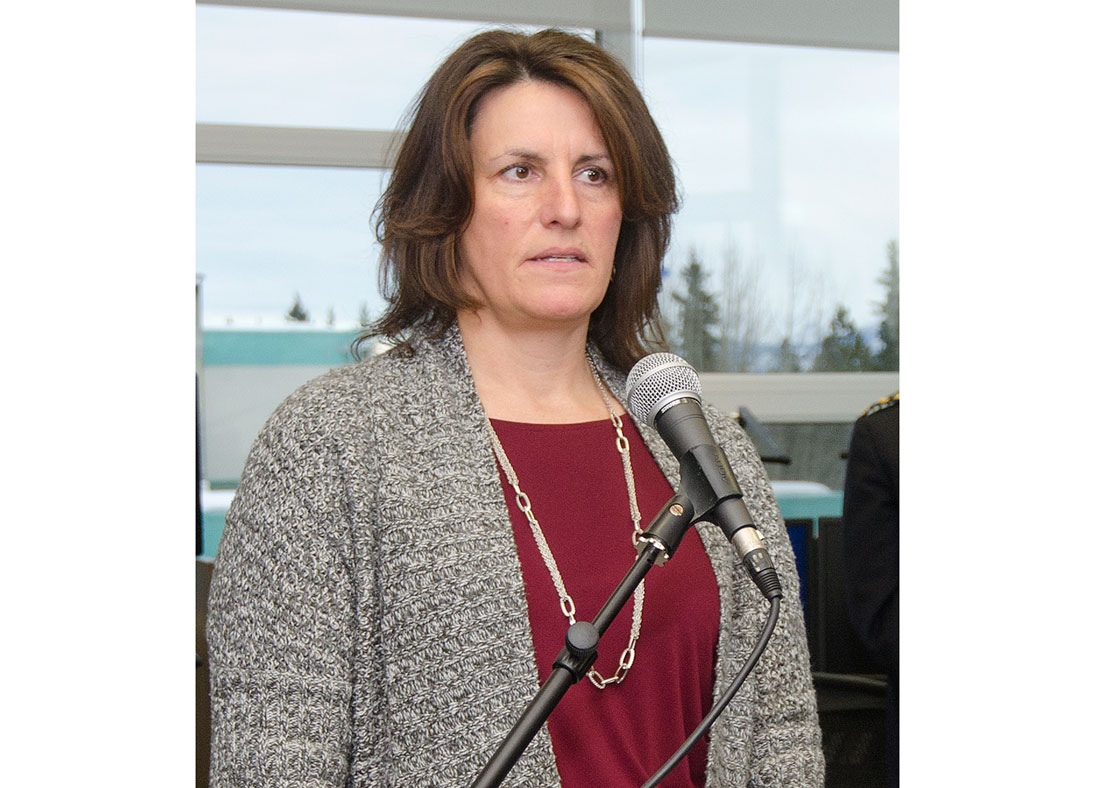
Photo by Whitehorse Star
Gaylene Shoemaker
Photo by Whitehorse Star
Gaylene Shoemaker
The RCMP are assuring Yukoners that if they dial 911, they will never be put on hold.
The RCMP are assuring Yukoners that if they dial 911, they will never be put on hold.
“We have to hear a two-way conversation before we disconnect,” Gaylene Shoemaker, the unit commander for the RCMP’s operational communications centre, said in an interview Monday.
When a call is made to 911 from anywhere in the territory, the operator will ask the caller what community he is calling from and what type of assistance he needs: medical, fire, police or some combination.
The caller will then be transferred to the appropriate local emergency agency (a community nursing station or fire hall, for example) where a second call-taker will ask for more information.
But the 911 operator will stay on the line with the caller until the next emergency responder has answered the phone.
“We have to stay on the line until, by policy, the caller is communicating with dispatcher for fire or ambulance,” said Shoemaker.
If the caller requires more than one kind of assistance, the call will be transfered to the service that is needed most.
If the call involves a medical response, she said, the caller will typically be transferred straight to the local ambulance station, she said.
“If it’s more than one (service that’s needed), medical is a priority,” said Shoemaker.
“If they need police and ambulance, we transfer to ambulance.”
Shoemaker noted that if the caller needs police, there is no need to transfer the call because the RCMP are the agency operating the 911’s central call centre.
The initial contact with a primary service answering point (PSAP) operator is “very brief,” said Shoemaker.
“We’re transferring immediately,” she said.
When a caller is in a panic, however, he may not realize that the PSAP operator is not able to take all of his information and dispatch the proper emergency response.
That’s why the PSAP operator stays on the line until he or she hears that the call has been picked up by ambulance or fire.
“We’re still with them; it’s ringing, but we’re still talking,” said Shoemaker.
“We’ll say, ‘hang on, we’re still on the line.’”
PSAP operators aren’t trained to walk a caller through a medical procedure, like how to help someone who’s choking, she said.
“We don’t have that training and we don’t need it honestly because they (ambulance and fire) answer immediately,” she said.
If the caller wants only medical assistance, the PSAP operator will hang up as soon as the call is answered by EMS, for privacy reasons.
There is someone manning the phones at local fire and medical services around the clock, she added.
The new territory-wide 911 service went live last Thursday.
Now, anyone in the Yukon with access to a landline or a cell phone signal can dial 911 in the event of an emergency.
The new system is basic, meaning the PSAP operator doesn’t get the caller’s location or phone number when the call comes through.
This is why it’s critically important that the caller gives the PSAP operator the most precise location possible.
The Yukon’s new, expanded 911 service is similar to existing systems in B.C. and Alberta.
In some Canadian jurisdictions, fire and ambulance are automatically dispatched on every call. This is not the case in the Yukon, said Shoemaker.
Again, she warned Yukoners against calling to test the number – it works.
Indeed, PSAP operators have fielded calls from several different communities across the territory since the expanded 911 service began four days ago.
Shoemaker also advised that smartphone users lock their home screens to avoid accidental “pocket dials.”
If 911 is dialed by accident, from a cell phone or landline, “stay on the line and tell us,” said Shoemaker.
“Otherwise we have to spend the time calling back and tracking them down ... it saves us a lot of time.”
The old, seven-digit numbers in the communities can still be called in the event of an emergency. Yukoners and tourists now have the option of calling 911, or using the old numbers when they need emergency fire, police and/or medical assistance.
In order to encourage thoughtful and responsible discussion, website comments will not be visible until a moderator approves them. Please add comments judiciously and refrain from maligning any individual or institution. Read about our user comment and privacy policies.
Your name and email address are required before your comment is posted. Otherwise, your comment will not be posted.
Be the first to comment