Elk wreaking havoc for area farmer
A farmer along the Takhini River Road says something has to change with how the government manages the elk it introduced to the Yukon.
By Chuck Tobin on February 13, 2015
A farmer along the Takhini River Road says something has to change with how the government manages the elk it introduced to the Yukon.
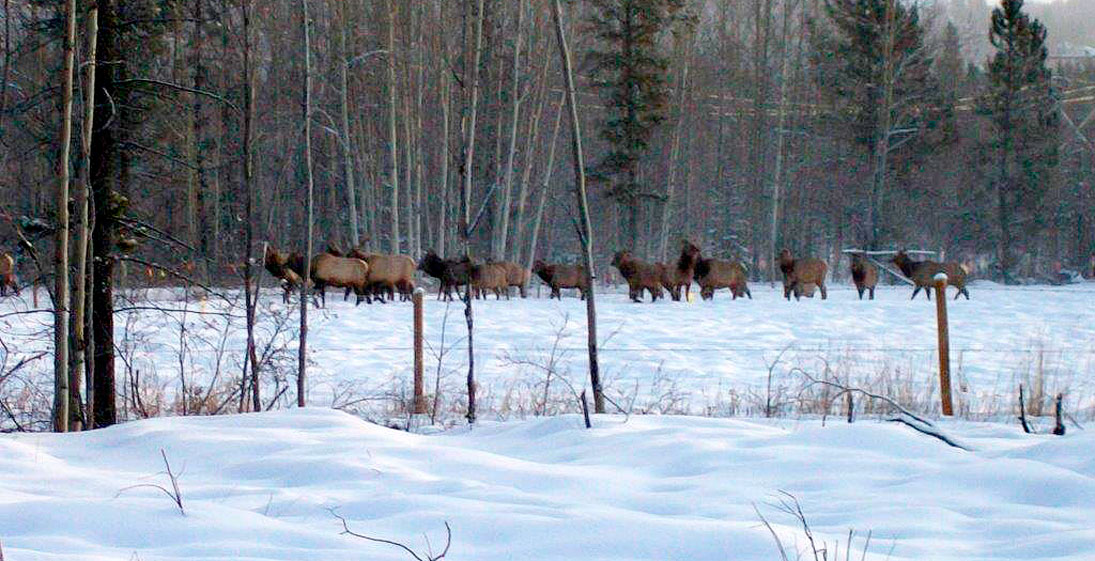
Since November, Mike Blumenschein has seen scores of the animals digging in his hay fields, and coming around his yard.
“I could have opened my bedroom window several times and reached out and touched them,” he said in an interview Wednesday at his home about a kilometre up from the river.
Blumenschein says he’s seen 50 elk in one field and 35 or 40 in another at the same time.
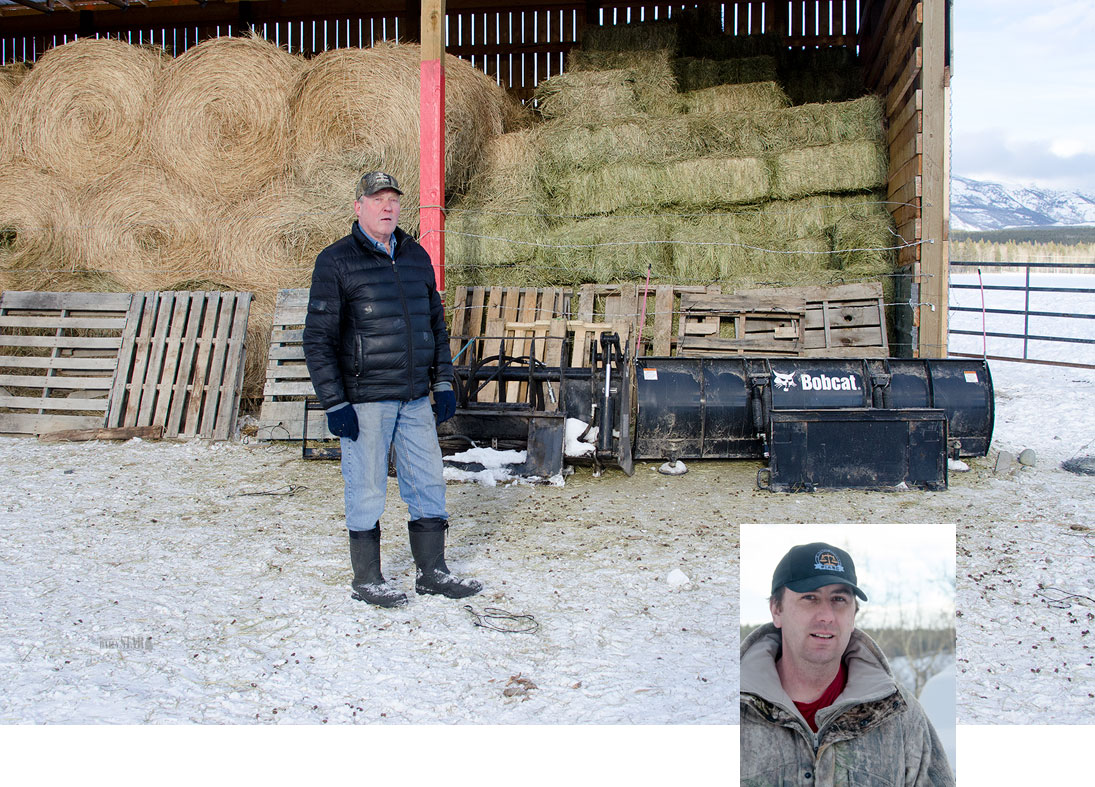
Most recently, in the last two weeks, the elk have been robbing his two hay sheds, even after he installed electric barbed wire fencing to deter the animals.
Pallets placed against the open side of one shed to block access are kicked or pushed away by the elk when they visit at night.
The electric fencing is either broken, pulled down or stretched, with tufts of elk fur hanging off. The thick eye hooks anchoring the barbed wire to hefty wooden support posts are bent
over at almost 90 degrees, as though they were made of straw.
Blumenschein says he’s had to repair regular field fencing damaged by elk in past years, but never has he had field damage or elk getting into his hay sheds.
He’s not certain how much crop he’ll lose this summer because of the elk, but he wouldn’t be surprised if it were upwards of 20 per cent. His annual revenue from hay sales is $70,000
to $80,000, Blumenschein estimates.
The elk like to paw through the snow to forage, and then they lay down.
Blumenschein suspects some of the damage will be caused from their body heat thawing the ground a bit, which freezes again when they leave.
He suspects the hay in the foraged areas will be somewhat stunted by the exposure to the elements, but by how much he’s uncertain.
Greg Paquin farms just down the road from Blumenschein, right along the river.
It’s the first year he’s seen elk dig through his fields in any great numbers. Like Blumenschein, he too is wondering how his summer hay crop will be affected.
A director with the Yukon Agricultural Association, Paquin believes what they are seeing is a permanent expansion of the elk’s winter range, for whatever reason.
Blumenschein says the Yukon government has to come up with a solution, or be prepared to compensate farmers because the elk were introduced by the government.
Perhaps it’s time to expand hunting opportunities on elk that roam outside what has been defined as the core area where no hunting is allowed, not even permit hunts, he says.
Hunting, Blumenschein adds, would help reduce the size of the herd, and may also serve as a deterrent to elk visiting farms.
He said while this is the first year he’s been overrun by elk, farmers along the Alaska Highway on the other side of the Takhini River have been dealing with it for a decade or longer.
Some may say a sturdier game fence around the farm may be the answer, along with closing in his hay shed, Blumenschein says.
He’s says it’s easy to say if you’re not paying for it.
“Why should I take money out of my pocket?” he asks. “It is an introduced herd. It is not a natural species here.”
Blumenschein points out he has three kilometres of fencing, or just under 10,000 feet, and game fencing runs about $7 to $8 a linear foot.
Under a federal agricultural program administered by the Yukon government, he was able to recover $1,400 last year for materials required to repair fencing damaged by wildlife.
But nobody covered his four days of labour, he says.
Historical records show the government initially introduced elk to southwest Yukon in 1951, under the encouragement of the Yukon Fish and Game Association (YFGA).
It was seen as a means of eventually providing hunters with an alternative while reducing pressure on indigenous animals, such as moose and caribou.
Another 30 were transplanted in 1954.
It wasn’t until 1989 when the next elk were introduced. From 1989 through 1994, another 119 were brought in, essentially re-invigorating two distinct herds – the Takhini valley herd that
roams in Blumenschein’s neck of the woods and the Braeburn herd.
The first permit hunt was held in 2009, when 40 permits were issued, resulting in 20 elk being harvested.
Another 71 permits were issued in 2010, resulting in 32 elk being killed; 72 permits were issued in 2011, resulting in 34 elk being harvested; 21 permits were issued in 2012, resulting in
nine elk shot.
For both the 2013 and 2014 seasons, six permits were issued, resulting in six elk harvested each season.
The most recent estimate by Environment Yukon put the Takhini valley herd at approximately 200 animals in 2013, and the Braeburn herd at 60.
Senior conservation officer Ken Knutson says complaints of elk from farmers are not new.
Nor is it surprising the animals have taken to farmers’ fields, given the availability of food and general lack of predators around populated areas, he adds.
The manager of conservation officers for Environment Yukon says they’ve tried numerous tactics to deter the animals.
They’ve even tried putting up a silhouette of a wolf accompanied by automated wolf howls, but that too gets old with elk after a while, Knutson says.
Knutson points out the government is well aware of the issue with farmers, and it’s one of the reasons the review of the elk management plan developed in 2008 has been bumped up a
year to this spring.
The first meeting of the elk technical team and the numerous interested parties, including the agricultural association, is scheduled for the end of the month.
Knutson said there is a variety of interests to be taken into consideration, including the concern being raised by farmers.
But there are also the interests of the YFGA, which has been behind the elk transplant from the beginning, and the interest of those who see elk as providing a valuable wildlife viewing
opportunity, he says.
Knutson says the review of the elk management plan is intended to take into consideration all concerns and points of view, and recommend how best to move forward.
Blumenschein says he doesn’t know how big the Takhini valley herd is getting. But he’s also not sure the government knows.
He goes on to point out how the transplanted bison herd has grown way beyond the government’s desired population target.
Perhaps, he suggested, the elk are expanding their range because they’re outgrowing the habitat available in and around the core area.
“My stand on it is you can have all the elk you want, just keep them in the core area,” he says. “The second they come out of that core area onto agricultural land, we should be able to hunt them.
“... Or they just have to start biting the bullet and paying for the damage.”
Comments (18)
Up 13 Down 5
Mike Blumenschein on Feb 18, 2015 at 1:23 pm
BnR andMoe whoever you are, you are misinformed, Mike has never received any government money for fertilizer, implements or any other freebies (especially free land) as you are suggesting.
Maybe all of you making misinformed comments should get fully informed on the situation before making foolish comments
Up 6 Down 7
Salar on Feb 17, 2015 at 7:40 pm
Like BNR said
The only food anyone could eat off those ag lands ARE the elk.....no comp....it ain't farming......hobby
Up 26 Down 22
melba on Feb 17, 2015 at 9:39 am
Shoot an elk when they are in your hay or pushing at the fence. The rest will probably decide this is not a good place to hang out. If the elk is killed quickly and then eaten, I do not see this as a problem.
Up 15 Down 20
Bill waschuk on Feb 16, 2015 at 8:42 pm
The MNR should have a cull and remove all the nuisance elk. They are a road hazard and the over grazing is ruining peoples livelihood .
Up 22 Down 18
Greg on Feb 15, 2015 at 8:57 pm
I think we are getting a little far off the "elk issue" topic here. Never mind the land and the cost of doing business. One of my main concerns is for the safety of the public. I am out at least two or three times a night trying to keep my live stock in and the elk out. I had really good fences until the elk showed up. I am just worried that my livestock will get out and someone will get hurt. I can't watch my fence 24 hrs a day. I have to go to work and make a living.
Remember where your food comes from.
Up 20 Down 22
My land wasn't free on Feb 15, 2015 at 8:44 pm
The ag land that people receive is far from free. Thousands of dollars are spent on the land some of you are refering to as "free" before the land is even officially yours. Not to mention the time that a person puts into establishing a farm on it. Clearing, piling, working the land, building fences (YES our place in completely fenced), building a place to live on the piece of land, buying equipment to properly care for and maintain your land is far from free. Yes we choose to live where we do and do what we do but so do you.
Yes some people get a piece of land and do the bare minimum to get it to title and then sell it, which I personally don't agree with but that's another topic for discussion.
And for the record I do live on a farm that I purchased with my hard earned money and I have never subdivided or plan to.
Remember: if you ate today...more then likely you need to thank a farmer!
Up 27 Down 12
BnR on Feb 15, 2015 at 8:09 pm
Agriculture in the Yukon; growing hay for horse owners and other agricultural parcel owners who don't farm. I guess it's "agriculture", but if I can't eat it, I really don't think it counts.
And as far as handouts go, guys like Mike can get crop insurance (really), they have received cash from YG for farm implements and fertilizers.
I fully support YG helping out a meaningful agricultural industry, but like I said, if we can't eat it, it's really about growing hay for horses.
Up 42 Down 11
moe on Feb 15, 2015 at 11:31 am
I don't know Mike personally but I know of him and I think he is a good guy. He is off base though trying to lay a claim that the Yukon Government owes him money because Elk are getting into his fields and his hay. His point is that they are an introduced species and therefore the responsibility of the gov't and therefore he is owed money. I call it bs. Those elk were around for decades before he started farming. Whether they walked up the highway like the white tails are doing, or were brought here 65 years ago, either way they are part of the scenery now, so that's why I say 'deal with it'.
Mike has gotten plenty of money and free land as a farmer in the Yukon. Don't push it.
Up 26 Down 13
Brief comment on Feb 15, 2015 at 8:09 am
WTH next thing is, they're gonna want us to go and plant/harvest the crops on the free agricultural land grabs.
Up 34 Down 14
north_of_60 on Feb 14, 2015 at 10:41 pm
This 'farmer' can't erect a chain link fence to keep elk out of his hay barn, and now expects us taxpayers to buy and install one for him?
That's ridiculous.
Up 32 Down 13
Salar on Feb 14, 2015 at 3:18 pm
Folks who want to be 'farmers' in the Yukon shouldn't complain about the work involved....nobody made you do it. But you got lots of cheap land to subdivide and profit from selling.....maybe carve off another slice and use the profits to build your new fence....honestly, compensate a person wealthy enough to afford a hobby in the Yukon.
Up 12 Down 24
Julius Caesar on Feb 14, 2015 at 12:40 pm
Bring in some wolves, from Alberta and BC where they want to shoot them because they eat the caribou and the poor hunters have nothing to shoot.
Up 30 Down 32
Fed up Yukoner on Feb 14, 2015 at 8:59 am
Moe, farmers were around long before the elk were introduced, why they were introduced is a good question, surely they knew 65 years ago that introducing animals was not a good idea. Why don't we get rid of them since it seems it really hasn't provided much food, just a few permits for selected hunters. Maybe they are attracting predators but since they hang out so close to farms the wolves are a bit leary of hunting them.
How much was spent on the tick fiasco a few years ago, all for an introduced species. I think anyone who farms would disagree strongly with your comment on free land, it is anything but and a lot of hard work goes into getting those fields ready. Thank goodness there are folks like Mike who actually walk the walk unlike a multitude of do gooders who talk the talk and have no clue what is going on in the bush. Time YTG stepped up to the plate and compensated these guys, you hand out tons of money to miners and tourism, lets support our agricultural community.
Up 31 Down 19
moose101 on Feb 14, 2015 at 6:55 am
No sympathy here - elk were there long before you started your agricultural land grab . Maybe we should manage our cariboo and moose better so exploration companies won't have to deal with them when they go in and set up camp and get the Government to pay for that to.
Up 20 Down 30
Greg on Feb 13, 2015 at 7:42 pm
I've spent over a half a million dollars on what you call "free ag land" should I have to "deal with it" as well?
Up 36 Down 20
jaymanc on Feb 13, 2015 at 7:13 pm
Welcome to the yukon. They've been here before you arrived. Ever heard of fences? They work pretty good you know. That's what they did back in the day of real farming. They built fences. Or farm somewhere else perhaps. Like somewhere where there are no animals around.
Up 28 Down 6
Groucho d'North on Feb 13, 2015 at 6:15 pm
Nature employs chaos while mankind attempts to apply order.
You're never going to win.
Up 92 Down 28
moe on Feb 13, 2015 at 4:47 pm
The elk were introduced in 1951. You knew those wild animals were there when you got your ag options (free land). Deal with it Mike.