Elk imports carry great risk: wildlife group
There is a risk of deadly disease arriving in the Yukon when importing game farm elk, says the executive director of the Saskatchewan Wildlife Federation.
By Chuck Tobin on March 25, 2009
There is a risk of deadly disease arriving in the Yukon when importing game farm elk, says the executive director of the Saskatchewan Wildlife Federation.
There is no such thing as no risk when transporting elk, insists Darrell Crabbe.
Crabbe said the experience in his province has been horrifying. The wild elk and deer populations are still paying the price for the arrival of chronic wasting disease (CWD) traced back to the importation of elk from South Dakota, a practice which began in the late 1970s.
CWD first surfaced in 1996 on a southern Saskatchewan game farm north of Swift Current, at what Crabbe describes as "ground zero."
"It has been the bane of wildlife populations in our province," Crabbe said in an interview last week. "Mule deer, white tail deer and elk populations have all contracted CWD.
"There are even moose that have contracted it."
Crabbe insists the only surefire way to prevent the disease associated with game farm animals from arriving in the Yukon is to prohibit the importation of game farm animals.
The executive director contacted the Star after seeing an online copy of a recent Star article published recently about eight elk imported from an Alberta game farm last March. Public knowledge of the import came to light just recently.
The elk went to Bill and Barb Drury's Circle D Ranch west of Whitehorse.
Bill Drury said last week he doesn't want to get into a debate in the media, but preferred to meet directly with the concerned parties to demonstrate there are ample safety mechanisms to eliminate the risk of importing diseased animals.
Local game farmer Shirley Ford said when animals come out of Alberta, they come from farms that must show no record of disease for at least four or five years.
It's the same measure of precaution she's faced with when shipping animals to Alaska, under the tougher international export-import regime.
The Yukon's Fish and Game Association is looking into last spring's shipment of elk to the territory.
Association president Paul Jacobs said recently board members are split on the importing issue. Some, he explained, believe the necessary safeguards are in place, and there are economic issues to consider. Others are outrightly opposed to importing game farm animals, he said.
The import of the eight elk a year ago was the first since 1998.
Environment Yukon spokesman Dennis Senger said there have been inquiries about another permit to import more elk, though there won't be any information about how many animals are being considered until a formal application is received.
Crabbe said he hopes people in the Yukon take the time to consider the implications of importing game farm elk.
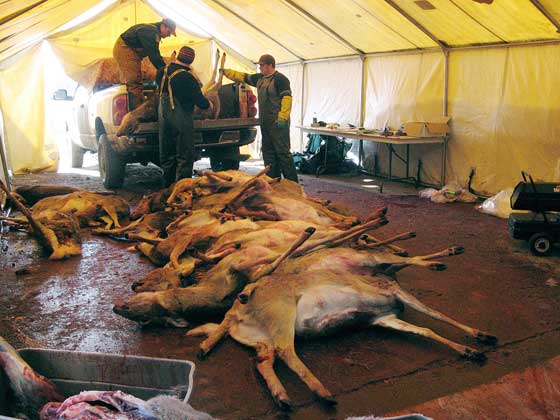
Thousands of wild deer in Saskatchewan and Alberta have been culled over the years in an attempt to control the spread of chronic wasting disease, he emphasized.
Darrel Rowledge, seen by some as a guru in the anti-game farm lobby, has been fighting the notion of game farming for more than two decades.
He recently completed a research book commissioned by Alberta's Professional Outfitters Society. The outfitters forwarded the book last November to the governments of Alberta, Saskatchewan, Manitoba and Ontario, and the federal government.
"And they are still chewing on it," Rowledge said in an interview last week from his office in Calgary.
He said the response from the government will be the final chapter.
His book, he said, was called No Action because it was a lack of action by governments who promoted and allowed game farming to take hold on the prairies, despite warnings of rough water ahead.
The first and foremost recommendation in Rowledge's book calls for:
- An immediate moratorium on the movement of all potentially infected tissue, living or dead. The ban must apply to all animals, carcasses, tissues, products (including velvet and urine) and all potentially infected equipment.
Rowledge emphasized there is no test available to see if live animals are infected with CWD, a neurological disease.
The only sure method is to examine the brain stem of a dead animal, and the CWD bug is next to indestructible, he said.
The largest culprit in the spread of CWD, Rowledge emphasized, is the transport truck.
Rowledge said his book was commissioned in part because there has never been a comprehensive, down-to-the-bone analysis of the elk and deer game farming industry, its roots and its impact.
"This is an enormous issue, and part of the problem is its size and its scope is very difficult to get your head around."
He said his research is showing that everybody is essentially saying the same thing.
"In a nutshell, this experiment in game farming has been a huge blunder, a huge mistake."
The game farm industry, he said, has cost taxpayers dearly.
And there are hundreds of game farmers who are suing the provincial governments for the predicament they're in, Rowledge said.
He said the provincial governments of Alberta and Saskatchewan began promoting the game farming of deer and elk as a means of diversifying economic opportunities within the agricultural sector.
They maintained there were opportunities to establish markets for venison meat and antler velvet.
Farmers, he added, were assured all the proper protocols were in place to keep the industry safe. It was a viable business venture, the provinces promised.
Rowledge said the scientific community, however, was saying "absolutely no" to game farming from the beginning. Government bean counters never did the math, and they never conducted an in-depth cost-benefit analysis which would have shown it was not a viable industry over the long run, he said.
It is for that reason, Rowledge added, that game farmers are suing the governments.
The governments knew of the resistance from the scientific community, and were aware of the void in economic analysis, but continued to flash the green light, he said.
Rowledge emphasized the ravage CWD has brought to the prairies is not due to game farmers.
"It has never been the fault of game farmers."
The provinces, he said, were actively recruiting by promoting diversification and new opportunities.
Rowledge said the Yukon government had its own study done in the mid-1980s which indicated game farming was not viable in the territory, though it was tucked away in a drawer.
"But I have a copy."
Game farming was OK in the beginning for those who got in on the ground floor and were able to generate revenue through sales of breed stock to other farmers wanting to catch the tide and cash in, he said.
Those days are long gone, Rowledge insisted. These days, he added, a mature elk cow goes for $100, and in many cases game farm animals are costing more to feed than they're worth.
There is no market for game farm elk or deer meat, nor velvet from antlers, he said.
He said pretty much the only market for big bulls in Alberta are "shoot farms" in Saskatchewan, where hunters pay handsomely to stock elk inside what is ultimately an enclosed area.
Prices in that market are coming down too, Rowledge said.
He said mathematically and economically, the equation is clear: wildlife as wildlife is far more valuable than as game farm animals, which inevitably cost taxpayers huge piles of money.
The federal government - with its quarantines, compensation for farmers, federal veterinarian bills - has spent hundreds of millions battling chronic wasting disease, he said.
Hunters and anglers, on the other hand, kick in $12.3 billion annually to North America's gross domestic product.
"So what we have been trying to do all these years is convince government to look at the whole picture."
All that being said, it cannot be forgotten that no one can rule out the more perilous and disturbing possibility of the chronic wasting disease being passed on to humans, Rowledge said.
It belongs to the same family as mad cow disease, and mad cow disease has killed scores of Brits since it first made the leap to humans in the 1990s, Rowledge emphasized.
The mere mention of mad cow disease - BSE - continues to send shivers through the agricultural industry.
He said 1996 brought two chilling revelations, within days of each other:
-
the presence of chronic wasting disease was confirmed on a Saskatchewan farm;
-
mad cow disease had made the leap from cows to humans, and was responsible for the first death in Britain.
CWD, said Rowledge, is arguably the most important issue in the management of the deer family, which includes moose and caribou.
Be the first to comment