Elk hunt tops list of hunting rules changes
Premier and Environment Minister Dennis Fentie has approved a limited elk hunt recommended by the Yukon Fish and Wildlife Management Board.
By Chuck Tobin on April 4, 2008
Premier and Environment Minister Dennis Fentie has approved a limited elk hunt recommended by the Yukon Fish and Wildlife Management Board.
Fentie accepted 14 of 15 recommendations by the board on 14 of 15 proposed changes to the Wildlife Act.
He did not accept the request initiated by the Town of Faro for tighter moose hunting restrictions in the area for non-resident hunters.
Also approved were higher bag limits for wolves, but a rejection of more deer tags for youth.
The minister also accepted a recommendation from the board which stirred the emotions of the outfitting community.
It requires all meat to be retreived and transported back to camp before the horns or antlers are.
There was acceptance of two changes aimed at increasing the bison harvest.
The board recommended Fentie turn down - and he did - the suggestion to open up the hunt to all licensed hunters, and eliminate the permit system.
Fentie also accepted the board's recommendation to reject a request to change the rules for grizzly bear hunters, from allowing one bear every three years to allowing one bear every year to a maximum of three in nine years.
The board recommended and the minister accepted the change in the act to allow for the local retailing of game farm meat - elk, bison - which has been inspected by a territorial inspector.
"I would like to thank the board for the effort and co-operation to make the joint public review process a success this year; also for the rigorous analysis of the regulation proposals and the clarity of the recommendations provided," Fentie wrote in his response to the board in February.
The board forwarded the recommendations to Fentie on Jan. 9 following a public consultation process last fall, and the annual hearing on proposed changes in early December.
The premier responded in February, and the results were released by the Department of Environment this week.
Under the Umbrella Final Agreement, the blueprint for land claim settlements in the Yukon, timelines are established for the minister to accept, reject or alter recommendations. Similarly, timelines are set out for the board to respond to the minister's decisions.
The last known elk hunt occurred in the early 1980s, when the Yukon Fish and Game Association was given two permits to auction off for one year as a fundraiser to finance an elk study.
The animals are protected. As a result of the limited hunt, officials will have to remove elk from the list of specially protected wildlife and list them as big game, among other requirements on the to-do list before the onset of the Aug. 1-Oct. 31 season.
The board rejected the request to recommend two permits be given the fish and game association to promote education and raise revenue.
The recommendation for the hunt calls for a two-year trial period. It puts the responsibility for setting the number of permits and the harvest target on the working group currently studying the infestation of winter ticks on the elk.
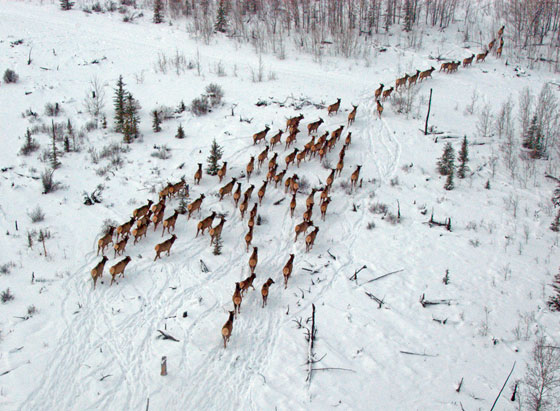
It was also recommended that there be separate management strategies for the Takhini herd of 150-plus animals and the Braeburn herd of 60-plus elk.
A sprinkle of elk were first transplanted to the Yukon in the 1950s. Elk transplant efforts were re-invigorated in the 1980s, and now there is concern the herd is growing unchecked.
Other recommendations by the board which Fentie accepted are:
- Provide the minister with the ability to make quicker changes to the bison management strategy, such as altering the hunting season or permits numbers, without going through an exhaustive exercise.
The goal is to increase the harvest level of bison, which currently number several hundred above the desired population target of 500.
Also accepted is the recommendation to allow hunters to apply for bison permits every year, rather than once every five years.
-
The board rejected the elimination of the permit system requested by the Alsek Renewable Resource Council, as the permit system is a means of controlling not only the harvest but the amount of traffic out on the land.
-
The board spurned the request from the fish and game association to provide five additional deer tags to encourage greater interest by youth.
The board was in favour of the concept, but decided it would be best to wait until the completion of the two-year review of the limited deer harvest which began in 2006.
It also suggested two permits designated specifically for youth be made available, instead of five, given the huge interest in permits by hunters of all ages.
-
The board and the minister also vetoed the association's request for two additional specially-guided sheep hunts for non-Canadians in game management zone seven, as a means of generating revenue for sheep management.
- While the board and the minister accepted an increase in the annual bag limit for wolves from four to seven for Yukoners, they rejected an increase from two to four for non-resident hunters.
-
The minister did accept the board's recommendation to require the retrieval of meat before antlers and horns, and to phase in the change over three years, with a strong educational component.
The change was requested by Environment staff, who believe there is still a significant amount of meat wastage by hunters who are tempted to leave a portion of meat after a couple of long hikes back to camp with some of the meat and antlers.
The big game outfitting association opposed the regulation change as an unnecessary burden.
- Allowing for the sale of game farm meat in local stores, as requested by the Department of the Environment, was recommended by the board and accepted by the minister.
Currently, game farmers can sell their meat at the farm gate but require a federal inspector to sell to local grocery stores and such.
There are no federal inspectors here, though some shops currently sell game meat inspected and imported from Alberta.
The change would allow the sale to local retail outlets after approval by a territorial meat inspector.
-
With the growing number of wild elk and bison getting into farmers' fields, there'll now be a provision in the Wildlife Act allowing farmers to chase away wildlife with snowmachines and such without facing charges of harassing wildlife.
-
The Town of Faro did request a restriction on the number of non-resident Canadians being guided on moose hunts in the Faro area by Yukon hunters using the special guiding provisions.
Locals have been voluntarily limiting their harvests since 1999, but are seeing an increase in the harvest under special guide permits.
The board agreed the town's concern is valid.
It recommended to the minister the special guide provision be eliminated for game management subzones 4-42 through to 4-46.
Fentie rejected the recommendation.
He suggested there is evidence the high harvest of eight moose on special guide permits in 2006 may have been a one-year event, as only one was taken last fall.
Under the moose management regime, the minister pointed out, there are other steps to be taken first, including more education efforts, before restricting special guide permits.
Under current regulations, licensed Yukon hunters can guide a non-Yukoner, Canadian or otherwise, on specially-guided hunts once every three years, but are not allowed to be paid.
The provision was made to allow for Yukoners guiding friends from Outside, who would otherwise be required to pay a big game outfitter if they wanted to hunt in the Yukon.
Be the first to comment