Photo by Vince Fedorof
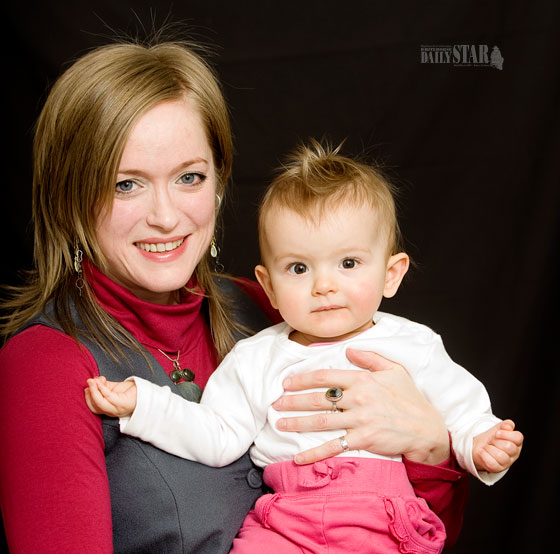
COUNSELLING SEX EDUCATION - Julia Saunders, a vancouver-based sex educator seen this morning with daughter Elizabeth, will give talks in Whitehorse This evening and on Friday.
Photo by Vince Fedorof
COUNSELLING SEX EDUCATION - Julia Saunders, a vancouver-based sex educator seen this morning with daughter Elizabeth, will give talks in Whitehorse This evening and on Friday.
Both teens and parents need to learn to talk about sex in an honest and comfortable way if young people are going to develop healthy habits for their lifetime.
Both teens and parents need to learn to talk about sex in an honest and comfortable way if young people are going to develop healthy habits for their lifetime.
That is the message coming from Julia Saunders, a Vancouver-based sex educator and the author of a new sex ed curriculum for Yukon elementary school students. She is in town this week to speak to parents and teens about sex education.
"There is so much shame around sexuality,” Saunders says from her Whitehorse hotel room, her baby girl, Elizabeth, playing contentedly on the bed beside her.
"The shame often doesn't come from someone saying outright ‘Masturbation is bad,' or something like that. It comes from silence. It's often just not talking about things that makes them seen shameful.”
When parents start talking to their children about their bodies at an early age, both sides benefit, Saunders says, using her own daughter as an example.
"Even before she understands, I can talk to her about her own body, teaching her the names of all her parts. It's good for her to learn so that when she's older, she can tell me about health problems or ask questions, but it also teaches me to be comfortable talking about it with her.”
The strategy Saunders gives to parents of elementary-aged children is "to have short, frequent conversations.”
This includes teaching children the proper scientific names for their private parts, showing them how to properly clean themselves and discussing the issue of personal boundaries and inappropriate touching.
Data compiled by Canadian sex educator Meg Hickling from countries where sex education has been standard for several generations show that increased knowledge about sexual health is directly connected to reduced incidents of sexual abuse, sexually transmitted diseases and unwanted pregnancies.
"Offenders become very skillful at choosing vulnerable children,” Hickling says in one of the lectures she gives to parents and educators all across the country.
"... If a child knows appropriate sexual vocabulary, the offender knows that some enlightened adult, usually the parent, has taught them.”
The potential predator knows that the child will likely tell this "enlightened adult” of any inappropriate touching or suggestions and moves on.
Sex education does not encourage young people to have sex, she says, but actually gives them tools to make safer choices, and often that choice is to not have sex.
"What we are teaching children is ‘body science.' They may never have sexual intercourse, but they will always have bodies to care for, and sexual health is no different than nutritional health.”
"This is about health, science and safety,” Saunders says when asked if she is concerned about the response of parents who think their children are too young to talk about anything related to sex, or think such topics should be left out of the classroom.
Although Saunders is working on a curriculum – a sex education plan for teachers, to be taught in school – she maintains that the home is the best place for kids to learn about sexual health. The problem there, she says, is that many adults never received a proper sex education, so have to learn themselves.
For many parents, talking to their teens about sex is daunting, Saunders says, especially if the early groundwork hasn't been laid.
"If you haven't spoken about it in the home, your teens aren't likely to come to you out of the blue,” Saunders says. That means parents will usually have to take the initiative in broaching the subject.
Starting from an early age also reduces the need for "The Talk,” Saunders says with a laugh. "But if you do have to have the Talk, it's best to do it in the car or some other place where they can't get away.
"But if you've been having those short, frequent conversations from an early age, then The Talk doesn't necessarily need to happen because things will come up more naturally.”
In creating the sex education curriculum for Grades 4-7 students, Saunders has tried to go beyond the physical aspects of sexual health. She also addresses the sexual imagery everyone is faced with on a daily basis in advertising and entertainment.
"The sex saturation that's happening in media is so prevalent ... there's all this pressure to be sexual, even for really young kids.”
She points to the now ubiquitous example of Grade 7 girls wearing push-up bras and mini skirts – dressing in a sexually provocative way before they have even gone through puberty.
"We desperately need to catch up with that.”
Saunders is talking to local parents, teens and teachers about sexual health, as well as work on the curriculum .
She will host a talk for parents of elementary school students from 5:30 to 7:30 this evening at Whitehorse Elementary School.
On Friday, she will hold a workshop for teens aged 15 to 17 at the Canada Games Centre Meeting Room 2.
For more information, call Susie Ross at 667-5762.
In order to encourage thoughtful and responsible discussion, website comments will not be visible until a moderator approves them. Please add comments judiciously and refrain from maligning any individual or institution. Read about our user comment and privacy policies.
Your name and email address are required before your comment is posted. Otherwise, your comment will not be posted.
Be the first to comment