Economy is fighting its way back, Poloz says
Despite low oil prices for the foreseeable future, and uneven export levels, the Canadian economy is making progress, the governor of the Bank of Canada assured Yukoners on Wednesday.
By Sidney Cohen on June 16, 2016
Despite low oil prices for the foreseeable future, and uneven export levels, the Canadian economy is making progress, the governor of the Bank of Canada assured Yukoners on Wednesday.
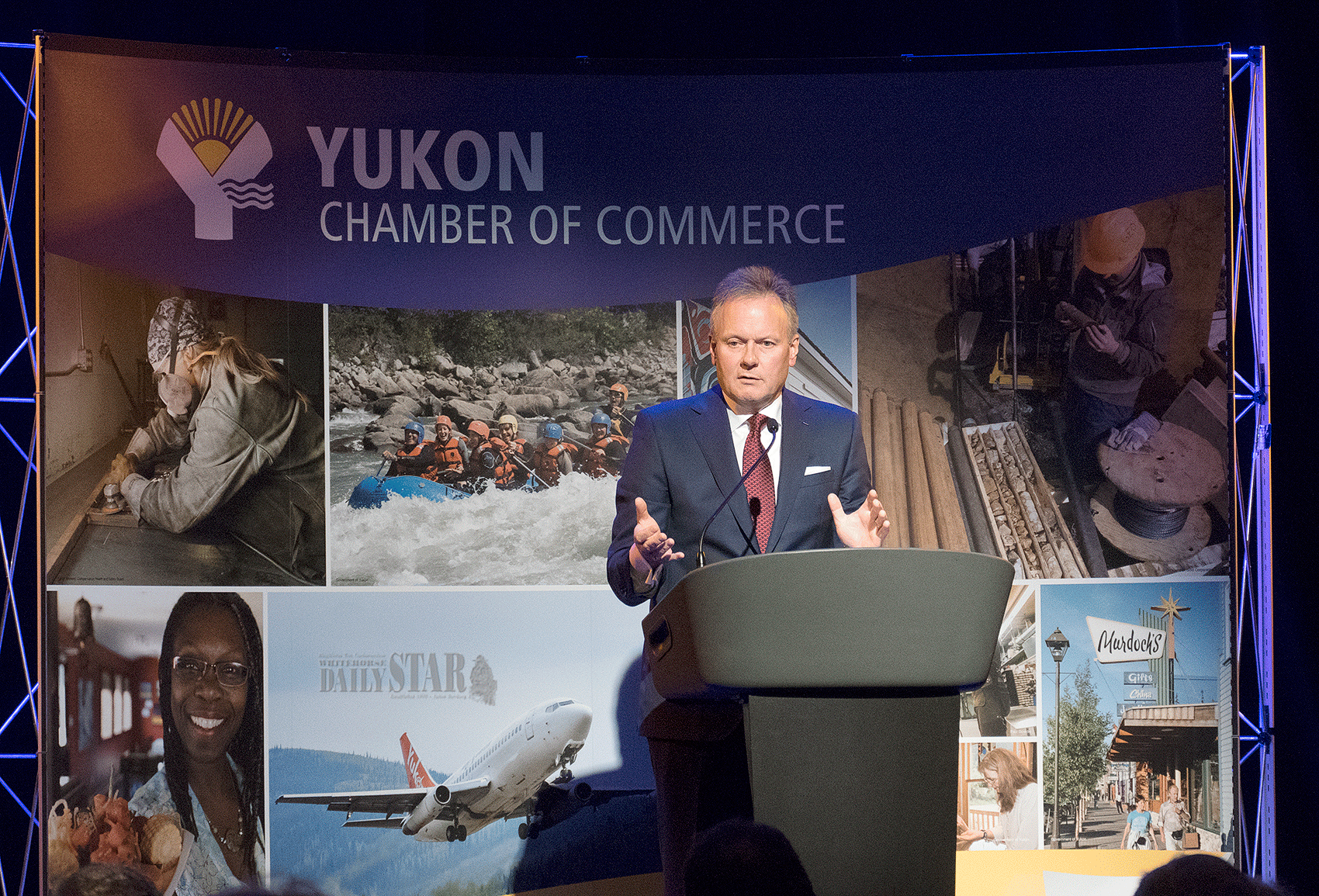
“Continued patience is required, but we have the right to be optimistic,” Stephen Poloz said at an event in Whitehorse hosted by the Yukon Chamber of Commerce.
While the energy sector has seen brighter days, there is hope in non-energy exports and tourism, the latter thanks in part to the low Canadian dollar, he said.
Still, Poloz called the current economic situation “very complicated and riddled with uncertainty,” and commented on some of the major forces the Canadian economy is up against.
As Canada continues to recover from the global financial crisis, the country must also come to terms with low commodity prices, particularly for oil and metals.
Adjusting to this, Poloz said, will require less investment and less employment, and lower levels of income in the resource sector, and more of these things in other sectors, like tourism and related service industries.
Lower interest rates and the lower Canadian dollar will help with the adjustment process, he said.
These changes will be especially acute in the Yukon, which is historically a resource-driven economy.
On the bright side, some resources are doing better than the others, and Poloz gave gold as an example.
“Yes, gold prices are lower than they were, but gold prices can be very profitable for some projects at the levels they’re at, and so not every sector is under the same
kind of stress,” Poloz said in a press conference following his speech.
“A new gold project for example, could have money in the scope for new jobs and new revenue for Yukon.”
What’s more, China continues to import greater amounts of metals each year, which is good for Canada, he said.
The take away is that the resource industry should not be abandoned altogether simply because prices are lower.
Rather, a region like the Yukon can benefit from shifting its focus to other sectors that are seeing growth, such as tourism.
“(Tourism) by the way, is the second most important sector here, and seems to be providing very well, and no wonder because, as I said, the U.S. economy is strong,
which is a big source of visitors,” said Poloz.
“The Canadian dollar is much lower, so it’s a bargain when you’re going on a trip to Canada, it costs less to stay in a hotel.”
Of course, all the people trained to work in mining can’t easily transfer their skills over to tourism, or hospitality, health care and education – other industries
experiencing strong growth.
So what do they do?
Poloz said a lot of manufacturing jobs were lost in 2010 through to 2013, and many of those workers moved into construction because there more houses and condos being built, and governments were spending on infrastructure.
“That’s not a big leap in terms of what you know and what sorts of jobs you can learn to do,” he told the Star in an interview Wednesday.
“People can move into the construction sectors from the mining sector.”
Indeed, the Yukon’s construction industry appears ripe for jobs, with $306.6 million for capital spending included in this fiscal year’s territorial budget.
Spending on non-residential building projects, specifically on health care facilities, went up 2015, according to a GDP study by Statistics Canada.
The continuing care facility in Whistle Bend, the ongoing expansion of the emergency department at Whitehorse General Hospital, and the new Sarah Steele Building, among others, hold promise.
Infrastructure spending too is getting a boost, thanks to money from the federal New Building Canada Fund, which will see $342 million injected into Yukon projects over the next 10 years.
Ultimately, diversification will help the Yukon weather the storm of low commodity prices, which doesn’t seem to be letting up any time soon.
Poloz also raised the Fort McMurray, Alta. wildfires in his talk at the Kwanlin Dun Cultural Centre. This was an unforeseen event that has significant implications for the Canadian economy.
The wildfires, which broke out in May, saw the removal of up to 90,000 people, destroyed about 2,400 homes, and put a major dent into Alberta oil and gas production.
The resulting insurance claims from the devastating wildfires are predicted to be between $2 billion and $6 billion, which is “the largest such event in Canadian history,” said Poloz.
The Bank of Canada estimates that the Fort McMurray wildfires will bring down growth in the second quarter by about one to one and a quarter percentage points,
Poloz said, “which is a pretty big impact.”
The long-term effects on the GDP will depend on how quickly Alberta can rebuild and get back to business, he said.
As for interest rates, they aren’t about to hit zero, Poloz said, but they are going to be “lower than we ever believed, for a very long time.”
This is in part because the babyboomers are aging out of their jobs in great numbers, which is slowing down growth in the workforce, and growth in the economy overall.
The govenor said that in 2008, the world economy stood at the brink of a collapse similar to the Great Depression of the 1930s.
G20 countries were able to prevent that from happening through sound fiscal and monetary policy.
The forces that drove the economy down in 2008 are still working today, and low interest rates are helping to prevent “that rock from rolling down the hill on top of us,” Poloz said.
Through all of this, the governor is positive.
“I find that pessimism on this just doesn’t work.... To me over and over we see the adjustments happen, people are much more adaptable than we think.”
He said government programs are in place to give people a safety net to fall back on, the chance to retrain, find new work and acclimate to new economic realities.
“The adjustment has to happen because those prices are low and they probably will stay lower ... for a long time. They’re not going to bounce back, that quickly to
where they were.”
Comments (6)
Up 0 Down 0
Werner Rhein on Jun 22, 2016 at 3:58 pm
The puppet didn't mention with one word divesting from fossil fuels, which we spend more than $200 000 000 on. That could produce jobs, local jobs and stop importing fossil fuels. But the most important thing is it would help keep our environment clean.
Not one word, zilch nothing?
Up 8 Down 2
Francis Pillman on Jun 20, 2016 at 10:09 am
Lol. A puppet telling us not to worry. Your institution is the reason our economy is so messed up in the first place. Why can't people wake up?
Up 14 Down 0
ProScience Greenie on Jun 18, 2016 at 5:40 am
In other words if you are lucky enough to have a full time government job don't quit it because it's a mess out there and getting worse.
Up 13 Down 3
Josey Wales on Jun 17, 2016 at 8:32 am
Is it now?
Yes and the planet is overheating, justice is blind, all Canadians are equal and of course Islam is the religion of peace.
I was not aware that...allah Akbar meant, nothing to see here.
Oh well, I guess I'm wrong as I was just told things are fine by our outgoing head blow-hole.
Up 16 Down 7
jc on Jun 16, 2016 at 9:44 pm
That should be good news for the NDP. Now they can come in and bankrupt the territory again.
Up 14 Down 3
June Jackson on Jun 16, 2016 at 7:26 pm
Wow.. Poloz said a whole lot don't hold your breath waiting for things to get better! His speech didn't even make sense.. line by line it was all doom and gloom. We have jobs right now because the government is building..how many of those employee's are actually Yukoner's and how many are from Alberta? Make miners construction workers? oh.. and don't worry about anything because "He said government programs are in place to give people a safety net to fall back on". Now there's good news..i don't have to starve when there aren't any more jobs, I can fall back on the food bank and welfare... Happy days are here again.. NOT.