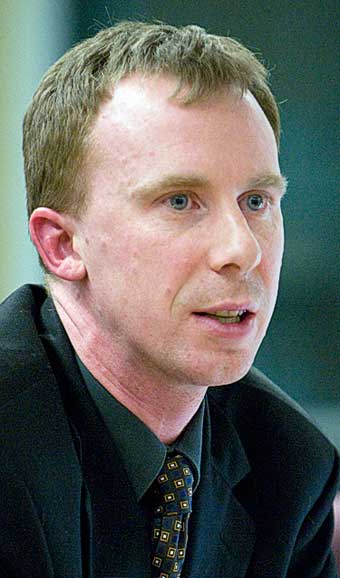
Photo by Whitehorse Star
Mike Ellis
Photo by Whitehorse Star
Mike Ellis
The first draft of the city's Official Community Plan (OCP) will be made public tonight at a meeting set for the Mount McIntyre Recreation Centre.
The first draft of the city's Official Community Plan (OCP) will be made public tonight at a meeting set for the Mount McIntyre Recreation Centre.
A total of 58 overall changes are suggested for the document.
"More changes are definitely going to come,” city planner Mike Ellis told reporters during a Tuesday afternoon briefing on the draft OCP, stressing this is simply the first draft of the revised document.
The blueprint acts as a visioning document for the city in planning for the next 20 years.
With the last update made in 2002, city planners began work to revise the current document last year, hosting numerous neighbourhood meetings and planning sessions.
"It's a visioning document, not a regulatory document,” Ellis said.
The latest draft document strives to strike a good balance between protecting the city's green space and providing for development, said Ellis and planning manager Mike Gau.
Included in the proposed document are a number of changes that were sought by many of the hundreds who brought forward ideas during the more than 20 open houses and meetings held on the issue.
A green space network strategy developed over the summer after many pushed for such a plan details areas of town which are or could be developed in the future, first nation lands, recreation areas, environmentally sensitive areas, green connections through the community and five proposed parks.
The parks proposed include the Chadburn Lake park area, which would likely undergo a map change before the OCP is adopted, along with sites around McLean Lake, McIntyre Creek, Paddy's Pond and Wolf Creek.
While the map is something many asked for and the 58 changes come from much of the input of residents, planners acknowledged that with many views being at opposite ends of the spectrum, it was impossible to meet all the requests.
"Of course, not everybody can get everything,” Gau said.
That said, the city has made some changes since it initially brought the proposal forward to council a few months ago.
At that time, planners proposed changing all the "shalls” to "mays”. Many spoke out against that, arguing it would take away from the city's responsibility to abide by the OCP.
Now, instead of changing all the 185 "shalls” to "mays”, planners are suggesting just 14 of them will be changed where there are policies that can be flexible.
As an example, Ellis noted one policy stating the city "shall” do a feasibility study on recreational facilities that are at the end of their lifespans. If it's a small recreation facility, a feasibility study likely wouldn't be needed.
Thus, the OCP proposes stating instead that a feasibility study "may” be done.
"We wanted to provide some flexibility there,” Ellis said as he went on to cite similar examples.
One of the biggest changes to the plan, Ellis and Gau explained, will be the inclusion of the city's 2007 50-year sustainability plan, an important feature for the OCP, which includes plans based on population growth.
The current OCP, adopted in 2002, estimated the city's growth to be about 1.2 per cent. Over the last five years, however, the population has been double that, far exceeding the estimates set out in the OCP.
For the city, estimating the growth means planning for residential development.
Included in the proposed document is a map detailing where the city could grow.
Three blobs indicate where larger developments could happen, including Whistle Bend on Porter Creek's lower bench. That area is expected to be the next major site for residential development in Whitehorse over the next approximately 20 years.
The other two sites suggested to accommodate growth are the area commonly known as Porter Creek D, parallel to McIntyre Creek; and another smaller area next to Hillcrest.
Also on the map are 14 small dots, representing potential spaces for infill development.
The sites are too small to be designated as a subdivision-type development, but could accommodate anywhere from five to 40 homes, depending largely on the type of infrastructure that would be needed, Gau said.
The sites were identified at public meetings as potential infill land, but no further work has been done to confirm if they are viable for more lots.
Gau was quick to note all but one of the sites would require rezoning – which involves a public input process – to develop any infill lots.
The area that would not require rezoning is between the Northlands Trailer Park off Range Road and a piece of land the city uses for a bus turnaround. Gau noted the land there, owned by the Yukon government, is already zoned to allow for more mobile homes.
The infill is identified to avoid the potential sprawling of the community and make residents aware of the possibilities for the future of their neighbourhoods.
As Gau explained, the more compact a fashion the city grows in, the less operational cost there is.
Among other major changes proposed in the draft OCP, planners are suggesting:
• the height limit on buildings downtown be changed from 20 metres to 25 metres;
• requesting the territory halt staking in city limits; and
• making walking, cycling and transit more feasible in the city.
This evening's meeting is set to happen between 4 p.m. and 9 p.m., with a presentation beginning at 7 p.m.
In order to encourage thoughtful and responsible discussion, website comments will not be visible until a moderator approves them. Please add comments judiciously and refrain from maligning any individual or institution. Read about our user comment and privacy policies.
Your name and email address are required before your comment is posted. Otherwise, your comment will not be posted.
Be the first to comment