Photo by Ainslie Cruickshank
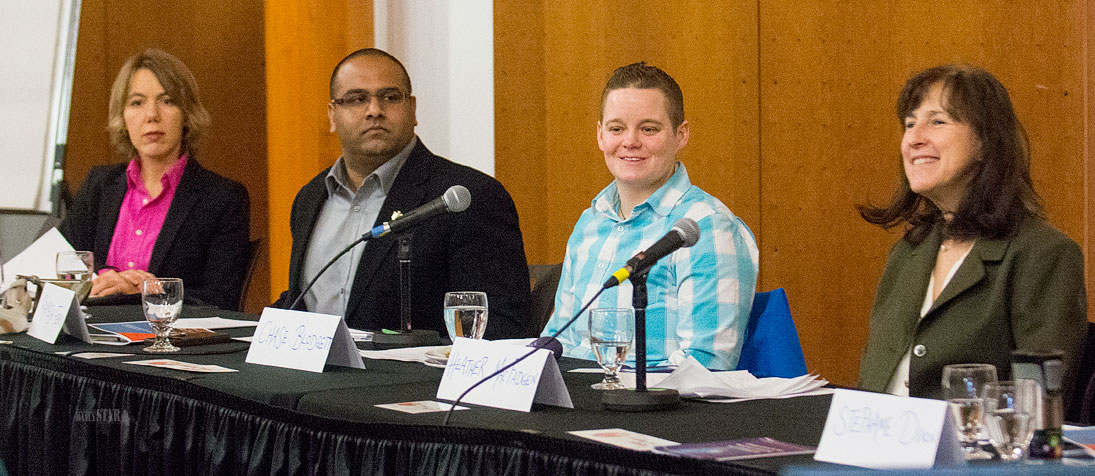
TALKING DISABILITIES ISSUES – Rebecca gowan, Ramesh Ferris, Chase Blodgett and heather macFadgen (left to right) are seen this morning at the Disability Rights Summit.
Photo by Ainslie Cruickshank
TALKING DISABILITIES ISSUES – Rebecca gowan, Ramesh Ferris, Chase Blodgett and heather macFadgen (left to right) are seen this morning at the Disability Rights Summit.
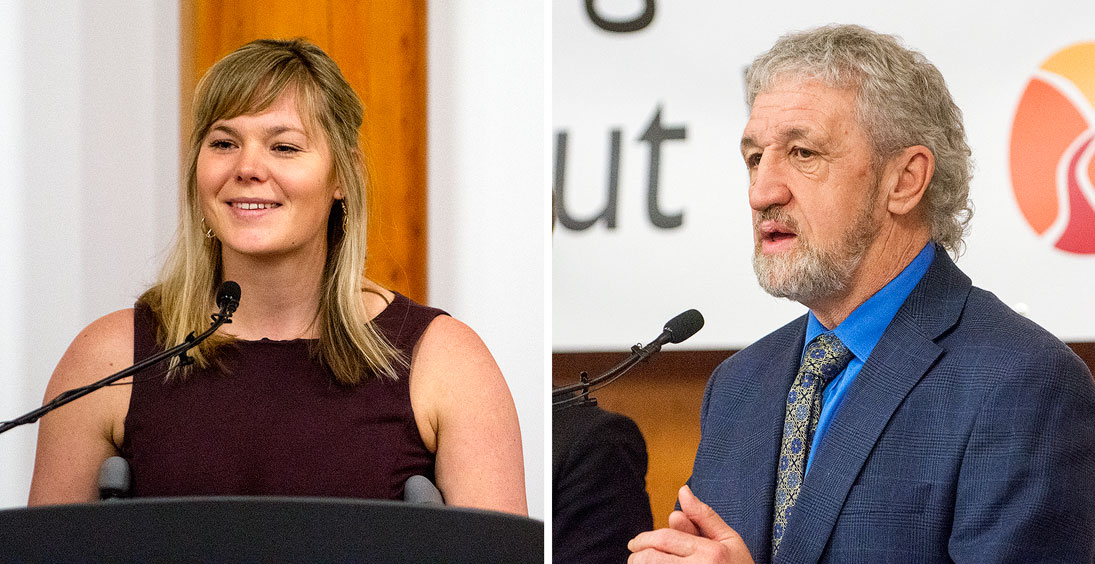
Photo by Whitehorse Star
Stephanie Dixon and Health and Social Services Minister Doug Graham
When Stephanie Dixon was growing up, the word “disability” wasn’t used in her family.
When Stephanie Dixon was growing up, the word “disability” wasn’t used in her family.
Born with one leg in Brampton, Ont., Dixon was active in sports throughout her childhood – her parents saw it as a way to foster positive self-esteem and self-worth.
Dixon didn’t have any friends with disabilities. When she went to school, she’d wear a prosthetic leg.
“I wanted to fit in,” she said. “I wanted to look normal ... I did not want to be considered a person with a disability.”
When travelling with her family, she wouldn’t join the line at the airport for people who needed assistance.
Then Dixon found swimming. It didn’t require crutches, and she couldn’t wear her prosthetic leg in the water.
“It made me feel very empowered and, truthfully, I felt like a mermaid, and I still like to picture myself that way,” she said. “It made me feel beautiful in a society where I felt deformed and ugly.”
Dixon, a Paralympic swimmer who now lives in the Yukon, was the first speaker at today’s Keeping Tracks of Our Rights: Disability Rights Summit, held at the Kwanlin Dun Cultural Centre.
Today’s public events – two panel discussions, a film screening and group talks this afternoon – follow a three-day workshop specifically for people with disabilities in the Yukon.
The goal: helping people learn how to monitor their own rights in their community, to ensure that their rights, as disabled people, are being respected.
This tracking model is taught all over the world by an organization called Disability Rights Promotion International.
It’s a response to the United Nations Convention on the Rights of Persons with Disabilities, which outlines principles and obligations governments have to provide inclusive environments and services.
Canada ratified the convention in 2010.
On this morning’s panel, discussions ranged from invisible disabilities, like intellectual or psychosocial limitations, to societal barriers to the role of human rights commissions.
Chase Blodgett, adult learning co-ordinator with the Learning Disabilities Association of the Yukon, spoke about being born with two learning difficulties – ADHD and an information processing deficit – and suffering a brain injury later on in life.
“For individuals with learning disabilities and cognitive impairments, there is often a lack of accommodations and a lack of understanding, both within educational institutions and the workplace,” Blodgett said.
There’s also a difference between being born with a disability and acquiring it later on in life.
“When you are born with a disability, the challenges and struggles are the norm,” Blodgett said.
“While you understand on an intellectual level that your struggles are beyond the scope of most people, you can’t feel that difference. You can’t feel it in your day-to-day activities, you can’t feel it in the decision-making process. You understand that it’s there, but you don’t know any difference.
“But when you acquire a disability partway through your life, you have a working memory of how things used to be.”
Ramesh Ferris, a polio survivor, advocate and the Yukon’s first international adoptee, shared his story of contracting the disease as a six-month-old in India.
It left his legs paralyzed.
Ferris was adopted by former Yukon bishop Ron Ferris and his family in the Yukon in 1982.
In 2008, he completed the Canada Cycle to Walk Polio Campaign, during which he hand-cycled across the country, raising more than $300,000 for polio eradication and education.
He spoke today about some of the obstacles still facing people with disabilities here in Whitehorse.
For instance, the Handy Bus service offered by the City of Whitehorse and the Government of Yukon has to be booked two weeks in advance.
Bus stops may be cleared promptly of snow, but sidewalks leading up to them are not; and while some stores have ramps and a larger door to accommodate wheelchairs, aisles inside are too narrow.
But while people can choose to be negative, bitter or angry, Ferris instead wants to focus on the “unique opportunity” to be a part of affecting change.
“The barriers that I’m living with today will hopefully not be your barriers in the future,” he said.
Rebecca Gowan, a senior policy analyst with the Canadian Human Rights Commission, commended the territory for this week’s events.
“Yukon is leading the country,” she said when it comes to implementing the UN convention. “I don’t know of any other jurisdiction that is undertaking this kind of work.”
Heather MacFadgen, executive director of the Yukon Human Rights Commission, also addressed the 80 or so people gathered:
“You are the reason we are here today. You are the experts, and you are the voices that we need to hear and are hearing. You understand the barriers in our society to your full inclusion and participation. You know what respect and dignity and inclusion and equality mean, and what it is like when they are not there in your life.”
And though many of the people present have disabilities, that only makes up a part of their identity, MacFadgen told them.
In his opening remarks, Health and Social Services Minister Doug Graham said summit participants and organizers are making a difference.
“You are heard,” he told them. “I know, talking to some folks here, that many people believe that the voice of people with different abilities is not always heard in government.
“But believe me, I hear you, and I appreciate anything that you have to say.”
In order to encourage thoughtful and responsible discussion, website comments will not be visible until a moderator approves them. Please add comments judiciously and refrain from maligning any individual or institution. Read about our user comment and privacy policies.
Your name and email address are required before your comment is posted. Otherwise, your comment will not be posted.
Comments (3)
Up 0 Down 0
Yukon Disability Rights Committee on Dec 12, 2014 at 4:56 pm
For more information visit
www.facebook.com/yukondisabilityrightscommittee
Up 5 Down 1
Sue on Dec 5, 2014 at 5:47 pm
I had a similar experience with the Feds in AB working there, but I have to say, so far YG has been quite accomodating with my limitations (longterm illness vs. True disability) but I might be in a branch that is the exception, not the rule..?
Up 7 Down 4
A person with disabilities on Dec 5, 2014 at 9:36 am
For a long time I did not want to think I had disabilities but the fact is I do. In government my disabilities have been explored, prejudiced and discriminated against and now they are using my disabilities to push me out. We live in what is supposed to be a normal healthy society that protects the rights of disabled people. The public officers that are supposed to protect our rights are the very ones that are not protecting my rights.